

 English
 日本語
 Español



Shen Yueqiao — After-Sales Quality Support Supervisor

Home / Author / Shen Yueqiao — After-Sales Quality Support Supervisor / Eight-Piece Foldable Children’s Building Block Sofa Set: A Safe, Creative, and Space-Saving Solution for Modern Families
Product Category
NEW Category
Contact us
Eight-Piece Foldable Children’s Building Block Sofa Set: A Safe, Creative, and Space-Saving Solution for Modern Families
Children need furniture that supports more than one activity. A suitable children’s sofa should provide a comfortable place to sit, a safe surface for play, and enough flexibility to adapt as a child’s interests and developmental needs change. The eight-piece foldable children’s building block sofa set is designed around this idea. Instead of functioning as a fixed miniature couch, it works as a collection of soft, lightweight modules that children can rearrange into different forms.
With a high-density foam interior, a slow-rebound feel, a frameless structure, rounded edges, and a neutral light gray and off-white appearance, this modular sofa is intended for living rooms, children’s bedrooms, playrooms, reading corners, preschools, and other educational environments. Its eight individual pieces may be combined into a sofa, playbed, tunnel, fort, climbing arrangement, rest area, or imaginative building structure.
The product is manufactured by Jiangsu Wellcare Household Articles Co., Ltd., a Chinese manufacturer with experience in foam materials, sleep products, and healthy home furnishings. The company’s development has been closely connected with research into ordinary sponge, memory foam, gel foam, temperature-insensitive foam, quick-dry foam, flame-retardant sponge, antibacterial sponge, and related materials. This material-focused background gives the product a strong foundation in comfort engineering, foam formulation, and practical household use.
1. A New Approach to Children’s Furniture
Traditional children’s sofas are usually designed as smaller versions of adult furniture. They may have a fixed seat, a backrest, and armrests, but their role is limited. Once children grow or lose interest in the original arrangement, the sofa becomes a static object that occupies floor space without offering much additional value.
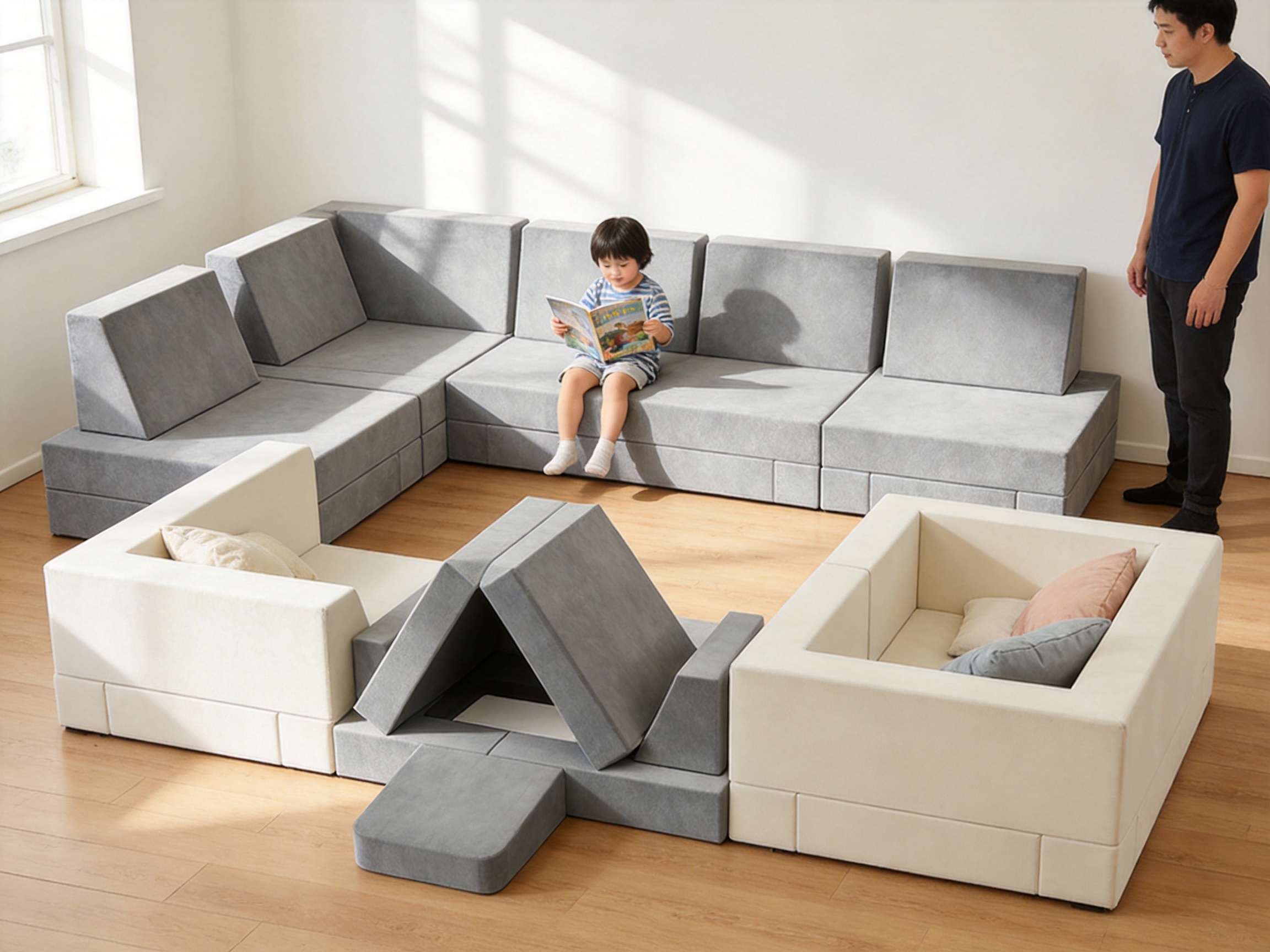
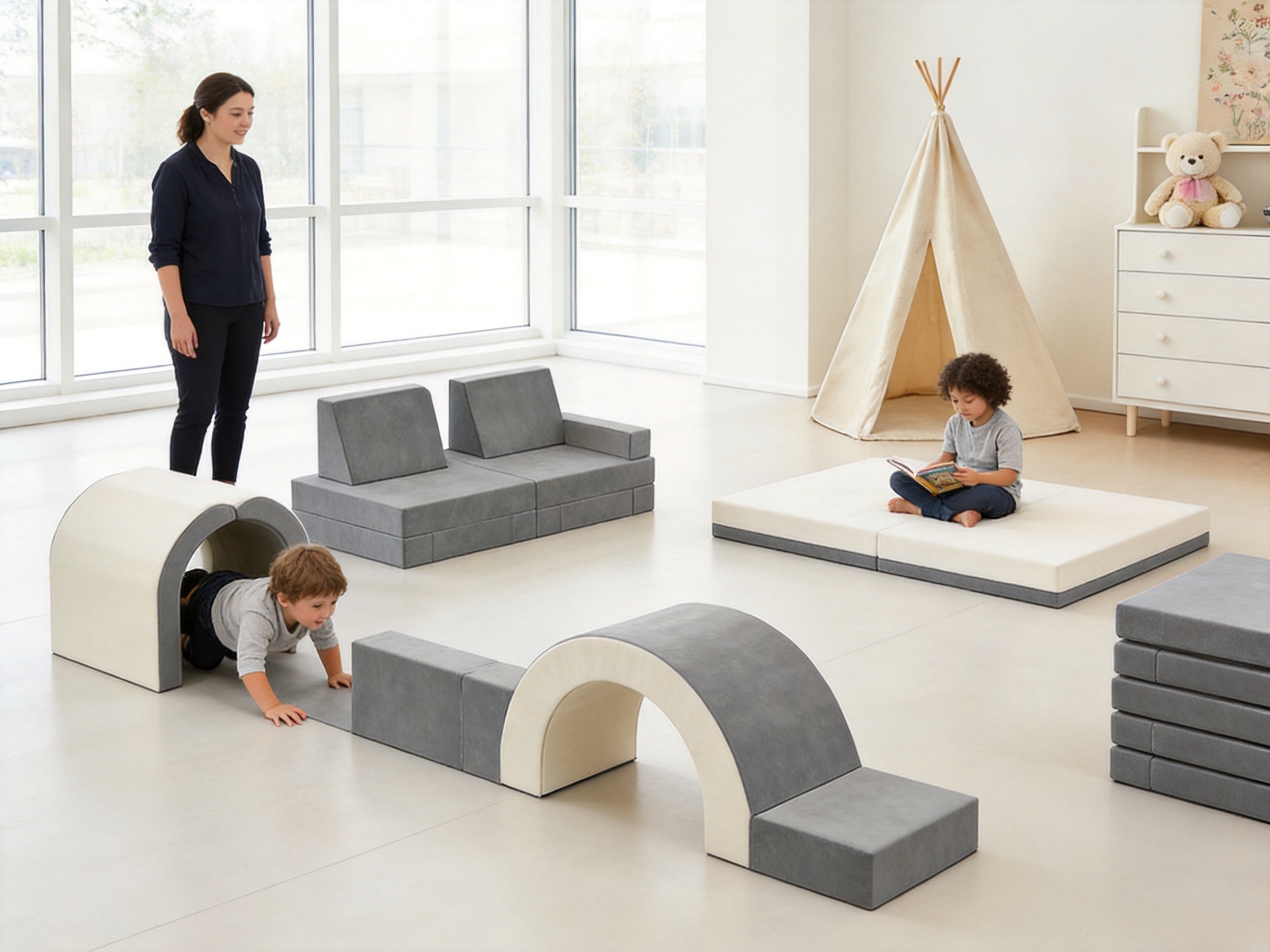
The eight-piece building block sofa follows a different concept. It treats furniture as a flexible play and rest system. Every module can contribute to a larger configuration, and each configuration can support a different activity. A low sofa can become a reading seat. A set of connected blocks can become a mattress-like play surface. Upright or curved arrangements can create a tunnel or a small fort. The same product may therefore serve children at different ages and during different parts of the day.
This multifunctional structure is especially useful in homes where space is limited. Rather than purchasing a sofa, play mat, lounge cushion, and soft climbing structure separately, parents can use one modular set for several purposes. When the play session is finished, the pieces can be stacked or folded for more efficient storage.
For schools and early childhood education centers, the modular design can support group activities. Teachers may arrange the pieces into reading corners, soft boundaries, obstacle paths, or imaginative play environments. Because the modules are lightweight, the classroom layout can be changed without requiring heavy lifting or professional installation.
Furniture That Encourages Participation
A fixed sofa tells children how it should be used. A modular sofa invites children to decide how it should be used. This difference is important for creative development. Children can participate in arranging, combining, separating, and rebuilding the pieces. They can create a setting for pretend play, construct a safe enclosure, or design a comfortable place for books and quiet activities.
The product is therefore not only a seating item. It is also a soft construction system. The building-block concept offers an opportunity for children to explore shape, balance, space, and movement while using a product that remains suitable for everyday family life.
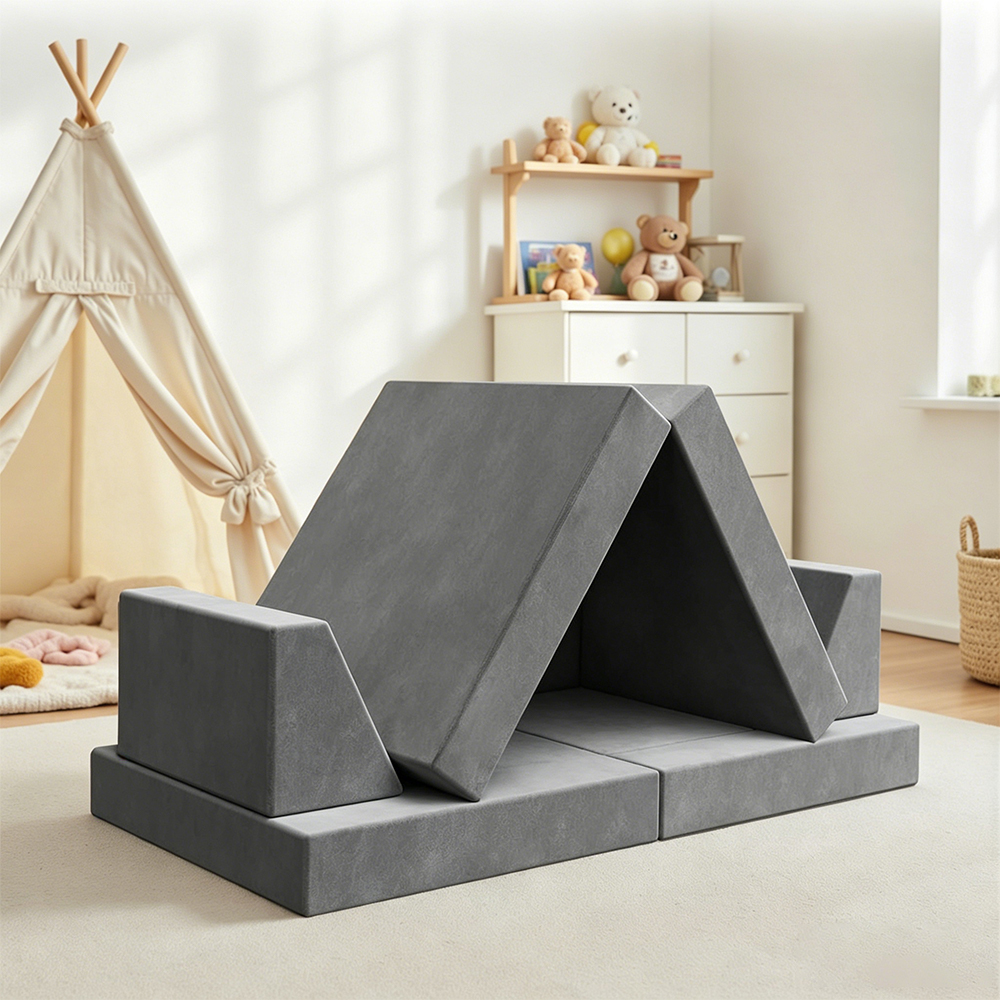
Eight-piece foldable children's building block sofa set
2. Product Structure and Main Configuration
The set contains eight separate modules. The modular design makes it possible to create arrangements that are suitable for sitting, lying down, crawling, leaning, or imaginative play. Unlike a sofa built around a permanent frame, the product can be reconfigured whenever the user’s needs change.
The listed overall specification is approximately 140 centimeters by 70 centimeters by 52 centimeters. Exact dimensions may vary depending on the arrangement of the individual modules. Because the product is made from soft components, the user can create a lower, wider configuration or a more upright configuration according to the available room and intended activity.
| Product Attribute | Specification |
| Product Type | Children’s modular sofa |
| Number of Modules | Eight pieces |
| Model | CH011 |
| Approximate Dimensions | 140 cm × 70 cm × 52 cm |
| Structure | Frameless and fully soft |
| Inner Material | High-density sponge or memory foam-based cushioning |
| Surface Material | Short-pile fabric |
| Color | Light gray and off-white appearance |
| Design Style | Modern minimalist |
| Function | Multifunctional seating, resting, and play furniture |
| Target User | Children |
| Installation | No installation service required |
| Customization | Not available for the listed model |
| Applicable Locations | Living rooms, children’s rooms, playrooms, and educational settings |
The modules are designed to be light enough for practical movement. This is valuable in a children’s environment because layouts often change throughout the day. A parent can transform the product from a sofa into a flat play surface, while a teacher can create a new activity zone without moving heavy furniture.
Flexible Arrangements for Different Activities
As a sofa, the modules can provide a comfortable location for sitting, drawing, watching educational content, or talking with family members. As a playbed or low mattress, they can support floor-based rest and supervised play. When arranged into a tunnel or fort, they can become part of an imaginative game. When positioned as a low climbing or stepping area, they can contribute to movement activities, provided that the arrangement is stable and supervised.
The product’s versatility is one of its clearest advantages over conventional children’s seating. A fixed sofa has one primary arrangement. The eight-piece set provides many possible layouts without requiring additional furniture. This may improve the value of the purchase over time, especially for families that want to reduce clutter and make one product serve several functions.
3. High-Density Foam and Slow-Rebound Comfort
The interior uses high-density foam with a slow-rebound feel. Foam density and resilience have a direct influence on how a soft furniture product supports the body. Low-quality filling may compress quickly, feel unstable, or lose its shape after repeated use. A higher-density interior is generally better suited to products that must withstand frequent sitting, leaning, folding, and rearranging.
The slow-rebound property allows the foam to respond gradually when pressure is applied. When a child sits down, the material can provide a softer and more cushioned sensation rather than an abrupt collapse. When the pressure is removed, the foam gradually returns toward its original form. This balance between softness and structural support is important for a children’s product that is used for both quiet rest and active play.
Compared with ordinary loose filling, molded or structured high-density foam offers a more consistent shape. Loose filling can shift inside a cushion and create uneven support. Foam maintains a more predictable form, which is helpful when several modules are placed together to create a larger surface.
The product description emphasizes resistance to sagging during prolonged sitting and quick recovery after use. These qualities are particularly relevant for shared family spaces, where children may use the sofa repeatedly throughout the day. A durable foam core can help the furniture remain comfortable and presentable for a longer period when used according to its intended purpose.
Balancing Softness and Stability
Children’s furniture must be soft enough to reduce the severity of accidental bumps while remaining stable enough for sitting and resting. Excessively soft material may allow a child to sink too deeply or make a structure difficult to arrange. Excessively firm material may not provide the comfortable, forgiving surface that parents expect from soft play furniture.
The high-density slow-rebound construction is intended to create a middle ground. It offers cushioning without relying on rigid wood or metal support. It also maintains a recognizable shape after repeated compression, which helps the modules remain useful in different configurations.
Because comfort preferences vary and children have different body weights and activity levels, the sofa should be used on a level surface and checked regularly. The foam construction contributes to stability, but the safety of any arrangement also depends on how the modules are positioned and how the child uses them.
4. Frameless Construction for a Softer Play Environment
The sofa has a fully boneless, frameless structure. It does not use a metal or wooden frame beneath the upholstery. This design choice makes the product different from many conventional sofas, which often contain hard structural components under padded surfaces.
A frameless construction can reduce the presence of hard edges and rigid corners. When children roll, lean, crawl, or move around the furniture, the entire exterior remains soft. The product also uses rounded edges designed to reduce the risk of bumps and knocks during normal play.
This does not mean that every possible accident can be eliminated. Children should still be supervised, especially when the modules are arranged for climbing, jumping, or building enclosed structures. However, the absence of a rigid internal frame provides an additional layer of softness that is valuable in active children’s spaces.
Frameless furniture also offers visual and practical flexibility. It can be placed directly on the floor without the formal appearance of a conventional adult sofa. The low-profile design is suitable for playrooms and family rooms where children need easy access to the seating surface.
Rounded Edges and Child-Oriented Design
Sharp corners are a common concern in children’s rooms. The 360-degree rounded exterior of this product is intended to create a more forgiving surface from every direction. This is useful because children may approach the sofa from the front, side, or back rather than using it in a single prescribed manner.
The rounded form also supports the building-block concept. Soft curved modules can be combined into inviting play spaces without introducing exposed corners. Their appearance is simple enough for modern interiors, while their shape remains engaging for children.
The product should be placed away from stairs, heaters, open flames, windows with unsecured cords, and other household hazards. A soft sofa is not a substitute for general childproofing. Nevertheless, the frameless design is a practical advantage when compared with furniture that contains rigid corners or exposed structural elements.
5. Fabric Selection and Everyday Practicality
The outer surface is described as a skin-friendly short-pile fabric. Short-pile textiles can provide a soft tactile experience while remaining visually neat. They are also generally easier to maintain than very long, loose-pile materials that may trap more debris or become difficult to clean.
The light gray and off-white color scheme gives the product a clean, understated appearance. Neutral colors are suitable for contemporary homes because they can blend with wood flooring, white walls, pastel children’s décor, and minimalist furniture. The sofa does not need to dominate the room visually, which makes it easier to use in a shared living area.
For families, visual simplicity can be an advantage. Children’s furniture often includes bright colors or cartoon patterns, but not every home requires a highly themed product. The neutral exterior allows the sofa to remain relevant as a child grows and preferences change.
As with all upholstered furniture, regular care is recommended. Surface dust can be removed using a suitable vacuum attachment, while small spills should be handled according to the care instructions supplied with the product. Parents should avoid saturating the foam unless the construction is specifically designed for washing, because moisture trapped inside foam can affect drying time and hygiene.
Suitable for Homes and Institutions
The neutral appearance and modular format make the sofa suitable for more than private homes. Preschools, nurseries, libraries, children’s activity centers, waiting rooms, and early childhood education spaces may also benefit from soft, rearrangeable furniture.
In an educational setting, the modules can define activity zones without permanent partitions. A set of pieces can mark the boundary of a reading corner, provide seating during group discussion, or create a temporary obstacle path for supervised motor activities. At the end of the day, the modules can be stacked to simplify cleaning and floor maintenance.
6. Safety and Material Considerations
Safety is a central consideration in any product intended for children. The sofa combines several child-oriented design choices: a soft foam interior, frameless construction, rounded edges, portable modules, and a skin-friendly surface. The product information also identifies the materials as OEKO-TEX® certified, indicating a focus on textile and material safety requirements associated with the applicable certification system.
Certification should be understood within its proper scope. Buyers should review the specific certificate, standard, product component coverage, and validity information for the purchasing market. A certification mark does not replace responsible use, supervision, or normal care. It is one part of a broader product-safety approach.
The use of foam without a wood or metal frame helps reduce the possibility of contact with rigid internal components. The rounded exterior further supports a safer tactile environment. The modules are also designed to be lightweight, making them easier for adults to move and reposition when necessary.
Parents and caregivers should inspect the product periodically. They should check whether seams remain intact, whether the fabric has been damaged, whether the modules remain stable when combined, and whether the foam has developed any unusual deformation. Damaged parts should not be used in active play until they have been repaired or replaced.
Responsible Use Guidelines
The sofa is designed for children’s seating, resting, and supervised play. It should not be used as a substitute for a crib, safety barrier, or fall-protection device. Children should not be allowed to jump from elevated furniture onto the modules. Arrangements intended for climbing should remain low, stable, and supervised by an adult.
Caregivers should place the sofa on a clean, dry, level surface. Heavy objects should not be placed on top of the modules, and the furniture should be kept away from sharp objects that could puncture the fabric or foam. If the product is used in a childcare facility, staff should establish simple rules for rearranging and climbing before children begin play.
These practical precautions apply to all soft modular play furniture. The frameless structure improves cushioning and comfort, but safe use still depends on the environment, arrangement, and behavior of the children using it.
7. Advantages Over Conventional Children’s Sofas
The most important competitive advantage of the eight-piece design is multifunctionality. A conventional children’s sofa normally provides a seat and perhaps a small sleeping surface. This product can become seating, a playbed, a tunnel, a fort, a reading nook, or a soft construction area. The range of possible uses helps it remain useful beyond a single activity.
A second advantage is portability. Fixed sofas can be difficult to move through narrow rooms or between floors. Individual modules are easier to carry, arrange, and store. This is beneficial for households that reorganize rooms regularly and for institutions that need to adapt their activity spaces throughout the day.
A third advantage is its frameless safety-oriented structure. Traditional sofas may include wooden boards, metal brackets, or rigid corners beneath the upholstery. The fully soft design minimizes the amount of hard material in the child’s immediate environment.
A fourth advantage is efficient storage. When the modules are folded or stacked, they occupy less space than a permanently assembled sofa. This makes the product suitable for apartments, shared bedrooms, multipurpose playrooms, and classrooms where floor area must be used flexibly.
A fifth advantage is aesthetic adaptability. The light gray and off-white colors are less likely to conflict with existing décor than highly themed or strongly colored furniture. The sofa can serve a toddler’s playroom and later remain suitable for a school-age child’s reading corner.
| Comparison Point | Fixed Children’s Sofa | Eight-Piece Modular Sofa |
| Primary Function | Mainly seating | Seating, resting, and imaginative play |
| Configuration | Usually permanent | Freely rearrangeable |
| Internal Structure | May include wood or metal | Fully frameless and soft |
| Storage | Requires a dedicated footprint | Modules can be stacked or folded |
| Portability | Often difficult to move | Individual pieces are easier to carry |
| Creative Play Value | Limited by fixed shape | Supports forts, tunnels, beds, and building forms |
| Interior Style | May use bold character themes | Neutral modern minimalist appearance |
| Long-Term Flexibility | May become less suitable as needs change | Can be rearranged for different ages and activities |
Value Beyond the Initial Purchase
Product value should not be measured only by the initial seating capacity. A modular sofa can replace or reduce the need for several separate items. It may serve as a soft mat, a low lounge, a reading seat, a temporary guest mattress, and a play structure. This can make it a practical investment for families that prioritize flexible furniture.
The product also offers value through participation. Children can help set up the modules and develop a sense of ownership over their play environment. Adults can create a calmer reading arrangement, while children can later transform the same pieces into a pretend-play structure. This ability to change according to the moment is difficult to achieve with fixed furniture.
8. Manufacturing Strengths of the Supplier
Jiangsu Wellcare Household Articles Co., Ltd. has a company history connected with foam research, product development, and household manufacturing. The business was founded in 2003 and focuses on high-performance sleep materials and healthy home products. Its product scope includes mattresses, pillows, cushions, foam products, and other applications that depend on comfort, resilience, and material consistency.
The company’s manufacturing strength is supported by an emphasis on research and development. According to the supplied company information, its doctor-led research and development team develops more than one hundred new foam materials each year. This type of material activity can help a manufacturer understand how changes in density, rebound behavior, cell structure, resilience, moisture response, and surface treatment influence the performance of finished products.
The company’s material portfolio includes ordinary sponge, memory foam, gel foam, temperature-insensitive memory foam, quick-dry memory foam, flame-retardant sponge, antibacterial sponge, and related foam solutions. Such a broad range of materials provides a technical foundation for selecting appropriate foam properties for different uses.
For a children’s sofa, the relevant manufacturing priorities include stable recovery, consistent density, soft touch, structural durability, reliable cutting or molding, and clean assembly. Experience with sleep products is particularly relevant because mattresses and pillows also require close control over comfort, support, resilience, and material safety.
Development Background and Production Experience
The company’s development history began in 1993 as a school-run scientific research enterprise. In 2003, it purchased a 12,000-square-meter factory building and jointly developed a new sponge material with Huai’an Institute of Technology. In 2008, it acquired 50,000 square meters of land, expanding the foundation for manufacturing and business development.
By 2010, its products were supplied to cross-border supermarkets in the United States, Germany, and Japan. The company later expanded sales to the United Kingdom, Canada, Australia, and Kuwait. This international market experience can be valuable because different markets may impose different expectations for packaging, labeling, textile safety, product documentation, and quality consistency.
The company became an Alibaba-certified Gold Supplier in 2018 and entered broader e-commerce operations. In 2020, it became a designated supplier for five-star hotels. These milestones indicate experience with both online distribution and professional hospitality supply chains, where product consistency and delivery coordination are important.
Its manufacturing background also supports the ability to supply products for domestic and foreign trade. The product information identifies cross-border export supply and lists Europe, Southeast Asia, North America, and the Middle East among the main sales regions.
9. Foam Processing and Quality Control Considerations
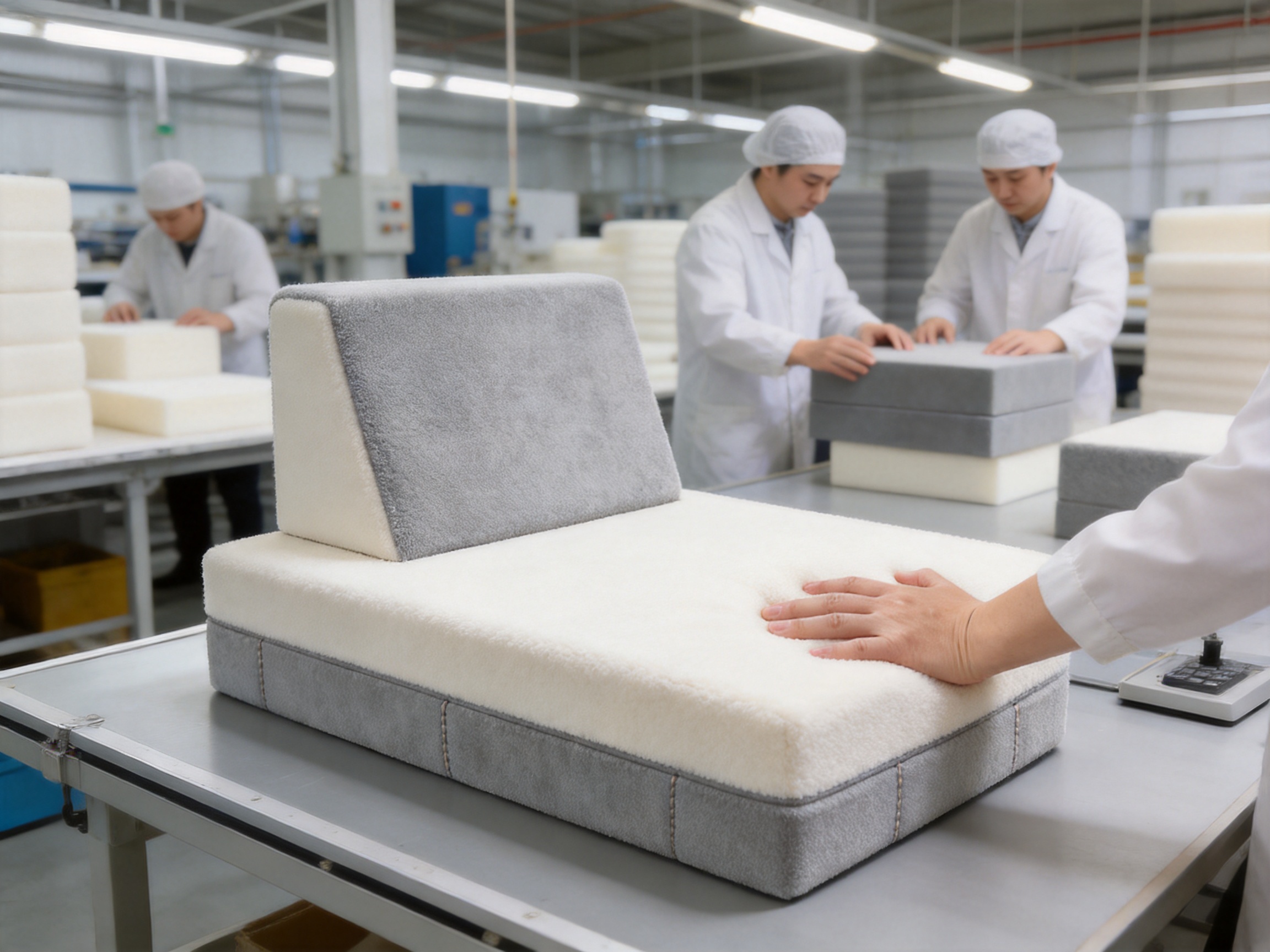
Advanced foam furniture manufacturing is not limited to selecting a soft material. The final performance of a modular sofa depends on the entire production process, including raw material preparation, foaming, curing, cutting, shaping, fabric preparation, sewing, assembly, inspection, and packaging.
During foam production, the formulation must be controlled so that the resulting material achieves the desired density and resilience. Variations in mixing, temperature, curing time, or raw material proportions may affect firmness and recovery. A manufacturer with experience across multiple foam categories is better positioned to identify the requirements of a particular product.
After the foam is cured, it may be cut into precise shapes and sizes. Accurate cutting is important for modular furniture because the individual components must combine effectively. If dimensions vary too widely, gaps may appear between pieces or the overall arrangement may become less stable. Consistent module sizing also improves the appearance of the finished product.
The fabric cover requires its own quality controls. Panels must be cut accurately, seams need to be secure, and the cover must fit the foam without excessive looseness or unwanted tension. The short-pile fabric should maintain a consistent appearance across the modules, while the gray and off-white sections should be coordinated to create a clean visual effect.
Final inspection may include checks for dimensions, surface appearance, stitching, odors, foam recovery, packaging integrity, and product identification. For export orders, packaging should also protect the product from dust, moisture, compression damage, and handling during transportation.
Research-Driven Material Innovation
The company’s stated focus on material innovation is a significant strength. Different foam applications require different performance profiles. A mattress may prioritize pressure distribution and sleep comfort. A pet product may require durability and easy maintenance. A children’s sofa must combine resilience, softness, safety, and play suitability.
Research into gel foam, temperature-insensitive foam, quick-dry foam, flame-retardant sponge, and antibacterial sponge suggests that the supplier has developed knowledge across a wide range of material functions. Even when a specific product uses a standard high-density foam structure, this broader knowledge can inform material selection and future product development.
The ability to develop new materials also helps a manufacturer respond to buyer requirements. Importers and distributors may ask for different firmness levels, cover fabrics, colors, packaging formats, or regional compliance documents. Although the listed CH011 model is not customizable, a company with an established research and manufacturing base may be better prepared for future product variations.
10. Sustainability and Environmental Management
Modern furniture buyers increasingly consider the environmental impact of manufacturing, materials, packaging, and product life. The company states that it invests in advanced eco-friendly energy systems and improves environmental management practices. Its stated goal is to move beyond basic compliance and create lasting environmental value.
A modular product may support more efficient use of materials because it is designed for multiple functions. One product can serve as a sofa, cushion system, playbed, and soft activity structure. Longer useful life and flexible use can reduce the need to purchase several separate items.
Durability is also connected with sustainability. A product that retains its shape and appearance for a longer period is less likely to be replaced quickly. High-density foam, durable stitching, and suitable fabric selection can all contribute to longer service life when the product is used and maintained correctly.
Environmental claims should always be evaluated through specific documentation, manufacturing records, certification information, and the applicable market standards. Buyers may request details about foam composition, fabric certification, packaging materials, production energy systems, and waste management procedures before placing larger orders.
Packaging and Export Readiness
The product is intended for domestic and international trade. Because foam furniture can be bulky, packaging design is important. Effective packaging can protect the product while reducing unnecessary shipping volume. Foldable or stackable modules may offer logistical advantages compared with one-piece furniture that cannot be compacted.
Export buyers should confirm carton dimensions, gross and net weight, loading quantities, packaging materials, shipping marks, product labeling, assembly or use instructions, and destination-market requirements. These details are particularly important for e-commerce, where products may pass through several distribution centers before reaching the consumer.
11. Applications in Different Environments
In a living room, the sofa can provide children with a dedicated low seating area while allowing parents to maintain a coordinated interior style. The neutral color scheme can fit beside adult furniture without making the room appear overly commercial or themed.
In a child’s bedroom, the modules can serve as a reading corner during the day and a low playbed during supervised rest. Because they can be moved, the layout can change as the child’s routine changes.
In a playroom, the eight pieces can be spread out for construction games or arranged into a soft obstacle course. Children can use the modules for pretend houses, tunnels, shops, stages, and other imaginative scenarios.
In an early childhood education environment, the product can create flexible learning zones. A teacher may use the modules to organize storytelling, group discussion, sensory play, or movement activities. Afterward, the components can be stacked to open the floor for cleaning or another class.
In a waiting area, the sofa can provide children with a softer and more inviting place to sit. Clinics, family service centers, and hospitality spaces may use modular children’s furniture to make their environments more comfortable and approachable.
Supporting Motor Skills and Creativity
The product’s modular structure can encourage children to practice simple forms of planning and coordination. Moving a piece, deciding where it belongs, crawling through a tunnel, stepping across a low arrangement, or balancing a soft block within a fort can involve gross motor movement and spatial awareness.
Imaginative play also benefits from open-ended materials. A fixed toy often has a defined purpose, while a building-block sofa can become many things. One day it may be a train, another day a reading boat, and later a small theater. This openness encourages children to create narratives and solve simple design problems.
Adults should select configurations appropriate to the child’s age and ability. The most active arrangements require supervision, and children should be reminded not to throw the modules or use them near hard furniture edges.
12. Buying Considerations for Importers and Distributors
Importers should evaluate the product from both a consumer and supply-chain perspective. The key product strengths are modular functionality, frameless construction, high-density foam, neutral styling, portable components, and broad application potential.
Before ordering, buyers should confirm the final material specification. The supplied information refers to memory foam, high-density sponge, and foam cushioning. The exact foam formulation, density range, firmness, cover composition, and certification scope should be documented in the commercial specification for the intended market.
Buyers should also request product drawings or technical sheets showing the dimensions of each individual module, not only the overall arrangement. This information helps with packaging design, warehouse planning, product photography, instruction preparation, and customer service.
Other useful purchasing questions include minimum order quantity, sample availability, lead time, packaging method, carton dimensions, loading capacity, color consistency, replacement-cover availability, inspection procedures, and after-sales support. For children’s products, buyers should also clarify labeling, warning statements, test reports, and documentation required by the destination country.
| Buyer Evaluation Area | Recommended Information to Confirm |
| Material | Foam type, density, firmness, cover composition, and certification details |
| Dimensions | Individual module size and assembled configuration size |
| Packaging | Carton size, compression method, protection, and shipping marks |
| Quality Control | Inspection standards, recovery testing, seam inspection, and appearance checks |
| Compliance | Applicable children’s product, textile, chemical, and labeling requirements |
| Commercial Terms | Minimum order quantity, sample policy, lead time, and payment terms |
| After-Sales Service | Spare parts, replacement covers, claims process, and technical support |
| Market Positioning | Home use, education, hospitality, retail, or online marketplace distribution |
Why the Product Works for E-Commerce
The sofa has several characteristics that are suitable for online retail. Its eight-piece format is easy to explain through product images and videos. Different configurations can demonstrate the product’s versatility more effectively than a written description alone. The neutral color scheme also appeals to a broad customer base.
Online sellers can position the product as children’s furniture, a soft play system, a reading corner, a modular lounge, or a space-saving family-room solution. The same item may attract parents, grandparents, daycare operators, and educational institutions.
Clear instructions are essential for e-commerce. Customers should understand how the modules are arranged, how the product is packaged, how long compressed foam may need to recover, how to clean the cover, and how to use the sofa safely. Accurate product communication helps reduce returns and improves customer satisfaction.
13. Care, Storage, and Long-Term Use
Proper care can help maintain the product’s appearance and performance. The sofa should be kept in a dry, well-ventilated location and protected from prolonged exposure to direct sunlight, which may affect fabric color over time. Food, beverages, markers, and sharp toys should be kept under reasonable control around the upholstery.
When the product is not in use, the modules can be stacked or folded to save floor space. They should not be compressed under excessive weight for extended periods unless the manufacturer specifically provides instructions for that storage method. Long-term heavy compression may influence foam recovery and shape.
Cleaning instructions should be followed according to the actual cover construction. If the cover is removable, buyers should confirm whether it may be machine washed, hand washed, or professionally cleaned. If the cover is not removable, spot cleaning with an appropriate mild method may be recommended. The foam core should be allowed to dry completely after any cleaning process.
Regular inspection is particularly important in schools and commercial settings because the product may receive more frequent use. Staff should check seams, zippers if present, fabric surfaces, foam edges, and module stability. A documented inspection routine can help identify problems before they become serious.
14. Frequently Asked Questions
What is included in the eight-piece sofa set?
The product is described as an eight-module modular children’s sofa set. The exact shape of each module should be confirmed through the supplier’s technical sheet or packaging list, but the pieces are intended to be freely combined into different seating and play arrangements.
Is the sofa suitable for children of all ages?
The product is designed for children, but suitability depends on the child’s age, size, abilities, and behavior. Active configurations such as tunnels, forts, or climbing arrangements should be supervised. Buyers should follow the manufacturer’s age recommendations and safety instructions for the final version of the product.
Does the sofa contain a wooden or metal frame?
No. The listed structure is frameless and fully soft. It is designed without a conventional wood or metal frame, helping reduce rigid internal components and hard edges.
What type of foam is used?
The product information describes a high-density sponge or memory foam-based interior with slow-rebound properties. Buyers should request the exact foam formulation, density, firmness, and technical documentation for a specific order.
Can the modules be arranged into a bed?
Yes. The modules can be combined into a playbed or low resting surface. This should be understood as children’s play and rest furniture rather than a replacement for an approved infant sleep product.
Can the sofa be used outdoors?
The product is primarily intended for indoor environments such as living rooms, children’s rooms, and educational spaces. Outdoor use is not recommended unless the manufacturer confirms that the fabric, foam, and construction are suitable for outdoor exposure.
Is assembly required?
No professional installation service is provided or normally required. The product consists of separate lightweight modules that can be arranged by the user. Buyers should check whether the shipping package requires a recovery period after compression.
Is the product customizable?
The listed CH011 model is identified as not customizable. Large-volume buyers should contact the supplier separately to determine whether different colors, covers, packaging formats, or related models are available.
How should the product be cleaned?
Cleaning should follow the care instructions for the actual fabric cover. Surface dust may generally be removed with a suitable vacuum attachment, while spills should be treated promptly. The foam should not be soaked unless the manufacturer specifically confirms that washing is permitted.
Is the product suitable for preschools?
Yes. Its portable modular design can be useful in preschools, nurseries, reading rooms, and activity centers. Staff should establish supervision rules and inspect the modules regularly because institutional use may be more frequent than household use.
What makes this sofa different from ordinary children’s seating?
Its primary differences are the eight-piece modular design, the ability to create multiple play and rest configurations, the fully soft frameless construction, the high-density slow-rebound foam, and the ability to store the pieces compactly. It is intended to function as both furniture and an open-ended play system.
What should international buyers confirm before ordering?
International buyers should confirm the final material specification, certification documents, product dimensions, packaging details, loading information, labeling requirements, test reports, lead time, minimum order quantity, and destination-market compliance requirements.
15. Overall Product Assessment
The eight-piece foldable children’s building block sofa set is a practical example of multifunctional foam furniture. Its strength lies in the way several product benefits work together. The high-density slow-rebound foam provides cushioning and shape recovery. The frameless structure creates a softer environment for children. The rounded edges reduce the presence of sharp corners. The modular format supports creative play and flexible room planning. The foldable and stackable design helps save space.
Compared with a fixed children’s sofa, this product offers a wider range of uses and a longer opportunity for adaptation. It can respond to changing routines, different room layouts, and different developmental stages. Its light gray and off-white appearance also makes it suitable for modern homes and professional educational environments.
The supplier’s experience in foam materials, sleep products, research and development, international trade, and environmental management adds further value. A manufacturer that understands foam formulation and processing is better equipped to control the material performance required for comfortable, durable, and child-oriented furniture.
At the same time, responsible purchasing requires attention to details that are not fully represented by a short product description. Buyers should verify exact foam specifications, certification coverage, testing, dimensions, packaging, cleaning instructions, and market-specific compliance. Parents and institutions should also use the sofa on a safe surface, supervise active play, and inspect the modules regularly.
When these considerations are addressed, the eight-piece modular sofa can become more than a place to sit. It can provide children with a comfortable personal space, a platform for imagination, and a flexible environment for movement and discovery. For families, it offers an efficient alternative to buying several separate pieces of children’s furniture. For distributors and institutions, it provides a versatile product category with applications across residential, educational, hospitality, and family-oriented commercial settings.
References
1. Product specification and technical information supplied for the CH011 eight-piece foldable children’s building block sofa set.
2. Jiangsu Wellcare Household Articles Co., Ltd. company profile and manufacturing history.
3. General principles of flexible polyurethane foam density, resilience, compression recovery, and furniture cushioning performance.
4. OEKO-TEX® certification framework and general textile safety considerations.
5. General guidance for children’s furniture design, rounded edges, supervision, stability, and indoor play environments.
6. General practices for upholstered furniture inspection, cleaning, storage, packaging, and export preparation.
Product: Eight-piece foldable children's building block sofa set

PREV:Foldable Memory Foam Seat Cushion: Portable Comfort for Work, Travel, and Everyday Support
NEXT:Gel Memory Foam Tatami Mattress: Cool Comfort, Flexible Support, and Reliable Manufacturing
NEXT:Gel Memory Foam Tatami Mattress: Cool Comfort, Flexible Support, and Reliable Manufacturing
Interested in cooperation or have questions?
Related News
WELLCARE was founded in 2003, boasting over a decade of profound and extensive experience.
Quick Links
Product
Media Centre
Contact Information
- [email protected]
- +86-517-84998062
- +86-15152354988
- No. 168 Nenjiang Road, Huaiyin District, Huai'an City, Jiangsu Province, China
Copyright © Jiangsu Wellcare Household Articles Co., LTD. All Rights Reserved.
Custom Memory Gel Mattress Manufacturers
