

 English
 日本語
日本語 Español


Shen Yueqiao — After-Sales Quality Support Supervisor

Home / Author / Shen Yueqiao — After-Sales Quality Support Supervisor / Egg Nest Memory Foam Mattress: Breathable Support for Flexible Everyday Sleep
Product Category
NEW Category
Contact us
Egg Nest Memory Foam Mattress: Breathable Support for Flexible Everyday Sleep
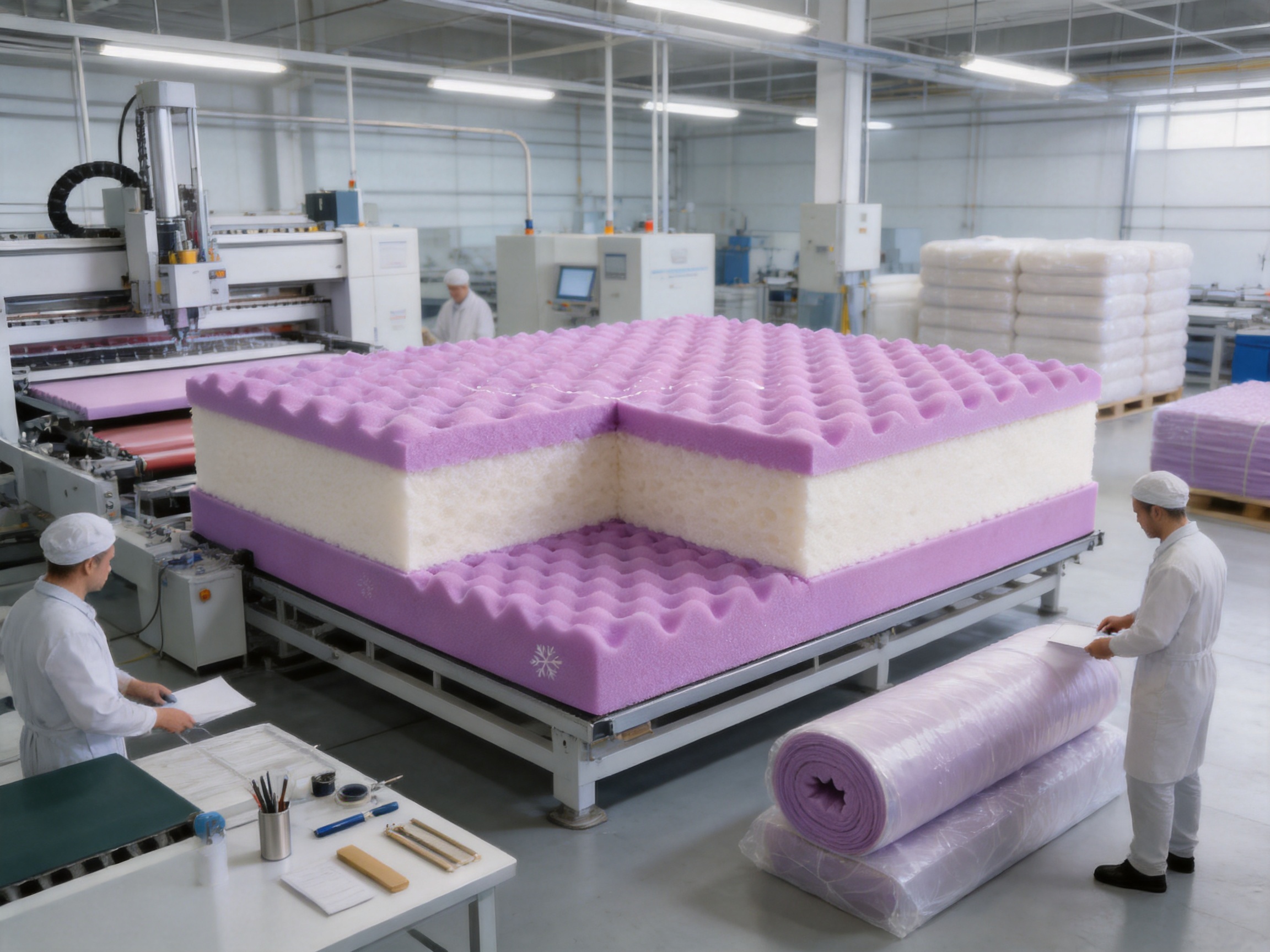
A mattress does more than provide a place to lie down. It influences how the body is supported, how pressure is distributed, how warm the sleeper feels during the night, and how easily the sleeping surface can be moved or stored. For homes, guest rooms, dormitories, temporary accommodation, and flexible living spaces, a mattress must balance comfort with practicality. The Egg Nest Memory Foam Mattress is designed around that balance, combining a slow-rebound memory foam base with a three-dimensional eggshell embossed surface.
This 50 mm mattress is intended for a 1.0-meter bed and is supplied in a violet color identified as Violet 5cm (2516). Its rollable construction makes it easier to transport than a traditional bulky mattress, while its relatively slim profile allows it to be used on bed frames, tatami-style surfaces, or floors. The product is also suitable for guest use, temporary overnight stays, student dormitories, children's rooms, and everyday sleeping arrangements where portability and simple handling are important.
Behind the product is Jiangsu Wellcare Household Articles Co., LTD., a Chinese manufacturer with experience in foam research, material development, and healthy home products. The company’s capabilities include ordinary sponge, memory foam, gel foam, temperature-insensitive memory foam, quick-dry memory foam, flame-retardant sponge, antibacterial sponge, and other foam materials. This broad technical background gives the manufacturer a foundation for developing mattresses that combine material performance, structural design, and production efficiency.
Product Overview
The Egg Nest Memory Foam Mattress uses high-density memory foam as its primary support material. Memory foam is known for its ability to respond gradually under body weight. Instead of immediately pushing back like a conventional firm foam, it slowly conforms to the contours of the body. This can help distribute contact pressure across a broader area and create a more balanced sleeping sensation.
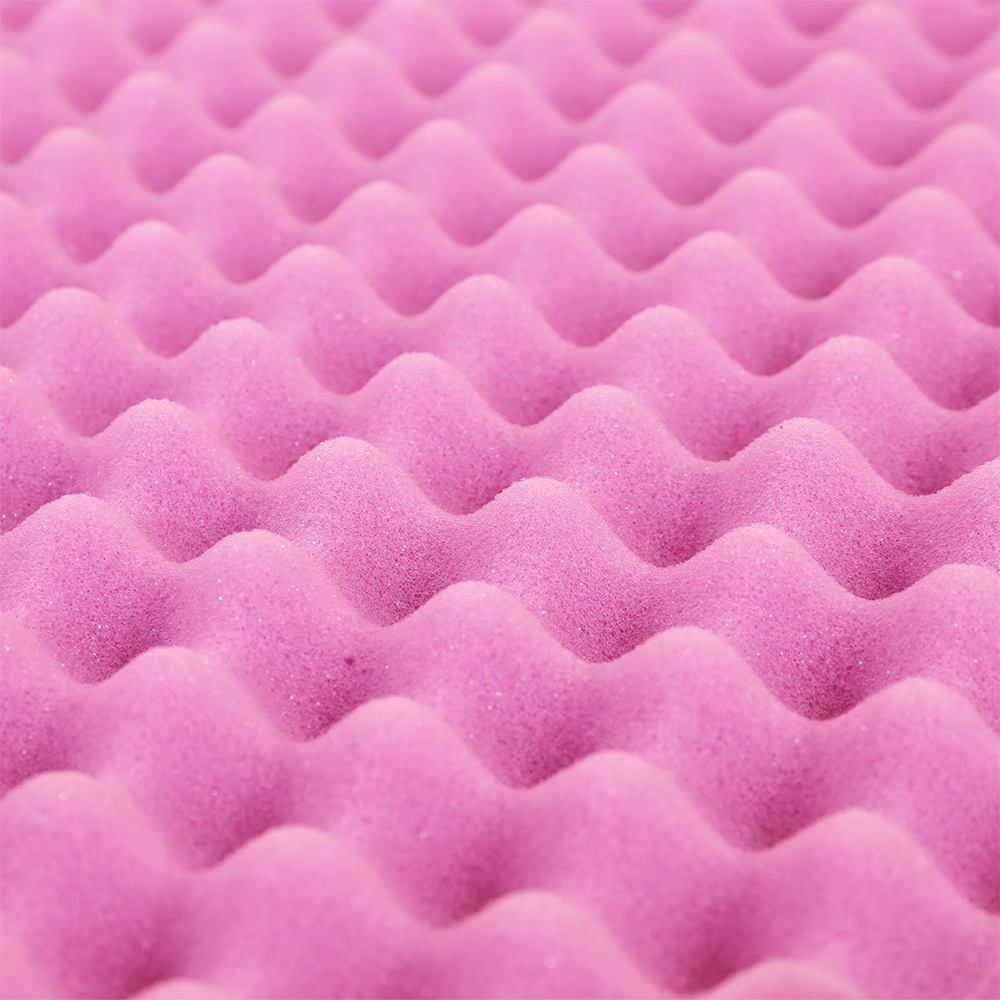
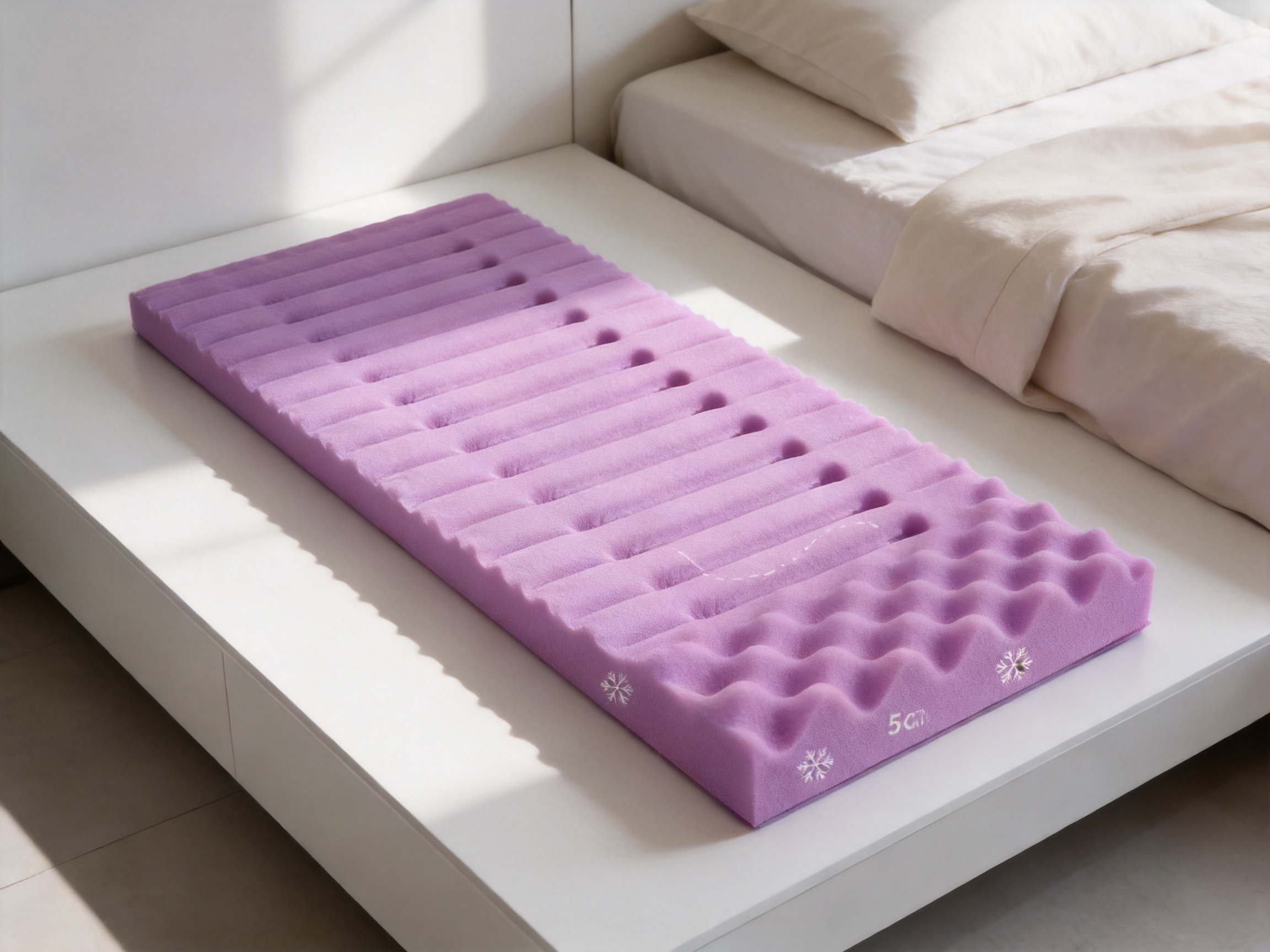
The surface is shaped with an egg-shaped, honeycomb-like embossing pattern. The raised and recessed structure creates a more textured top layer than a flat foam surface. This design is intended to improve air circulation around the upper sleeping area, reduce the closed-in sensation that can occur with solid foam, and add a degree of surface stability. It also gives the mattress a distinctive visual appearance without relying on complicated decorative components.
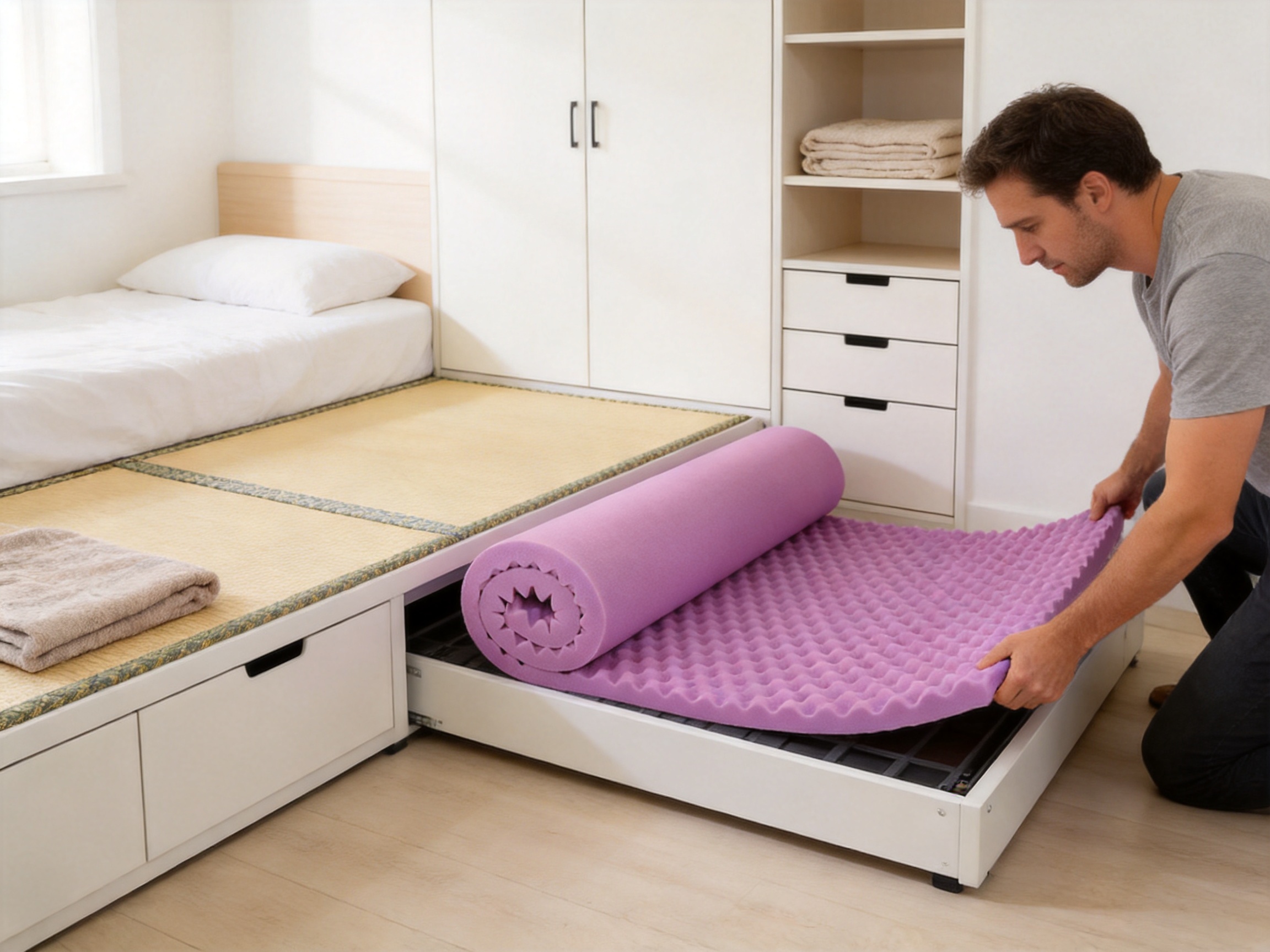
The mattress has a 50 mm thickness, making it different from a deep conventional mattress. Its slim construction is useful in situations where a compact sleep layer is preferred. It may be placed on a suitable bed base, tatami mat, platform, or clean floor surface. Because the mattress is rollable, it can be moved between rooms, stored when not in use, or transported for temporary accommodation more conveniently than many thick spring or multi-layer mattresses.
| Product Attribute | Specification |
| Product Name | Egg Nest Memory Foam Mattress |
| Product Category | Memory Foam Regular Mattress |
| Primary Material | Memory Foam |
| Surface Design | Three-dimensional eggshell embossing |
| Thickness | 50 mm |
| Applicable Bed Size | 1.0 m bed |
| Stated Dimensions | 190 × 100 cm |
| Color | Violet 5 cm, code 2516 |
| Item Number | M021 |
| Style | Minimalist Modern |
| Season | All-season use |
| Custom Processing | Available |
| Rollable Construction | Yes |
The stated outer carton dimensions are approximately 28 × 28 × 30 cm. Actual packed dimensions can vary according to compression, wrapping, and shipping requirements, so buyers should confirm final packaging details before placing a commercial order. The product information identifies the item as a qualified product and indicates that it supports cross-border export supply.
How the Egg Nest Surface Works
The most visible feature of this mattress is the eggshell embossed surface. Rather than presenting a completely level sheet of foam, the surface contains repeated raised forms that resemble an egg-crate or honeycomb pattern. This creates a series of small contact zones and channels across the upper layer.
One intended benefit of this arrangement is increased surface ventilation. When a sleeper lies on a flat, continuous foam surface, portions of the material can be pressed tightly against the body and bedding. The raised pattern creates additional spaces between sections of the foam, which may help air move through the surface area. This does not turn the mattress into an actively cooled product, but it can contribute to a less enclosed sleeping feel compared with an entirely flat foam pad of similar thickness.
The pattern may also help manage the way weight is introduced to the foam. The raised sections compress progressively under load, while the recessed channels remain available to support movement and airflow. This creates a more responsive surface feel than a plain, uniformly flat layer. The result is intended to be soft to the touch while retaining a stable underlying support sensation.
A textured surface can also offer a modest non-slip effect when placed correctly on a compatible base. However, the mattress should always be used on a clean, dry, level surface. The embossed design is not a replacement for a dedicated anti-slip mat, a fitted sheet, or a secure bed platform where those items are needed.
From a product development perspective, embossing also provides an efficient way to add functional structure without adding springs, electrical components, cooling modules, or multiple mechanically assembled parts. That helps keep the mattress lightweight and relatively simple to handle.
Egg Nest Memory Foam Mattress
Memory Foam Support and Pressure Distribution
The base material is described as high-density memory foam with slow-rebound properties. The term “slow rebound” refers to the foam’s gradual recovery after compression. When body weight is applied, the foam yields progressively and conforms to the shape of the sleeper. Once the pressure is removed, it returns toward its original form more slowly than standard resilient foam.
This response can be useful for sleepers who prefer a surface that gently accommodates the shoulders, hips, and other body contours. Instead of creating a sharp pressure point at every area where the body contacts the mattress, the foam spreads the load across a larger section. The perceived result may be a cradling sensation and a smoother transition between supported and unsupported areas.
The mattress is intended to relieve back pressure by following the body’s curves. In practical terms, this means the foam can adapt to differences in body shape rather than treating the entire body as a flat plane. Correct support still depends on the sleeper’s body type, sleeping position, bed base, and personal comfort preferences. A 50 mm mattress topper-style design may be suitable for many flexible-use applications, but it should not automatically be considered a substitute for a thick orthopedic mattress or a clinically prescribed sleep system.
High-density foam is also selected for its ability to provide a stronger support foundation than very soft, low-density foam. The product description emphasizes resistance to sagging and deformation during prolonged use. Actual service life depends on factors such as user weight, frequency of use, ventilation, base support, temperature, humidity, and care. Nevertheless, the combination of high-density material and structured surface is intended to offer a more durable experience than an inexpensive, unstructured foam pad.
Slow-rebound foam can be particularly attractive to users who want shock absorption and reduced movement transfer. When one person changes position, the material may absorb some of the movement rather than transmitting it instantly across the entire surface. The degree of motion isolation will vary according to mattress thickness and construction, but the material is naturally suited to a quieter, less springy feel than many traditional coil surfaces.
Advantages Compared with Conventional Mattress Options
Compared with Basic Flat Foam Pads
Basic flat foam pads are often lightweight and inexpensive, but they may offer limited breathability and little structural differentiation between the top and bottom surfaces. The Egg Nest Memory Foam Mattress adds a three-dimensional upper structure intended to improve airflow and create a more responsive contact surface. Its memory foam material also provides a more contouring feel than ordinary foam that immediately returns to shape.
The embossed structure may help the product feel less dense and enclosed than a flat sheet of the same material. It also gives the mattress a visually distinctive design, which can be useful for retailers seeking an alternative to plain white or gray foam products.
Compared with Traditional Spring Mattresses
Spring mattresses can offer strong bounce and a familiar sleeping sensation, but they are normally heavier, harder to roll, and more difficult to store. They may also contain more components, including coils, edge structures, padding, covers, and assembly layers. The Egg Nest Memory Foam Mattress is based on a compact foam construction, which simplifies handling and reduces the logistical burden associated with moving or storing a full spring mattress.
It does not attempt to imitate the buoyant feel of a spring system. Instead, it is aimed at users who value gradual conforming support, a low-profile form, reduced bulk, and a quieter surface. For dormitories, guest rooms, temporary beds, or flexible homes, these characteristics may be more important than pronounced bounce.
Compared with Thick Multi-Layer Memory Foam Mattresses
Premium multi-layer mattresses may include several foam densities, cooling gels, transition layers, edge reinforcements, and removable textile covers. These products can deliver a deep, substantial sleeping experience, but they are generally more expensive and less portable. The Egg Nest design is a simpler and thinner option for buyers who do not require a large mattress profile.
Its 50 mm construction can be used as a practical sleeping layer where space, shipping size, or budget is limited. It may also serve as a supplemental comfort layer on a suitable existing surface. Buyers who require deep edge support, a tall mattress profile, or a highly specialized firmness arrangement should compare the product with thicker models before making a final selection.
Compared with Flat Bed Mats and Tatami Pads
Traditional bed mats and tatami-style pads can be convenient, but they may offer limited pressure relief because they are often relatively firm and uniform. The memory foam layer introduces more contouring and shock absorption while preserving the low-profile nature that makes floor or platform sleeping practical.
The rollable design is also valuable for spaces that serve multiple purposes. A room can function as a study, playroom, guest room, or living area during the day and become a sleeping space at night. The mattress can be rolled and stored when it is no longer required, provided it is dry, clean, and stored in a suitable ventilated location.
Portability, Storage, and Flexible Use
Portability is one of the product’s clearest practical advantages. The mattress is lightweight compared with a conventional thick bed mattress and can be rolled for movement. This makes it suitable for buyers who frequently rearrange rooms, manage temporary accommodation, or need to prepare sleeping spaces quickly.
For guesthouses and hospitality operators, a rollable mattress can provide an efficient way to add sleeping capacity without permanently installing another bed. It can be stored between reservations and brought out when additional guests arrive. Student dormitories and rented rooms may also benefit from a mattress that can be transported during relocation or used on different support surfaces.
In family homes, the mattress may be used in a children's room, guest room, or temporary sleeping area. The violet color adds a soft decorative accent, while the minimalist modern style allows it to fit into bedrooms with different interior themes. Its visual design is simple enough for practical accommodation settings but more distinctive than an uncolored utility pad.
Storage should be handled carefully. The mattress should be kept away from persistent moisture, direct heat, sharp objects, and heavy items that could permanently compress the foam. If it has been rolled for transport, it should be allowed to expand and recover according to the supplier’s handling instructions before regular use. Buyers should also verify the condition of the foam and packaging after delivery.
The product is described as ready to use without complicated installation. Even so, preparation is important. The receiving surface should be level, clean, dry, and strong enough to support the intended user. Bedding should be placed over the mattress to protect the foam from body oils, dust, spills, and abrasion.
Applications Across Different Markets
Everyday Home Sleeping
For a 1.0-meter bed, the 190 × 100 cm size is intended to provide a compact single sleeping area. It can be used in bedrooms where space is limited or where a low-profile mattress is preferred. The slow-rebound foam is intended to provide a softer, body-conforming feel than a basic firm mat.
Guest Rooms
Guest rooms often need products that remain useful even when they are not used every day. A rollable mattress can be stored when the room has another function and prepared when guests arrive. Its lightweight construction also reduces the effort required to change or clean the room.
Student Dormitories
Dormitory residents frequently need products that are easy to carry, compact to store, and adaptable to unfamiliar furniture. The mattress can be placed on an approved bed frame or other suitable sleeping surface. Its 50 mm thickness offers a practical balance between cushioning and transportability.
Children’s Rooms
The mattress may be appropriate for children’s sleeping spaces when its dimensions and support characteristics match the child’s bed and the family’s needs. Parents and caregivers should always ensure that the sleeping environment is age-appropriate, secure, properly ventilated, and free from hazards. The product should not be used as a substitute for guidance concerning infant sleep safety.
Guesthouses and Temporary Accommodation
Accommodation providers may value a product that can be moved, rotated, and stored efficiently. The mattress can support flexible room layouts and temporary sleeping arrangements. Its simple construction may also help simplify inventory management compared with mattresses containing numerous specialized components.
Travel and Relocation
When moving between homes or furnishing a temporary residence, a rollable mattress can be easier to transport than a rigid mattress. It is useful for people who need an immediate sleeping solution while waiting for larger furniture to arrive. Commercial buyers can also consider it for short-term housing projects and seasonal accommodation, subject to local requirements.
Manufacturing Strengths and Material Development
The product is manufactured by Jiangsu Wellcare Household Articles Co., LTD., a company focused on high-performance sleep materials and healthy home products. The company’s history includes research cooperation, foam development, export supply, and e-commerce production. This background is important because a memory foam mattress is not defined only by its shape. The quality of the finished product depends on formulation, density control, cell structure, curing, cutting, embossing, inspection, packaging, and storage.
WELLCARE states that it is supported by a doctor-led research and development team and develops more than one hundred new foam materials each year. A large material-development program can help a manufacturer compare different formulations and performance characteristics. Potential areas of investigation include rebound behavior, compression response, resilience, durability, breathability, moisture management, flame performance, antibacterial properties, and temperature sensitivity.
The company’s portfolio includes temperature-insensitive memory foam and quick-dry memory foam in addition to conventional memory foam. This suggests that the manufacturer has experience addressing different usage conditions rather than treating all foam products as identical. Although the Egg Nest Memory Foam Mattress is not presented as a gel or quick-dry model, the wider technical capability can support better understanding of foam chemistry and production control.
The company’s development history began in 1993 as a school-run scientific research enterprise. In 2003, it purchased a 12,000-square-meter factory building and jointly developed a new sponge material with Huai’an Institute of Technology. In 2008, it purchased 50,000 square meters of land. These milestones indicate a long-term transition from research-oriented activity toward expanded manufacturing and commercial supply.
By 2010, the company reported supplying products to cross-border supermarkets in the United States, Germany, and Japan and cooperating with Qingdao University of Science and Technology. It later exported products to markets including the United Kingdom, Canada, Australia, and Kuwait. In 2018, it became an Alibaba-certified Gold Supplier and entered e-commerce, while in 2020 it became a designated supplier for five-star hotels. These market experiences can help a manufacturer understand different packaging, communication, consistency, and supply expectations.
Foam Formulation and Process Control
Memory foam performance begins with the material formulation. The ratio and selection of raw materials influence density, resilience, rebound speed, firmness, elasticity, and long-term compression behavior. A controlled formulation helps ensure that the finished foam behaves consistently from batch to batch.
For the Egg Nest Mattress, the intended combination is a supportive high-density base with a surface pattern that modifies contact and airflow. Manufacturing control is therefore needed at two levels: the foam must have stable internal properties, and the embossed surface must be formed evenly. Inconsistent density can lead to noticeable differences in firmness, while uneven embossing can affect the feel and appearance of the finished mattress.
Foaming, Curing, and Stabilization
Foam production generally involves controlled mixing, expansion, curing, and stabilization. During these stages, manufacturers manage factors such as material temperature, mixing uniformity, rise behavior, curing time, and environmental conditions. Proper stabilization helps the foam achieve more predictable dimensions and performance before it is cut into finished components.
Although detailed process parameters for this specific product are not provided, the manufacturer’s research background and broad foam portfolio suggest that it has experience working with material behavior at different stages of production. Buyers seeking private-label or customized versions should request detailed specifications, tolerances, sample approvals, and quality-control documentation.
Precision Cutting and Embossing
Once the foam has stabilized, it can be cut to the required length, width, and thickness. The stated mattress size is approximately 190 × 100 cm with a 50 mm thickness. Precision cutting is important because dimensional variation can affect how well the mattress fits a bed frame or platform.
The eggshell surface requires an additional forming or embossing operation. The repeated raised design needs to be sufficiently uniform across the mattress. A controlled process helps maintain consistent peak height, channel spacing, edge appearance, and overall visual quality. It also helps ensure that the surface provides a similar feel from one area to another.
Inspection and Packaging
Quality inspection may include checking dimensions, surface appearance, foam integrity, rebound behavior, compression response, odor, packaging condition, and labeling. The appropriate inspection program depends on the buyer’s market and order requirements. For export orders, packaging must also protect the mattress during handling, loading, transportation, and warehousing.
The rollable design allows the product to be packed in a compact form. Compact packaging can improve container utilization and reduce the amount of warehouse space required before sale. It can also make last-mile delivery more manageable. At the same time, compression and rolling must be controlled so that the mattress is not damaged or held under unsuitable conditions for excessive periods.
Customization and Business Supply Potential
The product information indicates that custom processing is available. This can be valuable for distributors, furniture retailers, hospitality suppliers, bedding brands, and online sellers who need products adapted to a particular market. Potential customization discussions may include dimensions, colors, surface patterns, packaging, labels, logos, carton printing, product inserts, and order quantities.
Customization should be confirmed in writing before production. Buyers should clarify whether a requested change affects the material formulation, thickness, density, firmness, packaging size, minimum order quantity, lead time, tooling, testing, or shipping cost. A change in surface design may also affect production tooling and the final sleeping feel.
The manufacturer lists major downstream platforms such as eBay, Amazon, Wish, AliExpress, independent websites, Lazada, and other channels. It also identifies sales regions including Africa, Europe, South America, Southeast Asia, North America, and the Middle East. This international orientation can be useful for businesses seeking a supplier familiar with cross-border product handling.
The company does not indicate support for dropshipping for this particular product, so buyers should plan for conventional wholesale, distribution, or inventory-based fulfillment unless separate arrangements are confirmed. The product is identified as suitable for cross-border export supply, but importers remain responsible for checking destination-market requirements relating to labeling, packaging, chemical content, fire safety, consumer protection, and mattress standards.
WELLCARE states that it is not an authorized own-brand product supplier for this item and that no patent is available. These details should be considered by buyers planning brand strategy, exclusive distribution, or intellectual-property positioning. A buyer seeking an exclusive design or private-label program should discuss territorial rights, artwork ownership, tooling ownership, and market exclusivity separately.
Sustainability and Responsible Manufacturing
Foam products require responsible management of raw materials, energy, emissions, packaging, and end-of-life disposal. The manufacturer states that it invests in advanced eco-friendly energy systems and improves environmental management practices. It also describes sustainability as an ongoing part of its business operations rather than a one-time compliance activity.
Energy-efficient systems can help reduce the environmental impact of manufacturing operations, while improved process control may reduce material waste. Efficient cutting, accurate embossing, and careful packaging can also improve yield and reduce the number of products rejected for cosmetic or dimensional reasons.
Because the provided information does not specify recycled content, formal environmental certifications, carbon accounting, or a take-back program for this mattress, buyers should request supporting documents before making environmental claims in marketing materials. Responsible promotion should distinguish between the manufacturer’s stated sustainability efforts and verified product-level certifications.
The rollable design may contribute to logistical efficiency by reducing packed volume compared with a full-size rigid mattress. More efficient shipping can potentially reduce handling space and improve transportation utilization. The actual environmental benefit depends on packaging materials, shipping distance, transport mode, storage time, and product life.
Comfort, Care, and Use Recommendations
Comfort is personal, and no single mattress suits every sleeper. The Egg Nest Memory Foam Mattress is intended for users who appreciate a soft surface, slow rebound, contouring support, and a low-profile design. People who prefer a very firm, highly buoyant, or thick mattress may prefer another construction.
The mattress should be placed on a stable base that is compatible with its dimensions. A flexible or uneven base can change the feel of a thin foam mattress and may contribute to uneven wear. If the mattress is placed on the floor, the floor should be clean and dry, and the mattress should be periodically lifted to allow both the surface and underside to air.
A breathable mattress protector or fitted sheet can help preserve cleanliness without completely covering the embossed structure with a thick, restrictive layer. Bedding should be washed according to its own care instructions. Spills should be addressed promptly, and excessive liquid should not be poured directly onto the foam.
Memory foam can retain a temporary packaging odor after unpacking. Adequate ventilation may help dissipate such odor. The product should be kept away from open flame, high heat, and sharp objects. It should not be folded sharply unless the supplier specifically confirms that such folding is acceptable.
Regular rotation may help distribute wear, although the product’s surface design and intended orientation should be considered. Users should inspect the mattress periodically for damage, moisture, or changes in shape. If the mattress becomes permanently compressed or no longer provides adequate support, it should be replaced.
Why the Product Is Suitable for Modern Retail
Modern consumers increasingly value products that are easy to receive, move, use, and store. A mattress that arrives in compact packaging can be more suitable for apartment buildings, online retail, and delivery services than an oversized rigid mattress. The Egg Nest design also gives retailers a clear visual feature to communicate through product photography and in-store displays.
The violet color differentiates the product from the large number of neutral-colored mattresses in the market. Its color and embossed texture can appeal to customers furnishing children's rooms, guest spaces, rental properties, or modern bedrooms. At the same time, the minimalist form does not depend on highly specialized decorative styling.
For online sellers, the product’s main communication points are straightforward: memory foam comfort, eggshell ventilation, compact rollability, 50 mm thickness, 1.0-meter bed compatibility, and broad application. Retailers should provide accurate information about dimensions, unpacking, expansion, suitable bases, care, and the difference between a slim mattress and a full-depth mattress.
For hospitality and contract buyers, the main advantages are handling efficiency, flexible storage, consistent visual presentation, and the ability to order customized versions. Bulk customers should evaluate samples under realistic conditions, including repeated use, cleaning routines, storage conditions, and the expected user profile.
Questions and Answers
What is the Egg Nest Memory Foam Mattress made of?
The mattress is made primarily from memory foam. Its material is described as high-density memory foam with slow-rebound properties. No separate fabric material is listed in the product specifications.
What does the eggshell embossing do?
The three-dimensional eggshell pattern creates raised and recessed areas on the surface. It is intended to improve breathability, add surface structure, support pressure distribution, and create a more stable, textured feel. It may also provide a modest non-slip effect when used on an appropriate surface.
How thick is the mattress?
The stated thickness is 50 mm, or 5 cm. This makes it a slim and portable mattress rather than a deep conventional mattress.
What size bed is it designed for?
The listed applicable bed size is a 1.0-meter, or approximately 3.3-foot, bed. The stated product dimensions are approximately 190 × 100 cm. Buyers should confirm final dimensions and tolerances before ordering, especially when fitting a specific bed frame.
Can the mattress be used on the floor?
It is described as suitable for use on bed frames, tatami mats, or floors. When using it on the floor, select a clean, level, dry surface and lift the mattress periodically to promote ventilation and help prevent moisture accumulation.
Is the mattress suitable for daily sleeping?
The product is described as suitable for daily sleep, temporary overnight stays, and student dormitory use. Suitability depends on individual comfort preferences, body weight, sleeping position, base support, and the condition of the product. Users who require specialized medical or orthopedic support should consult an appropriate professional.
Can it be rolled for transport?
Yes. Its lightweight, rollable construction is one of its intended advantages. Rolling makes it easier to move and store than many thick mattresses. The mattress should be unpacked, handled, and stored according to the supplier’s instructions.
Does the product include a textile cover?
The specification lists “Fabric Material: None.” Buyers should confirm whether any protective packaging, removable cover, fitted cover, or additional textile component is included in the final configuration.
Is the violet color the only available color?
The listed configuration is Violet 5cm, color code 2516. Since custom processing is available, buyers may ask the manufacturer whether alternative colors or private-label options can be produced. Availability may depend on order quantity and production requirements.
Can the mattress be customized?
Custom processing is listed as available. Possible customization topics may include dimensions, colors, packaging, labels, and branding. Each request should be reviewed with the manufacturer because customization can affect tooling, minimum order quantity, price, lead time, and testing.
Does the supplier support dropshipping?
The product information states that dropshipping is not supported. Buyers should therefore plan for wholesale purchasing, inventory management, or another fulfillment arrangement unless the supplier agrees to different terms in a separate contract.
What makes this product different from a flat foam pad?
It combines slow-rebound memory foam with a three-dimensional eggshell embossed surface. A basic flat foam pad may not offer the same contouring response or structured airflow channels. The Egg Nest mattress is designed to provide a more supportive and breathable feel while remaining slim and portable.
Is the product a gel memory foam mattress?
The listed product material is memory foam, and the product description does not identify gel foam in this specific mattress. The manufacturer does develop gel foam and memory gel materials as part of its broader product capabilities, but buyers should not assume that this item contains gel unless the configuration is specifically confirmed.
What should commercial buyers request before placing an order?
Commercial buyers should request a sample, final dimensions, density and firmness information, packaging specifications, tolerance standards, inspection procedures, customization terms, minimum order quantity, production lead time, shipping terms, and destination-market compliance documentation. These details help ensure that the delivered product matches the intended retail or hospitality application.
Conclusion
The Egg Nest Memory Foam Mattress is designed for buyers who want the pressure-conforming feel of memory foam without the weight and bulk of a deep conventional mattress. Its high-density slow-rebound base is intended to provide stable support and gradual body conformity, while the eggshell embossed surface adds ventilation channels, texture, and structural interest.
Its 50 mm thickness, approximately 190 × 100 cm dimensions, violet finish, and rollable construction make it suitable for compact single beds, guest rooms, student dormitories, children's rooms, tatami-style spaces, temporary accommodation, and flexible household use. Compared with flat foam pads, it offers a more developed surface structure. Compared with spring and multi-layer mattresses, it provides easier movement, storage, and transportation.
The product is supported by a manufacturer whose history includes foam research, university cooperation, material innovation, export supply, and healthy home product development. WELLCARE’s wider capabilities in memory foam, gel foam, quick-dry foam, temperature-insensitive foam, flame-retardant sponge, and antibacterial sponge provide a useful technical base for customized sleep-material programs.
As with any mattress, the right choice depends on the intended user, sleeping position, support base, room conditions, and required service life. Buyers should evaluate samples and confirm technical, packaging, and compliance details before committing to large orders. When selected for the right application, this mattress offers a practical combination of comfort, breathability, portability, simplified handling, and modern foam manufacturing.
References
1. Product specification and technical description supplied for the Egg Nest Memory Foam Mattress, item M021.
2. Manufacturer-provided company profile and development history for Jiangsu Wellcare Household Articles Co., LTD.
3. General reference literature on viscoelastic memory foam behavior, pressure distribution, and rebound characteristics.
4. General reference literature on foam mattress ventilation, surface profiling, and airflow considerations.
5. General reference materials concerning mattress packaging, storage, transportation, and cross-border product supply.
6. Manufacturer-provided information concerning foam material research, customization, export markets, and environmental management practices.
Product: Egg Nest Memory Foam Mattress
PREV:Neck Support Silicone Pillow for Children: Safe Materials, Thoughtful Ergonomics, and Reliable Manufacturing
NEXT:Triangular Memory Foam Bed Guard for Safer Children’s Sleep Spaces
NEXT:Triangular Memory Foam Bed Guard for Safer Children’s Sleep Spaces
Interested in cooperation or have questions?
Related News
WELLCARE was founded in 2003, boasting over a decade of profound and extensive experience.
Quick Links
Product
Media Centre
Contact Information
- [email protected]
- +86-517-84998062
- +86-15152354988
- No. 168 Nenjiang Road, Huaiyin District, Huai'an City, Jiangsu Province, China
Copyright © Jiangsu Wellcare Household Articles Co., LTD. All Rights Reserved.
Custom Memory Gel Mattress Manufacturers
