

 English
 日本語
 Español



Luo Jinyi — Senior After-Sales Service Specialist

Home / Author / Luo Jinyi — Senior After-Sales Service Specialist / Striped Pet Staircase: A Safer, More Comfortable Route for Dogs and Cats
Product Category
NEW Category
Contact us
Striped Pet Staircase: A Safer, More Comfortable Route for Dogs and Cats
Pets often want to share the same spaces as their owners, whether that means resting on a sofa, looking out from a bed, or riding comfortably in a vehicle. For many dogs and cats, however, climbing onto elevated furniture can be difficult. Small breeds, senior pets, animals recovering from injury, and pets with sensitive joints may struggle with repeated jumping. A single awkward landing can place unnecessary pressure on the knees, hips, shoulders, and spine. The Striped Pet Staircase provides a practical way to reduce this challenge by creating a stable, cushioned route between the floor and elevated surfaces.
Designed for use beside beds, sofas, chairs, and vehicle seats, this foam pet staircase combines a high-density sponge core with a thick, wear-resistant fabric cover. Its stepped structure provides a gradual incline rather than requiring one large leap. The surface features a three-dimensional striped texture intended to improve traction, while the raised side supports and widened base help the staircase remain stable during use.
The product is available in two-step, three-step, and four-step configurations. This range allows buyers to select a suitable height for different furniture styles and pet sizes. The staircase can also be customized in size and height, making it suitable for furniture manufacturers, pet-product distributors, retailers, and cross-border e-commerce sellers seeking adaptable foam pet-access solutions.
Beyond its functional design, the staircase has a warm patterned appearance that can blend into domestic interiors. Its soft visual character is intended to make the product look more like a home furnishing than a clinical mobility aid. This combination of safety, comfort, appearance, and manufacturing flexibility gives the product a strong position within the growing market for supportive pet furniture.
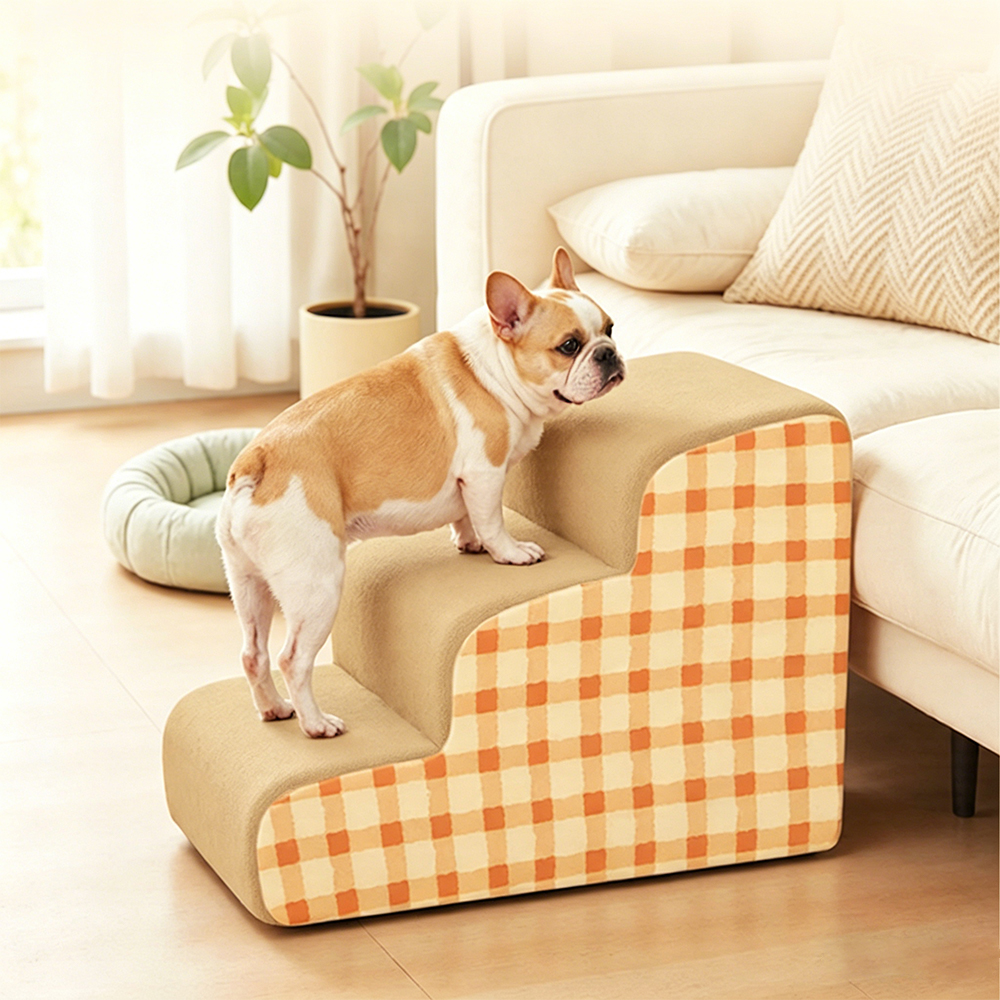
Striped Pet Staircase
Why Pet Stairs Matter in Everyday Homes
Jumping is a natural movement for many pets, but repeated jumping from elevated furniture can become increasingly difficult over time. A young and active dog may easily leap onto a sofa, while an older dog may hesitate, slip, or land heavily. Cats are generally agile, but age, weight, illness, injury, and reduced confidence can also affect their ability to climb safely.
A pet staircase offers a controlled alternative. Instead of moving directly from the floor to a high surface, the pet climbs through several shorter steps. Each step reduces the height of an individual movement and provides the animal with a more predictable place to position its paws. This can help minimize sudden impact and give pets greater confidence.
Pet stairs may be especially useful for animals with sensitive joints or reduced mobility. While a staircase is not a medical device and cannot replace veterinary advice, it can support a more convenient daily routine by reducing the need for frequent high jumps. It may also help owners maintain safer access to furniture without lifting heavier pets repeatedly.
The design is also useful for active pets that move quickly. A staircase with poor traction, a narrow base, or insufficient side support may shift during use. This can frighten the pet and discourage future use. The Striped Pet Staircase addresses these concerns through a combination of textured upholstery, a broad footprint, dense foam support, and raised side structures.
Core Product Design
High-Density Sponge Core
The internal core is made from high-density sponge designed to provide a balance of softness and structural support. Unlike a completely rigid step, a foam staircase offers a more forgiving surface under a pet’s paws. Unlike a very soft cushion, a properly formulated high-density core is better able to maintain the shape of the steps during repeated use.
Shape retention is essential for a pet staircase. If the steps compress unevenly, the height of each level may change and the walking surface may become less predictable. A stable foam core helps preserve the intended profile so that pets can climb with greater consistency. It also helps the staircase maintain an attractive appearance over time.
The foam structure supports comfort without making the product unnecessarily hard. This is particularly valuable for pets that are cautious about unfamiliar surfaces. A slightly cushioned step can feel more welcoming than a hard plastic or wooden alternative, encouraging the pet to use the staircase regularly.
Three-Dimensional Anti-Slip Texture
The surface is embossed with three-dimensional stripes. These raised patterns are intended to enhance contact between the pet’s paws and the upholstery. Increased surface texture can help reduce sliding, particularly when a pet approaches the stairs at an angle or moves quickly between levels.
Traction is one of the most important features of any pet staircase. A smooth textile surface may look attractive but can provide limited grip. By adding a dimensional texture, the product combines a decorative pattern with a practical function. The stripes help create a more tactile surface while contributing to the product’s visual identity.
No pet staircase can guarantee that slipping will never occur. The actual level of traction depends on the pet’s size, coat, nails, movement, the cleanliness of the surface, and the flooring beneath the staircase. Nevertheless, a textured surface is a meaningful design advantage compared with completely smooth upholstery.
Raised Side Supports
The staircase includes raised sides intended to provide additional guidance and support. These side structures can help a pet remain centered while climbing and may reduce the likelihood of stepping off the edge. They are especially valuable for smaller dogs, cautious animals, and pets with reduced balance.
Raised sides also contribute to the product’s sense of enclosure. Some pets feel more confident when the route is visually defined rather than completely open. The side supports can make each step appear easier to understand, helping the pet recognize the staircase as a dedicated path to the elevated surface.
The side supports are not a substitute for supervision during initial use. Owners should introduce the product gradually and confirm that the staircase is correctly positioned. However, compared with a narrow, unsupported platform, the raised-edge design offers an additional layer of stability and user guidance.
Widened Base
A broad base is essential to stability. When a pet climbs, its weight moves from one step to another and may shift forward or sideways. A staircase with a narrow footprint can be more likely to rock, especially on smooth floors. The widened base of this model helps distribute the load over a larger area.
The broader footprint also improves the visual balance of the product. A stable base makes the staircase look substantial and purposeful rather than fragile. For homes with active pets, this feature can be particularly beneficial because the staircase must accommodate movement rather than simply serve as a stationary decorative object.
Positioning remains important. The staircase should be placed on a level surface, with the highest step aligned securely with the target furniture. Owners should check that the product does not sit on loose rugs, uneven flooring, or surfaces that allow it to slide.
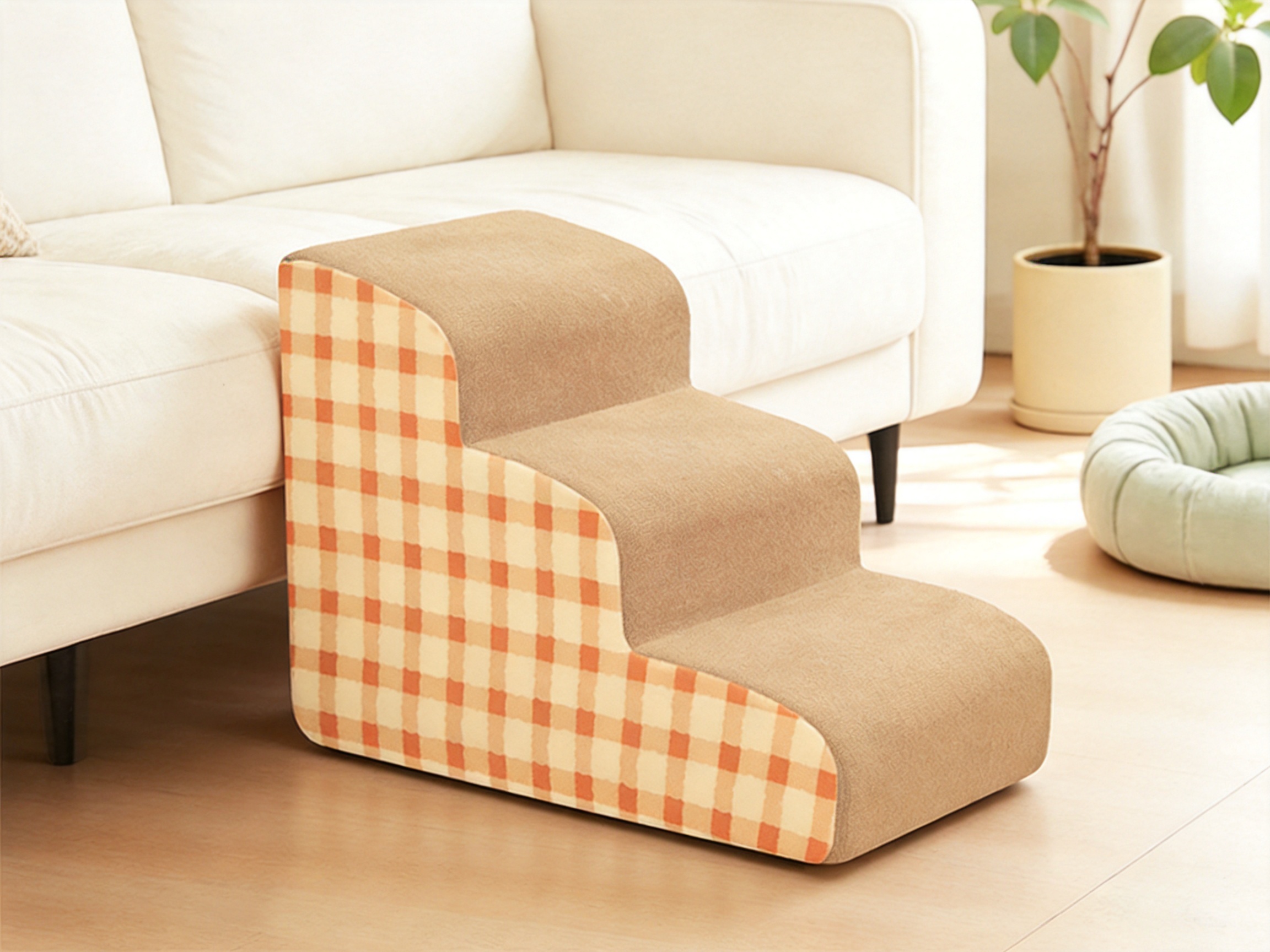
Available Sizes and Furniture Compatibility
The Striped Pet Staircase is offered in three standard configurations:
| Configuration | Approximate Dimensions | Typical Application |
| Two-tier | 40 × 40 × 30 cm | Lower sofas, chairs, and compact furniture |
| Three-tier | 56 × 40 × 35 cm | Standard sofas, beds, and moderate-height platforms |
| Four-tier | 72 × 40 × 40 cm | Higher beds, tall sofas, and extended climbing routes |
These dimensions provide a starting point for product selection, but the correct configuration depends on more than the height of the furniture. Buyers should also consider the pet’s body size, stride length, confidence, age, and mobility. A larger dog may require a more generous step depth, while a small dog may prefer a compact staircase with closer step spacing.
The two-tier configuration is suitable when the target surface is relatively low or when space is limited. It can be convenient beside a low sofa, lounge chair, or small platform. Its compact footprint may also appeal to apartment owners who want a mobility solution without occupying excessive floor area.
The three-tier model offers a balanced option for many household settings. It provides a gradual route while remaining relatively easy to position beside common sofas and beds. For retailers, this configuration may serve as a versatile core product because it can meet the requirements of a broad range of consumers.
The four-tier model provides the longest route and is suitable for higher furniture. It can reduce the size of each individual climb and may be preferable for pets that are uncomfortable with steep steps. Its extended base should be measured carefully against available floor space before purchase.
Customization in size and height adds commercial flexibility. Furniture brands, pet retailers, and hospitality businesses may request dimensions that correspond to specific furniture collections or room layouts. Custom sizing can also help distributors develop product lines for different pet categories or regional housing styles.
Advantages Compared with Basic Pet Steps
Many basic pet steps are made from lightweight plastic, thin fabric, or low-density padding. These materials can be inexpensive, but they may not provide the same combination of comfort, traction, and stability. The Striped Pet Staircase is designed as a more supportive foam product with a structure intended for repeated household use.
Compared with Smooth Plastic Stairs
Plastic stairs can be easy to wipe clean, but smooth plastic may feel slippery or cold under a pet’s paws. Some animals may hesitate to use a hard surface, particularly if they are older or lack confidence. The foam construction of this staircase provides a softer contact surface, while the three-dimensional striped upholstery helps improve grip.
Foam also reduces the harshness of contact when a pet steps down. A cushioned surface may be more comfortable for sensitive paws and joints than a rigid molded platform. The fabric-covered appearance can also blend more naturally with living-room furniture.
Compared with Soft but Unstructured Cushions
Some pet ramps and steps rely on soft padding without a defined internal structure. These products may feel comfortable initially but can lose their shape or develop uneven areas under repeated pressure. A high-density sponge core is designed to provide more dependable support and better shape retention.
Defined step geometry is also important for safety. Pets need to know where each level begins and ends. A structured staircase offers more predictable foot placement than a loose pile of cushions or an overly flexible pad.
Compared with Narrow or Lightweight Steps
Narrow stairs may be difficult for larger dogs or pets that need additional room to turn. Lightweight products can move when a pet climbs quickly. The widened base and raised sides of this model address both concerns. The pet receives a broader route, while the staircase benefits from a more stable overall footprint.
Compared with Visually Clinical Mobility Products
Some mobility aids are designed primarily for function and may appear out of place in a carefully decorated home. The warm patterned cover of this staircase is intended to create a more domestic appearance. Its decorative surface can complement living rooms, bedrooms, balconies, and other shared spaces.
The product information describes the cover using patterned color terms, including an orange-and-white checkered appearance and a floral-print color classification. Because product finishes can vary by production batch or sales listing, distributors should confirm the final fabric pattern and color before publication. The central design concept remains a warm, soft, decorative cover that combines household appeal with pet-oriented functionality.
Materials and Safety Considerations
Material safety is a major consideration for products used by animals inside the home. The staircase is described as using safe, environmentally responsible materials and as being associated with OEKO-TEX® certification. Such certification is generally intended to indicate that tested textile components meet defined requirements concerning harmful substances. Buyers should review the applicable certification documentation for the specific model, cover, and production batch.
The product is described as non-toxic and odor-conscious. These characteristics are valuable because pets may spend considerable time close to the cover and may occasionally touch it with their mouths. A low-odor material can also make the product more comfortable to introduce into bedrooms, living rooms, and other enclosed spaces.
Material safety depends on the complete product, not only the exterior fabric. The foam, thread, backing, adhesive components, dyes, and packaging should all be managed through appropriate quality-control procedures. A professional manufacturer should maintain clear specifications for incoming materials and finished-product inspections.
Owners should inspect the staircase periodically for damage. If the cover becomes torn or the foam is exposed, the product should be repaired or removed from use. Pets should also be prevented from chewing loose fabric, labels, or damaged seams.
Easy Cleaning and Maintenance
Pet products must withstand hair, dust, paw marks, and occasional spills. The wipeable surface of this staircase is designed to make routine maintenance more convenient. Regular cleaning helps preserve the appearance of the fabric and contributes to a more hygienic living environment.
For everyday care, owners can remove loose hair with a soft brush or vacuum attachment. Small marks can generally be addressed by wiping the surface with a suitable damp cloth. Excessive moisture should be avoided because foam products need adequate drying time. Strong solvents, harsh bleach, and abrasive tools may damage the fabric or affect its color.
Manufacturers and distributors should provide care instructions appropriate to the final cover construction. If the cover is removable, washing guidance should specify water temperature, drying method, and whether machine washing is permitted. If the cover is not removable, spot cleaning and surface wiping should be clearly explained.
Maintenance also includes checking the base and position of the staircase. Dust or smooth debris beneath the product may reduce contact with the floor. Owners should keep the base clean and make sure the staircase has not shifted away from the furniture.
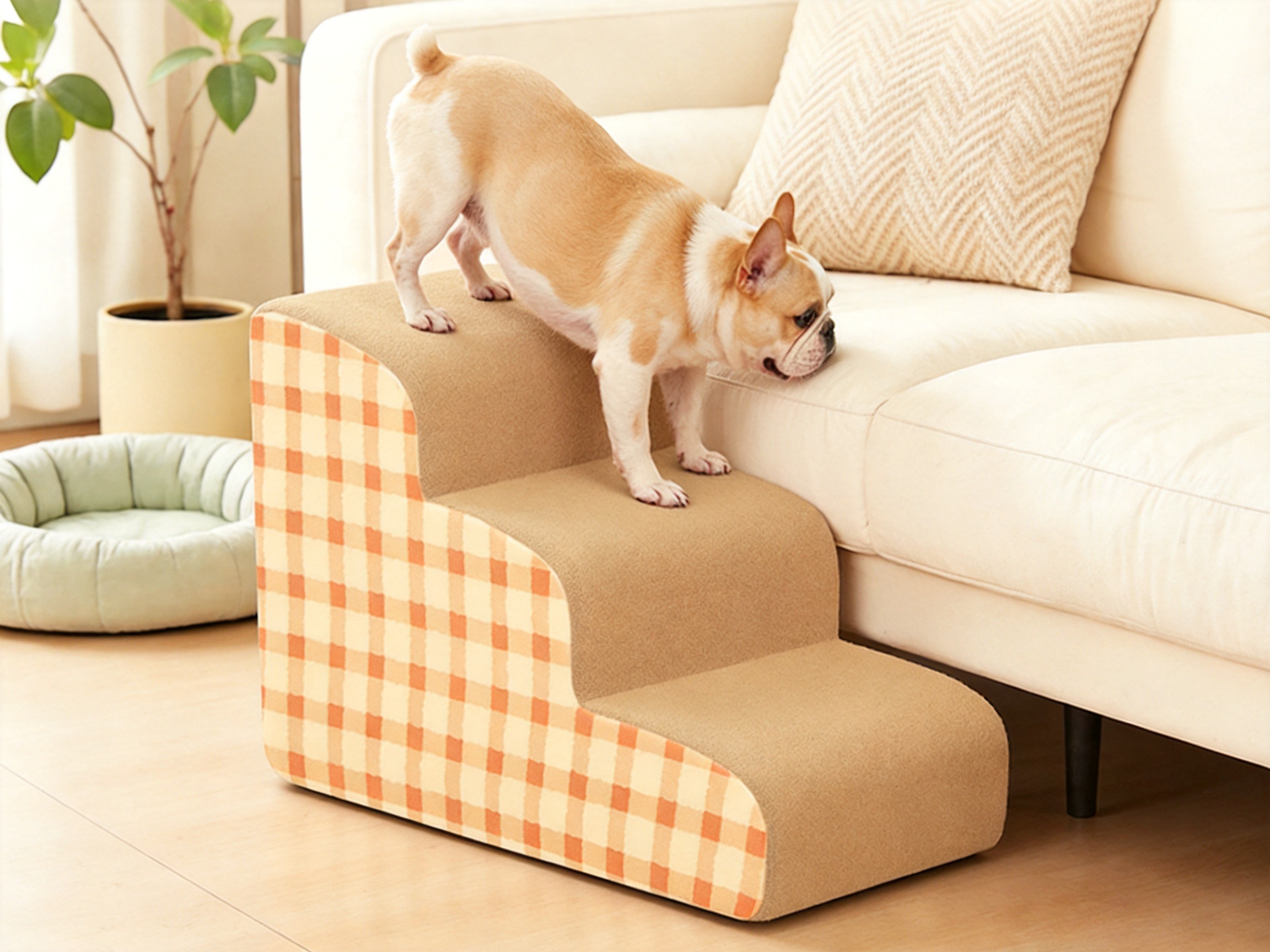
Introducing the Staircase to a Pet
Even a well-designed product may require an introduction period. Pets can be cautious about new objects, especially when the object changes their usual route to a sofa or bed. Owners should place the staircase securely and allow the pet to investigate it without pressure.
Small treats or familiar toys can be positioned on the lower steps to encourage exploration. Once the pet is comfortable, the owner can gradually move the reward toward the higher steps. Positive reinforcement is generally more effective than pulling or forcing the pet onto the staircase.
During early use, the owner should observe whether the pet approaches from the front, uses the steps evenly, and remains comfortable. If the animal jumps over several steps, slips, or avoids the product, the owner should review the staircase position, surface traction, furniture height, and step size.
For senior pets or animals recovering from injury, introduction should be especially gradual. A veterinarian may provide specific guidance regarding the pet’s movement and permitted activity. The staircase can support daily access, but it should not be used to encourage activity that is inappropriate for the animal’s condition.
Applications in Different Environments
Living Rooms
In a living room, the staircase can be positioned beside a sofa or armchair. The patterned cover helps it coordinate with domestic furnishings, while the foam core gives the pet a comfortable route to a favorite resting area. The product may be useful in homes where the sofa is high enough to make direct jumping difficult.
Bedrooms
Beside a bed, the staircase can reduce the need for pets to jump from the floor to the mattress. This is particularly relevant for low-mobility dogs that sleep near their owners. Buyers should select a height that aligns the top step closely with the bed while leaving enough room for the staircase to sit securely.
Balconies and Rest Areas
Some pets use raised cushions, platforms, or window-side resting areas. A compact two-tier model may provide access to these lower platforms. Outdoor placement should be evaluated carefully because prolonged exposure to moisture, sunlight, or extreme temperatures may affect textile and foam performance. The product should be kept dry and protected from weather unless the specific material specification allows outdoor use.
Vehicles
The product description also identifies cars as a possible use environment. A pet may use the staircase to enter or exit a vehicle when the surrounding space permits safe placement. In a vehicle, the staircase must be completely stable, and owners should never allow a pet to climb while the vehicle is moving. The product should not replace an approved pet restraint system.
Pet Retail and Hospitality Settings
Pet shops, grooming facilities, boarding centers, and pet-friendly accommodation providers may use foam stairs as part of a more accessible environment. The decorative finish can help the product fit into customer-facing areas, while the wipeable surface supports routine cleaning between uses.
Manufacturing Strengths Behind the Product
The product is manufactured by Jiangsu Wellcare Household Articles Co., LTD., a company focused on foam materials, sleep products, and healthy home goods. The company was founded in 2003 and has developed manufacturing experience across ordinary sponge, memory foam, gel foam, temperature-insensitive memory foam, quick-dry memory foam, flame-retardant sponge, antibacterial sponge, and related material categories.
This material-centered background is relevant to the pet staircase because the performance of a foam product depends heavily on formulation, density, resilience, compression behavior, and long-term shape retention. Experience across multiple foam types can support more informed selection of the core material for a specific application.
The company describes a doctor-led research and development team that develops more than one hundred new foam materials each year. Continuous material development can help manufacturers respond to changing market demands, including improved comfort, reduced odor, faster drying, greater resilience, environmental performance, and application-specific support.
According to the supplied company history, the business began in 1993 as a school-run scientific research enterprise. It later purchased a 12,000-square-meter factory building in 2003 and expanded its land holdings to 50,000 square meters in 2008. These developments indicate a long-term investment in production capacity and technical infrastructure.
The company also reports cooperation with Huai'an Institute of Technology and Qingdao University of Science and Technology. Collaboration with academic and technical institutions can contribute to material research, testing, formulation improvement, and process development. For buyers seeking customized foam products, access to research capabilities may be an important advantage over manufacturers that only assemble finished goods.
Integrated Foam Knowledge
A pet staircase requires more than a decorative fabric cover. The core must be selected to support the intended dimensions, load-bearing requirements, and compression profile. Foam knowledge helps manufacturers evaluate how the material behaves under repeated loading and how it interacts with the exterior cover.
For example, a staircase intended for a larger dog may require a different support balance from one designed for a small breed. The step height, width, density, and edge structure all influence usability. A manufacturer with experience in multiple foam categories can approach these variables systematically rather than relying only on visual design.
Material Innovation
The company’s reported development of quick-dry, antibacterial, flame-retardant, and temperature-insensitive foam technologies demonstrates a broad material-development direction. Not every technology is necessarily used in the Striped Pet Staircase, but the wider capability suggests that the manufacturer can explore different performance requirements for future pet products.
This may benefit buyers who need specialized versions for different markets. For example, a distributor may seek a quick-dry construction for humid regions, a more resilient core for large dogs, or a specialized cover for a hospitality environment. Any such feature would need to be confirmed through product-specific specifications and testing.
Experience with International Markets
The company reports supplying products to cross-border supermarkets in the United States, Germany, and Japan by 2010, followed by exports to the United Kingdom, Canada, Australia, and Kuwait. It also reports becoming an Alibaba-certified Gold Supplier in 2018 and a designated supplier for five-star hotels in 2020.
International supply experience can help a manufacturer understand packaging requirements, communication standards, product documentation, and the expectations of buyers in different regions. It may also support more efficient coordination with e-commerce distributors and private-label customers.
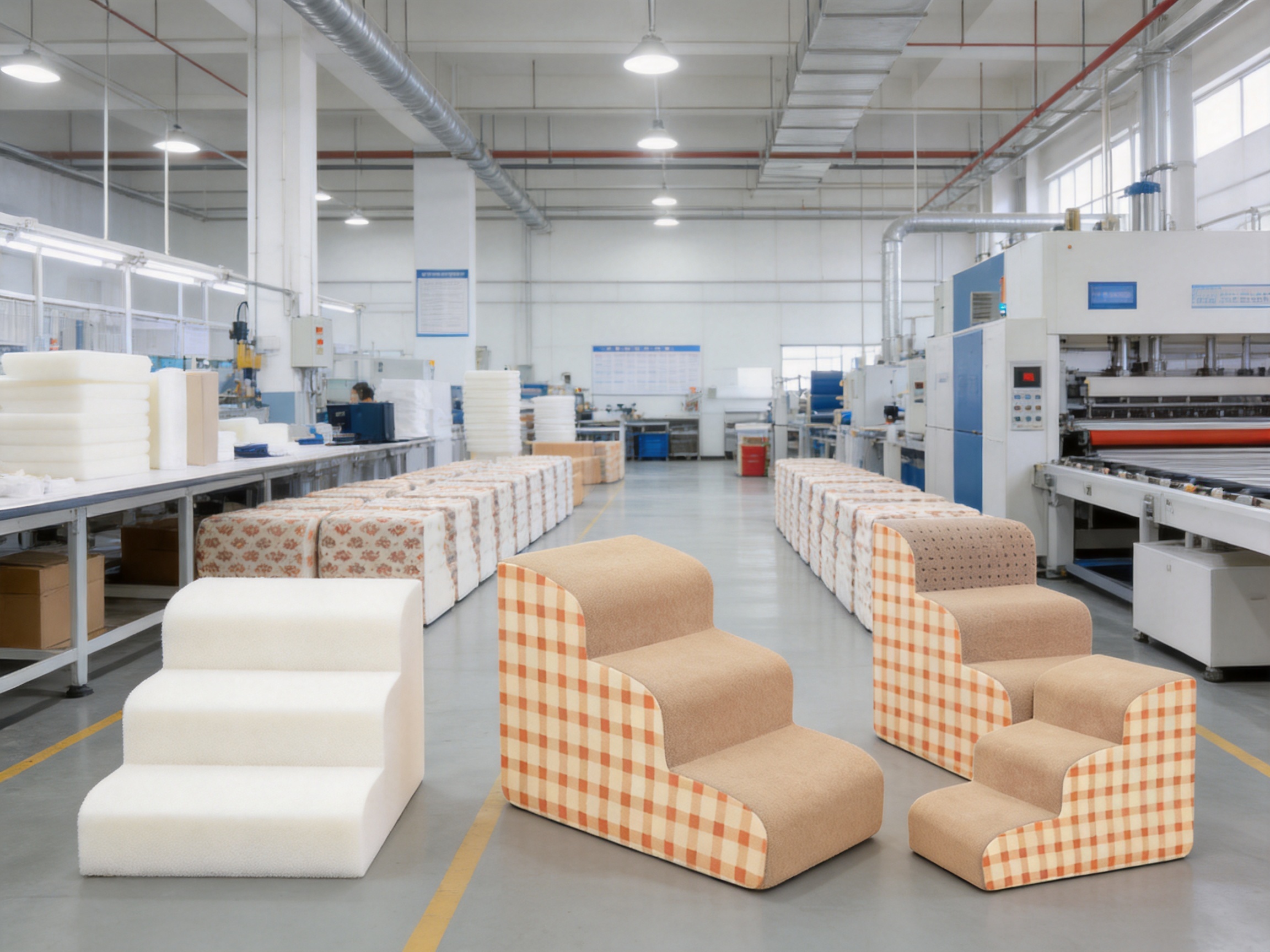
Quality Control and Production Process
A high-quality foam pet staircase typically passes through several production stages. The process begins with material selection. Foam density, resilience, hardness, and recovery behavior should be matched to the intended product dimensions and load requirements. The selected foam should be checked for consistency before entering cutting or forming operations.
The next stage involves shaping the foam into the required stair profile. Accurate cutting is important because uneven steps may affect both appearance and usability. The dimensions of the two-tier, three-tier, and four-tier versions should be checked against approved specifications.
After the core is shaped, the cover material is prepared and sewn or otherwise fitted according to the design. The fabric must be sufficiently durable for repeated paw contact, movement, and cleaning. Seams should be inspected for loose threads, uneven tension, and weak points.
The three-dimensional stripe pattern requires consistent surface production. The embossed texture should remain visible and sufficiently defined across the usable walking surfaces. Quality checks can evaluate pattern uniformity, fabric attachment, and the absence of excessive flattening or surface defects.
Side supports and the widened base must be integrated so that the final product maintains its intended geometry. A staircase that looks correct but lacks structural consistency may shift or deform during use. Finished products should therefore be checked for overall balance, base contact, step alignment, and dimensional accuracy.
Inspection should also include appearance, odor, packaging condition, and cleanliness. Products intended for export should be packed to protect the fabric and foam from compression damage, dust, and moisture during storage and transport. Packaging design should balance protection with reasonable shipping efficiency.
Customization and Wholesale Opportunities
The product’s customizable size and height create opportunities for buyers that need more than a standard retail item. Pet furniture brands can request dimensions that match their existing product families. Furniture manufacturers may integrate the staircase with beds, sofas, or pet lounges. Retailers can also select configurations suited to the floor space and customer preferences of particular markets.
Customization may include step count, overall height, length, width, fabric appearance, packaging, and labeling. Any customization should be evaluated against the pet’s safety and comfort requirements. Changes to the step height or depth can affect how easily animals climb, while changes to the core density can alter support and weight.
For cross-border sellers, the product may be suitable for marketplaces and independent online stores. The supplied downstream platform information includes eBay, Amazon, Wish, AliExpress, independent sites, and Lazada. Product listings should provide accurate dimensions, recommended applications, material information, cleaning guidance, and clear photographs.
Retailers should avoid overstating safety claims. A textured surface can help improve grip, but it should not be marketed as completely slip-proof. Similarly, the staircase can support easier access but should not be described as a guaranteed treatment for joint disease or injury. Accurate claims help protect consumers and build long-term trust.
Practical Selection Guide for Buyers
Before ordering, buyers should measure the height of the target furniture from the floor to the surface the pet needs to reach. The top of the staircase should meet the furniture in a stable and convenient position. A mismatch that leaves a large gap may make climbing more difficult.
The available floor area should also be measured. The four-tier version has the longest listed footprint, while the two-tier version is more compact. Owners should leave enough surrounding space for the pet to approach and turn safely.
Pet size and movement style are equally important. A small, cautious dog may benefit from a lower configuration with supportive sides. A larger or energetic dog may need the broader route and stronger support associated with a larger model. The product information identifies dogs as the primary suitable animal, but cats may also use it depending on their size, confidence, and individual preferences.
Owners should consider the floor surface. Smooth tile, polished wood, and other low-friction floors may require additional attention to placement. The staircase should not be positioned where it can slide away from the furniture as the pet climbs. A stable wall, furniture edge, or appropriate non-slip underlay may help, provided it does not create a tripping hazard.
Benefits for Pet Owners
The most immediate benefit is convenience. Owners can provide their pets with independent access to elevated resting areas instead of lifting them repeatedly. This is especially useful for households with larger dogs or owners who have limited ability to carry animals.
The staircase may also help preserve household routines. A dog that normally sleeps on a sofa or bed may continue to access that location without relying on a large jump. Maintaining familiar routines can contribute to a pet’s comfort and confidence, particularly during aging.
From a home-design perspective, the patterned surface and warm appearance make the staircase easier to integrate into shared spaces. Buyers do not necessarily need to hide it when guests arrive. Its appearance is intended to complement domestic interiors while still clearly serving a practical purpose.
For commercial buyers, the product offers a combination of functional differentiation and visual appeal. Foam construction, textured traction, side supports, several size options, and customization potential can help retailers build a stronger product presentation than a basic unstructured cushion.
Limitations and Responsible Use
Responsible use requires realistic expectations. The staircase improves access but does not eliminate every risk. Pets may still move too quickly, become distracted, or attempt to jump from the side. Owners should monitor initial use and place the product where the animal is most likely to approach it correctly.
The staircase should not be treated as a restraint, barrier, or substitute for veterinary rehabilitation equipment. If a pet has severe mobility limitations, recent surgery, neurological symptoms, or significant pain, professional advice should be obtained before introducing any climbing product.
Foam products can also be affected by excessive moisture, prolonged outdoor exposure, or chewing. Proper cleaning, storage, and inspection are necessary to maintain performance. The staircase should be replaced if its structural integrity is compromised.
Frequently Asked Questions
What is the Striped Pet Staircase made from?
The staircase uses a high-density sponge core covered with thick, wear-resistant fabric. The surface includes a three-dimensional striped texture designed to improve traction. The supplied material information also describes the materials as safe, environmentally responsible, non-toxic, and odor-conscious, with OEKO-TEX® certification referenced for the product materials.
Is it suitable for older dogs?
It is designed to support easier access for dogs, including pets that may have sensitive joints or reduced confidence with jumping. However, suitability depends on the individual animal’s condition. Owners should introduce it gradually and consult a veterinarian when a pet has pain, injury, or serious mobility limitations.
Can cats use the staircase?
The product specifications identify dogs as the primary suitable animal. Some cats may also use it, especially if they prefer a gradual route or have reduced mobility. Cat behavior varies considerably, so owners should allow the cat to investigate the staircase voluntarily.
Does the surface prevent slipping completely?
No product should be described as completely slip-proof. The three-dimensional texture is intended to enhance grip and reduce the risk of slipping, but performance depends on the pet, floor surface, cleanliness, speed of movement, and placement. The staircase should always be positioned securely.
Which size should I choose?
Choose a configuration based on the height of the furniture, the available floor area, and the pet’s size and mobility. The two-tier version measures approximately 40 × 40 × 30 centimeters, the three-tier version approximately 56 × 40 × 35 centimeters, and the four-tier version approximately 72 × 40 × 40 centimeters.
Can the dimensions be customized?
Yes. The supplied information states that the size and height can be customized. Buyers should confirm minimum order quantities, available fabrics, step dimensions, packaging, and production lead times with the manufacturer.
How should the staircase be cleaned?
The wipeable surface can be maintained with routine surface cleaning and a soft damp cloth. Loose hair can be removed with a brush or vacuum attachment. Buyers should follow the final product’s care instructions and avoid harsh chemicals or excessive moisture unless specifically permitted.
Can it be used in a car?
The product description includes cars among its possible applications. It must be placed on a stable surface with sufficient room, and the vehicle must remain stationary while the pet climbs. It does not replace a proper pet restraint during travel.
What makes the product different from simple pet stairs?
Its main distinguishing features include a high-density foam core, a three-dimensional anti-slip texture, raised side supports, a widened base, several standard sizes, a decorative patterned cover, and customization potential. These features are intended to provide a more balanced combination of comfort, stability, appearance, and commercial flexibility.
Where is the product manufactured?
The product is manufactured in Jiangsu, China, by Jiangsu Wellcare Household Articles Co., LTD. The company has experience in foam materials, sleep products, healthy home products, research and development, and international supply.
Conclusion
The Striped Pet Staircase is designed to make everyday movement easier for pets that need help reaching sofas, beds, chairs, and other elevated surfaces. Its high-density sponge core provides supportive cushioning, while the embossed three-dimensional texture is intended to improve paw traction. Raised sides and a widened base add stability, and the patterned cover helps the product fit naturally into domestic interiors.
Compared with basic plastic, narrow, or unstructured alternatives, the staircase offers a more considered balance of comfort, support, grip, and visual appeal. The availability of two-tier, three-tier, and four-tier configurations allows buyers to select a size suited to different furniture heights. Custom dimensions further expand its usefulness for retailers, private-label brands, furniture manufacturers, and cross-border distributors.
The manufacturing background of Jiangsu Wellcare Household Articles Co., LTD. strengthens the product proposition. The company’s long-term focus on foam research, material innovation, production expansion, academic cooperation, international markets, and environmental practices provides a technical foundation for developing reliable foam-based home products.
With correct sizing, secure placement, gradual pet introduction, and routine maintenance, this staircase can become a practical part of a pet-friendly home. It is not a substitute for veterinary care or careful supervision, but it offers a thoughtful and attractive way to reduce unnecessary jumping and give pets a steadier route to the places they enjoy most.
References
1. Product specification and descriptive materials for the Striped Pet Staircase, including dimensions, construction details, applications, and maintenance information.
2. Company-provided history and manufacturing profile of Jiangsu Wellcare Household Articles Co., LTD., including foam research, production development, and international supply experience.
3. General principles of pet-accessibility design concerning traction, step geometry, stable bases, and gradual movement for companion animals.
4. General textile-safety and material-assessment principles associated with OEKO-TEX® certification and harmful-substance testing.
5. General product-care guidance for upholstered foam goods, including surface cleaning, moisture control, inspection, and safe replacement practices.
Product: Striped Pet Staircase

PREV:Multifunctional Tri-Fold Memory Foam Pad: Flexible Comfort for Modern Living
NEXT:How a Neck-Support Silicone Pillow Helps Create a More Comfortable Sleep Environment for Young Children
NEXT:How a Neck-Support Silicone Pillow Helps Create a More Comfortable Sleep Environment for Young Children
Interested in cooperation or have questions?
Related News
WELLCARE was founded in 2003, boasting over a decade of profound and extensive experience.
Quick Links
Product
Media Centre
Contact Information
- [email protected]
- +86-517-84998062
- +86-15152354988
- No. 168 Nenjiang Road, Huaiyin District, Huai'an City, Jiangsu Province, China
Copyright © Jiangsu Wellcare Household Articles Co., LTD. All Rights Reserved.
Custom Memory Gel Mattress Manufacturers
