

 English
 日本語
 Español



Deng Caiwei — International Sales Manager

Home / Author / Deng Caiwei — International Sales Manager / Patchwork Double Sofa: A Flexible Foam-Filled Solution for Modern Living
Product Category
NEW Category
Contact us
Patchwork Double Sofa: A Flexible Foam-Filled Solution for Modern Living
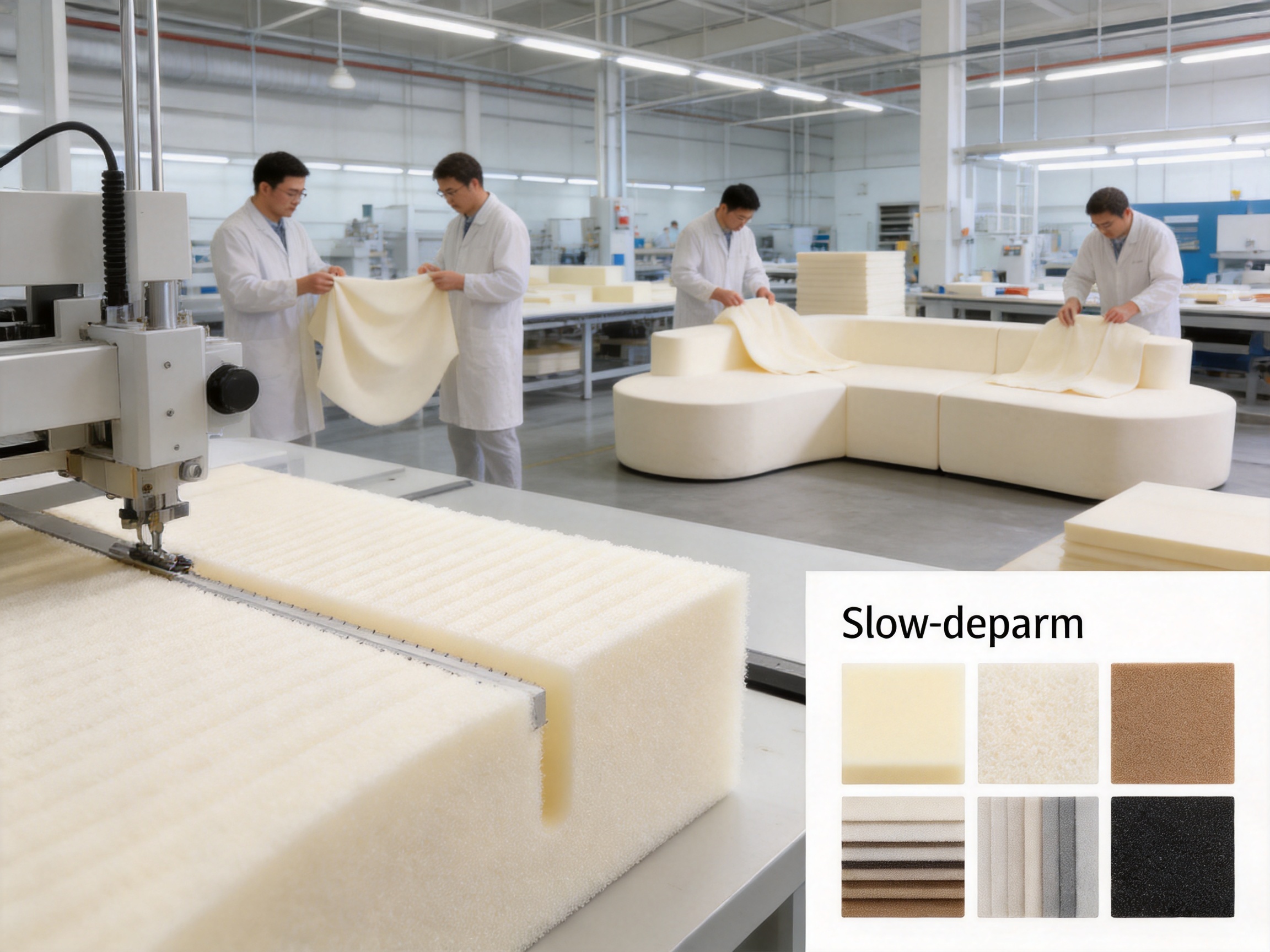
Modern homes increasingly require furniture that can perform more than one function. A sofa may need to provide daily seating, support quiet reading, accommodate guests, create a relaxing personal corner, and fit comfortably into a compact apartment. The Patchwork Double Sofa is designed around this changing lifestyle. It combines a soft contemporary appearance, high-density slow-rebound foam, breathable polyester upholstery, and a modular structure that allows users to adapt the arrangement to different rooms and occasions.
Rather than treating a sofa as a fixed piece of furniture, this design views seating as a flexible part of the living environment. Its smooth curves and creamy off-white color create a calm visual presence, while its modular construction supports straight, L-shaped, and U-shaped layouts. This makes it suitable for living rooms, bedrooms, balconies, studies, reading areas, and other spaces where adaptable furniture is valuable.
The sofa is manufactured by Jiangsu Wellcare Household Articles Co., LTD., a Chinese producer with long-term experience in foam research, sleep materials, and healthy home products. The company’s development work covers ordinary sponge, memory foam, gel foam, temperature-insensitive memory foam, quick-dry memory foam, flame-retardant sponge, antibacterial sponge, and other specialized materials. This technical background gives the product a foundation that extends beyond visual design. Its comfort, resilience, and functional positioning are connected to material research and controlled manufacturing processes.
Designed for the Changing Needs of Contemporary Homes
Traditional two-seater sofas often have a fixed shape and a limited purpose. They are placed against a wall or in front of a television and remain in that position for years. Although this arrangement can be practical, it may not suit homes where rooms serve several functions. A living room may become a workspace during the day, a reading area in the afternoon, and a social space in the evening. A bedroom may need a compact lounge area, while a balcony may be transformed into a small retreat.
The Patchwork Double Sofa responds to these needs through its modular structure. The separate or coordinated sections can be arranged according to available floor space and household activities. A straight configuration can support a conventional seating arrangement. An L-shaped layout can define a corner while leaving more open space in the center of a room. A U-shaped configuration can create a more enclosed conversation area or relaxation zone.
This flexibility is particularly useful for small apartments. Instead of requiring several large pieces of furniture, a modular sofa can help one seating system perform multiple roles. Users can adjust the placement when moving to a different home, changing the room layout, or preparing for guests. The result is a more efficient use of floor space without sacrificing comfort.
The two-seater category also makes the sofa approachable for homes that do not have the space or need for a full-size sectional. It can provide comfortable seating for one or two people while retaining the ability to participate in a larger modular composition. This combination of compact positioning and expandable arrangement is one of the product’s strongest practical advantages.
Comfort Based on High-Density Slow-Rebound Foam
The internal filling is made with high-density slow-rebound foam. This material is designed to respond gradually to pressure, allowing the seating surface to conform to the contours of the body. When a person sits down, the foam distributes pressure across a wider area rather than concentrating it at a few contact points. This can create a more balanced and supported feeling during extended periods of sitting.
Compared with ordinary low-density filling, high-density slow-rebound foam is better suited to furniture that must retain a stable shape through repeated use. It is designed to provide both softness and structural support. A sofa that is too firm may feel uncomfortable, while a sofa that is too soft may allow the body to sink excessively and make it difficult to maintain a relaxed posture. The slow-rebound construction aims to create a middle ground in which the user receives cushioning without losing support.
The foam’s gradual recovery also contributes to a smoother seating experience. As weight is removed, the material returns toward its original form rather than collapsing permanently after a short period. Its rebound behavior helps the sofa remain visually neat and functionally stable when used by different people throughout the day.
Back pressure is another consideration in sofa comfort. When the seat and back support do not distribute body weight effectively, users may experience discomfort during long periods of reading, conversation, or entertainment. The high-density foam structure is intended to relieve excessive pressure by following the body’s curves. This does not replace ergonomic assessment for every individual, but it provides a supportive foundation for ordinary home seating.
The foam material also gives the product a distinct advantage over sofas that rely mainly on loose fiber or basic sponge filling. Loose filling can feel soft at first but may require frequent adjustment. Low-density sponge may lose resilience more quickly under heavy daily use. By using a high-density slow-rebound material, the Patchwork Double Sofa is positioned as a more durable and supportive alternative for households seeking long-term comfort.
A Curved Form with a Calm Visual Character
The sofa’s design is defined by graceful curves rather than sharp, formal lines. Its rounded contours soften the appearance of the room and help create a more welcoming atmosphere. Curved furniture can also work well in spaces where users want to avoid a rigid, office-like appearance. The shape suggests relaxation and makes the sofa suitable for quiet personal areas as well as shared family rooms.
The creamy minimalist aesthetic is another important feature. Soft off-white upholstery gives the product a warm and neutral appearance that can blend with a wide range of interior styles. It can complement Nordic interiors with light wood and natural textures, Japanese-inspired rooms with restrained decoration, or modern minimalist spaces with clean architectural lines.
Neutral upholstery also supports long-term interior planning. A strong color may dominate a room and become difficult to coordinate when other furniture changes. Creamy off-white allows users to update rugs, cushions, tables, wall colors, and decorative accessories without replacing the main sofa. This makes the product suitable for residential projects, furnished apartments, hospitality spaces, and interior design schemes that prioritize adaptable palettes.
The rounded form does not depend on excessive ornamentation. Instead, the product relies on proportion, texture, and material quality. This restrained approach can help the sofa maintain a contemporary appearance over time. It also enables the piece to function as a visual anchor without making a small room appear crowded.
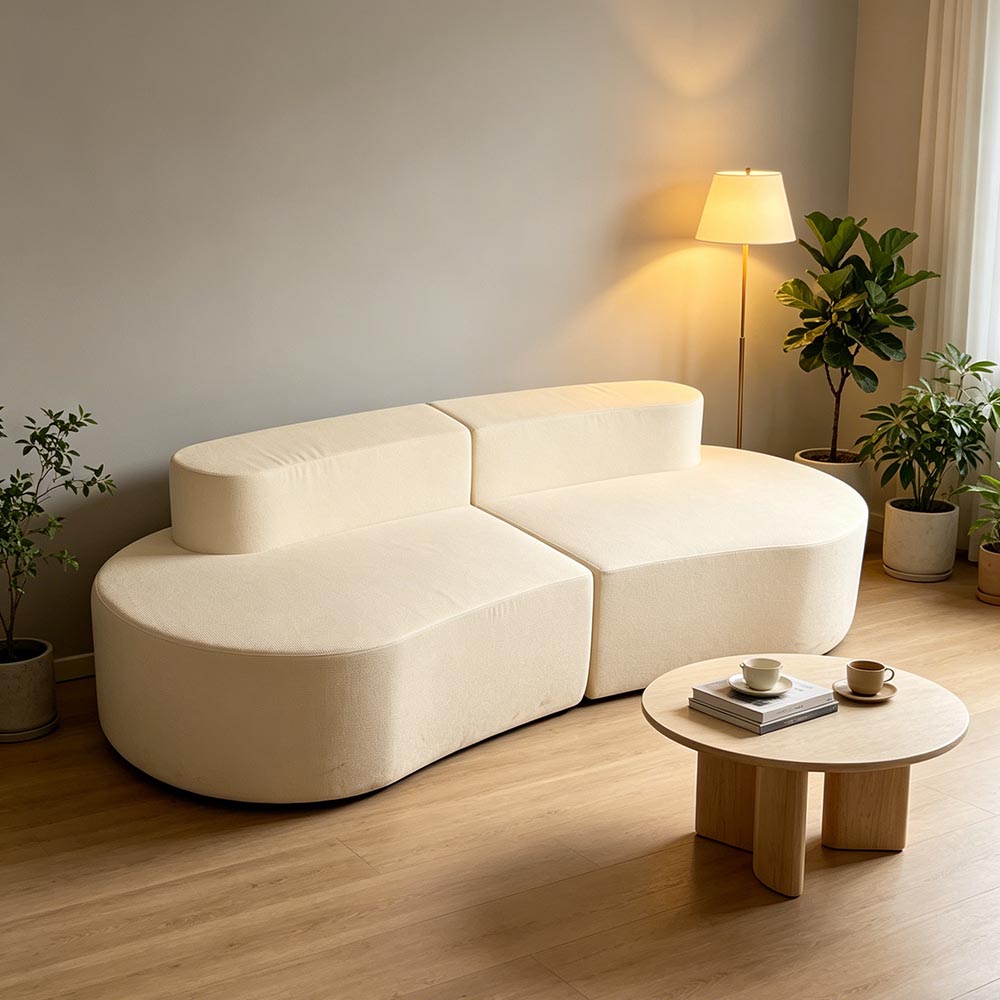
Patchwork double sofa
Breathable and Practical Polyester Upholstery
The outer fabric is composed of 100% polyester fiber. Polyester is widely used in upholstered furniture because it can offer a combination of softness, wear resistance, dimensional stability, and ease of care. In this design, the fabric is intended to feel smooth and skin-friendly while remaining practical for repeated household use.
The supplied fabric specifications include a width of 1.5 meters and a fabric weight of 260 grams per square meter. These details are relevant to furniture manufacturers and project buyers because fabric weight and width affect cutting plans, sewing operations, material consumption, and upholstery consistency. They also provide a clearer basis for evaluating the product than appearance alone.
Polyester fabric is less prone to wrinkling than many natural fibers and can help the sofa maintain a tidy appearance. Its wear-resistant characteristics are useful in homes where the sofa is used every day. Families may sit, recline, read, work, or rest on the furniture for many hours, so the upholstery must be able to withstand regular friction and movement.
The fabric is also described as breathable and delicate to the touch. Breathability contributes to a more pleasant seating experience by reducing the heavy or overly enclosed feeling that some upholstered surfaces can create. Comfort depends on the entire construction, including the foam, cover, room temperature, and user clothing, but the fabric is selected to support a more agreeable contact experience.
Daily maintenance is another area in which the product is designed to be practical. The smooth, wrinkle-resistant surface is easier to keep presentable than heavily textured or loose materials that trap dust and require frequent reshaping. Users should still follow appropriate care instructions for stains, spills, and cleaning agents, but the polyester cover offers a sensible foundation for regular upkeep.
Modular Configuration for Multiple Room Types
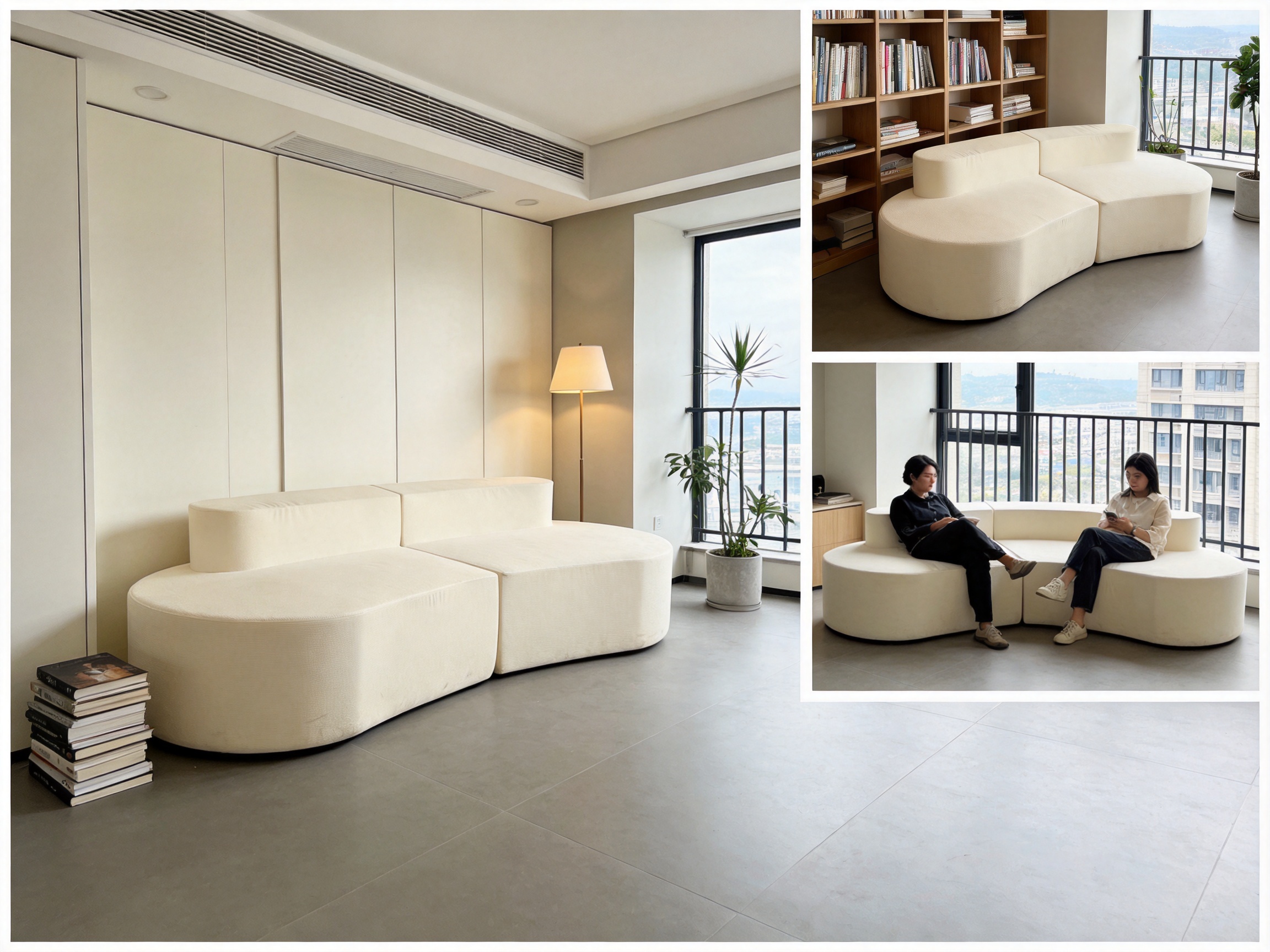
The sofa’s modular character allows it to serve different environments without requiring a completely different furniture product for each room. In a living room, it can be placed as a central seating area or positioned against a wall. In a bedroom, it can provide a comfortable lounge zone separate from the bed. On a balcony, it can support a small relaxation setting where users read or enjoy a view. In a study, it can create a softer alternative to a desk chair for breaks and informal reading.
The product can also function as a temporary sleeping or resting surface when circumstances require it. This may be useful when a guest needs a place to rest, when a family member wants to relax in another room, or when a user wishes to create a quiet recovery area. It should be understood as a multifunctional sofa rather than a replacement for a dedicated bed, but its broad surface and foam-based construction increase its usefulness beyond ordinary seating.
Flexible arrangement is particularly valuable during cleaning, moving, and home reorganization. Modular pieces can be repositioned to provide access to flooring and surrounding walls. They may also be arranged differently after a renovation or when a household’s needs change. This adaptability can extend the practical life of the furniture because the sofa does not depend on a single permanent floor plan.
For commercial buyers, modularity can simplify interior planning. A hospitality operator, serviced apartment provider, or furnishing contractor may use similar sofa components across rooms with different dimensions. Instead of ordering entirely different shapes for every project, buyers can work with a coordinated modular system. This may assist purchasing, storage, installation, and replacement planning.
Key Product Specifications
| Parameter Item | Specification |
| Product Title | Patchwork Double Sofa |
| Product Category | Two-Seater Sofa |
| Overall Dimensions | 240 × 95 × 62 cm |
| Primary Filling | High-density slow-rebound foam |
| Fabric Composition | 100% polyester fiber |
| Fabric Width | 1.5 m |
| Fabric Weight | 260 g/m² |
| Configuration Options | Straight, L-shaped, and U-shaped arrangements |
| Application Areas | Living rooms, bedrooms, balconies, studies, reading areas, and relaxation zones |
The listed dimensions of 240 × 95 × 62 centimeters provide a useful reference for planning. The length gives two users generous seating space, while the depth supports a relaxed posture. The overall height is visually moderate, which can help preserve a sense of openness in a smaller room. Buyers should confirm the final configuration, packaging dimensions, access routes, and installation requirements before placing a project order, especially when the product will be delivered to apartments or upper-floor spaces.
Advantages Compared with Conventional Sofa Designs
The first advantage is adaptability. A fixed sofa can serve only the arrangement for which it was designed. The modular structure of the Patchwork Double Sofa allows users to adjust the layout to the room rather than forcing the room to conform to the furniture. This is an important distinction for modern homes, where rooms often change function over the course of the day.
The second advantage is the balance between softness and support. Some competitors in the entry-level furniture market rely on basic foam or loose filling that may feel comfortable in a showroom but become less supportive after repeated use. The high-density slow-rebound foam used here is intended to maintain a more stable support profile and respond to body pressure more gradually.
The third advantage is the combination of minimal styling and broad compatibility. Highly decorative sofas may suit a specific interior theme but become difficult to integrate into different projects. The creamy off-white color and curved silhouette are more versatile. They can be used in Nordic, Japanese, contemporary, and understated luxury environments without requiring extensive coordination.
The fourth advantage is functional range. The sofa can provide seating, a reading corner, a relaxation area, a temporary resting surface, and a flexible room divider or conversation zone depending on how it is positioned. This multi-purpose value can be especially important in smaller homes, rental properties, guest rooms, and furnished residential developments.
The fifth advantage is the material knowledge behind the product. The manufacturer is not limited to furniture assembly. Its business is built around research and production involving multiple categories of foam and sleep materials. That background supports a more technical approach to cushioning, rebound behavior, comfort, and material performance than a supplier focused solely on external appearance.
Material Research as the Foundation of Product Quality
Jiangsu Wellcare Household Articles Co., LTD. has developed an extensive portfolio of foam materials. Its research and manufacturing capabilities include ordinary sponge, memory foam, gel foam, temperature-insensitive memory foam, quick-dry memory foam, flame-retardant sponge, antibacterial sponge, and related formulations. Each material category addresses different performance requirements, such as pressure response, temperature behavior, moisture management, safety, hygiene, or durability.
This breadth of experience matters because a sofa is a layered product. The visible cover represents only one part of the final performance. The foam formulation, density, rebound characteristics, cutting precision, internal assembly, and upholstery tension all influence how the furniture feels and how it retains its shape.
A manufacturer with experience across several foam technologies can compare material behaviors and select a filling approach that matches the intended use. For a sofa, the priorities may include balanced support, resilience, comfort over long sitting periods, and stability under repeated loading. For mattresses or pillows, pressure distribution and sleep posture may receive greater attention. The company’s broader material knowledge can therefore contribute to more informed product development across categories.
The company reports that its doctor-led research and development team develops more than one hundred new foam materials each year. This indicates an active development culture rather than reliance on a single established recipe. New formulations may be assessed for different combinations of density, elasticity, resilience, breathability, safety, and application suitability. While individual product results depend on the selected specification and production controls, continuous research provides a stronger basis for improvement and customization.
Manufacturing Experience and Production Development
The company’s development history extends back to 1993, when it began as a school-run scientific research enterprise. In 2003, it purchased a 12,000-square-meter factory building and jointly developed a new sponge material with Huai’an Institute of Technology. This cooperation between industrial production and academic research established a foundation for material innovation.
In 2008, the company purchased 50,000 square meters of land, supporting further expansion of its manufacturing and development operations. By 2010, its products were supplied to cross-border supermarkets in the United States, Germany, and Japan. It also cooperated with Qingdao University of Science and Technology. These milestones indicate experience in serving demanding international channels and working with external technical partners.
The company later expanded exports to the United Kingdom, Canada, Australia, and Kuwait. International distribution requires attention to product consistency, packaging, documentation, communication, and delivery coordination. It also exposes a manufacturer to different market expectations regarding comfort, safety, design, and application. This experience can be valuable when developing furniture products for overseas buyers.
In 2018, the company became an Alibaba-certified Gold Supplier and entered e-commerce. In 2020, it became a designated supplier for five-star hotels. These developments demonstrate a progression from material manufacturing toward broader product and supply-chain capabilities. Hotel supply in particular can require consistent quality, repeat ordering, schedule reliability, and products that maintain an appropriate appearance under frequent use.
Manufacturing Processes Supporting the Sofa
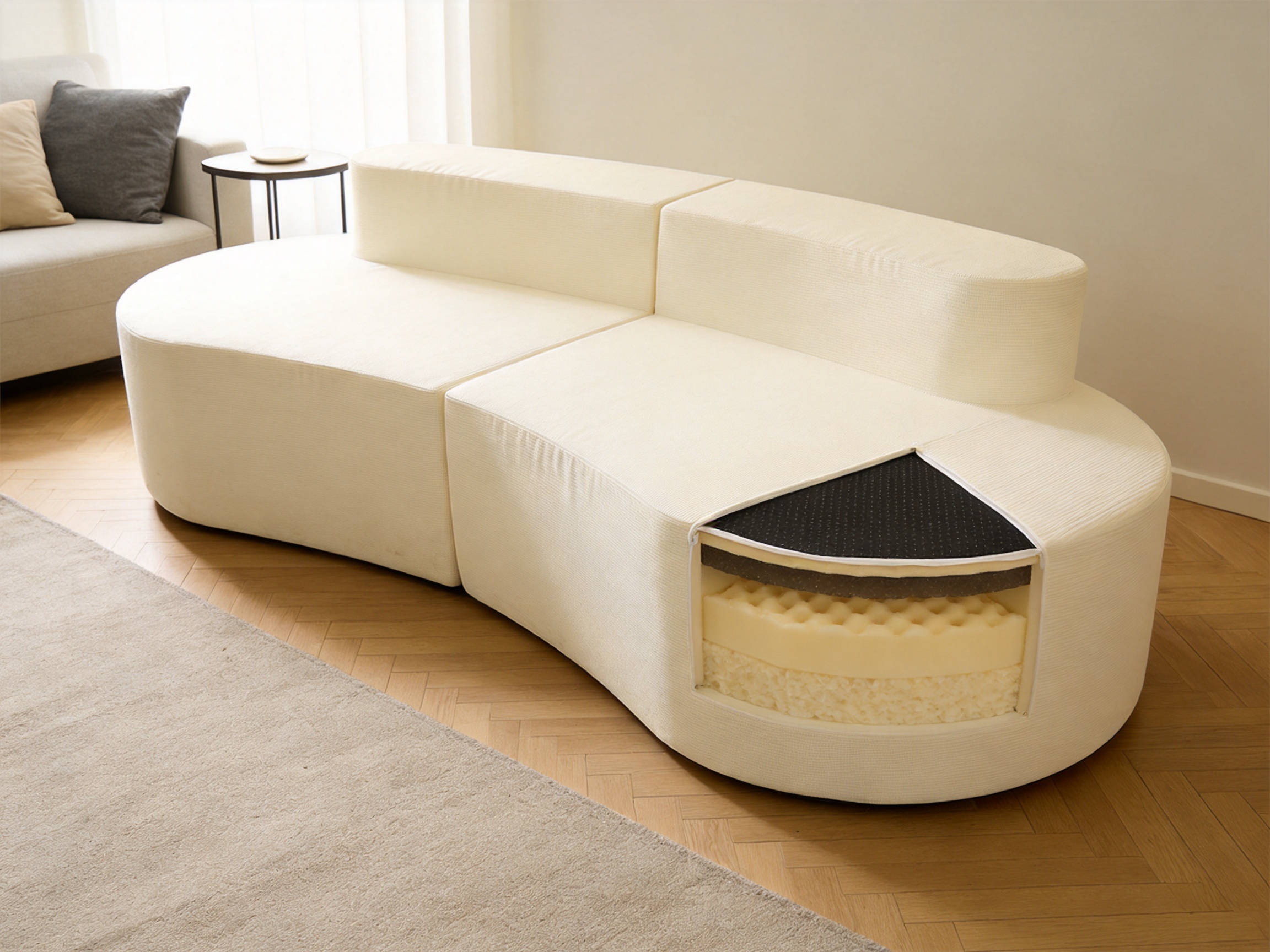
The production of a foam-filled modular sofa generally involves multiple controlled stages. Material selection comes first. The manufacturer must identify a foam formulation with suitable density, rebound, softness, and support for the intended seating experience. Because different users perceive comfort differently, the material must be evaluated as part of the complete product rather than in isolation.
Foam preparation and shaping are then carried out according to the design dimensions. Accurate cutting is important because uneven sections can affect the finished appearance, seating balance, and alignment between modules. For a sofa with curved contours, precision is especially important. The foam must follow the intended profile without creating visible irregularities beneath the fabric.
After shaping, the foam components are assembled into the required structural arrangement. A modular product may require consistent sizing across units so that straight, L-shaped, and U-shaped layouts remain visually coherent. Alignment between adjacent sections affects both appearance and user comfort. Manufacturing control is therefore relevant not only to individual modules but also to how those modules work together.
The upholstery stage involves cutting the 100% polyester fabric, matching panels, sewing seams, and fitting the cover over the foam. The specified 1.5-meter fabric width and 260-gram-per-square-meter fabric weight are useful production parameters. They help planners calculate fabric consumption and establish a repeatable cutting method. Correct tension during upholstery is needed to preserve the smooth curved appearance without making the cover excessively tight or loose.
Quality inspection should address dimensions, fabric condition, seam quality, foam consistency, surface appearance, and module compatibility. Packaging must protect the curved structure and upholstery during handling and transportation. For export orders, packing design is especially important because products may pass through several stages of loading, storage, and delivery before reaching the final destination.
Although the supplied product information does not specify every individual production machine or inspection standard, the company’s long-term foam specialization and research infrastructure provide a strong manufacturing context. Buyers seeking private-label or customized production can discuss detailed requirements such as foam density, cover construction, color, modular dimensions, packaging, and inspection procedures during the order process.
Customization Potential for Commercial and Private-Label Buyers
The sofa’s design offers a practical starting point for customization. Buyers may wish to adapt dimensions to a particular room, project, container plan, or retail channel. Modular products are often well suited to this process because changes can be made to individual sections or proportions rather than redesigning a single monolithic frame.
Fabric selection is another possible area of customization. The current specification uses 100% polyester in a creamy off-white tone, but commercial buyers may require alternative shades for different markets or interior projects. Neutral, gray, beige, muted green, and other coordinated colors can be considered according to the buyer’s product strategy and available materials.
Comfort preferences may also vary between regions and customer groups. Some markets favor a firmer seat, while others prefer a softer and deeper lounge experience. Foam density, firmness, thickness, and layered construction can be discussed with the manufacturer to achieve an appropriate balance. Any change should be tested as a complete seating system because a modification to one layer can affect the entire feel of the sofa.
Branding and packaging may be important for retailers, hospitality groups, and furnishing distributors. Buyers can inquire about labels, cartons, protective materials, assembly instructions, product inserts, and palletization. Consistent packaging can help reduce damage risk and create a more professional presentation at the point of delivery.
Customization should be developed through clear technical communication. Drawings, samples, tolerance requirements, color references, inspection standards, and approved pre-production samples can reduce misunderstandings. A supplier with foam research and export experience can support this process by discussing material and construction alternatives rather than treating customization as a purely cosmetic change.
Sustainability and Environmental Responsibility
Furniture manufacturing has environmental responsibilities that include material selection, energy consumption, production waste, packaging, product longevity, and end-of-life considerations. The manufacturer reports investment in advanced eco-friendly energy systems and improved environmental management practices. Its stated goal is to move beyond basic compliance and create lasting environmental value by integrating respect for nature into business operations.
Product durability is one part of a more responsible furniture strategy. A sofa that retains its comfort and appearance for a longer period may reduce the need for early replacement. The high-density foam, wear-resistant polyester upholstery, and modular structure are relevant in this context. If a layout can be changed or the product can continue serving a new room after relocation, its useful life may be extended.
Modularity may also support more efficient logistics and replacement planning. Depending on the construction, individual sections can be handled more easily than one large fixed sofa. If a specific component requires replacement or if a room layout changes, the entire furniture system may not need to be discarded. Buyers should confirm the availability of replacement modules and service components when evaluating a long-term project.
Environmental performance should always be assessed through verifiable documentation appropriate to the target market. Buyers may request information regarding material compliance, production controls, packaging, testing, and relevant certifications. The manufacturer’s environmental direction provides a positive basis for discussion, while project-specific documentation remains important for responsible procurement.
Applications in Residential Interiors
In a family living room, the sofa can become the central place for conversation, reading, streaming, and informal relaxation. Its two-seater scale gives it a more intimate character than a large sectional, while its modular format allows additional sections or different arrangements when needed. The creamy color can help maintain a bright and calm room atmosphere.
In a small apartment, the sofa can support several functions without overwhelming the available area. A straight layout may preserve a clear walkway, while an L-shaped arrangement can make productive use of a corner. When guests arrive, the modules can be repositioned to create a more social setting. This flexibility is especially valuable when one room must combine living, working, and dining functions.
In a bedroom, the sofa can create a separate area for reading or resting. Its soft contours contrast with the more formal shape of a bed and can make the room feel more complete. In a balcony or enclosed terrace, it can provide a comfortable place to sit while enjoying daylight, plants, or outdoor views. Users should ensure that the environment is protected from moisture and that the upholstery is used in conditions appropriate for indoor furniture.
In a study, the sofa can provide an alternative posture for reading and creative work. Changing position during the day may make the room more comfortable and reduce the monotony of remaining at a desk. The sofa can also act as a quiet retreat for short breaks without requiring a separate lounge chair.
Applications in Hospitality and Furnished Projects
Hotels, serviced apartments, co-living developments, and model residences often require furniture that looks refined while remaining practical. The sofa’s neutral appearance can fit a variety of room concepts, from minimalist guest rooms to warm apartment-style suites. Its modular layout can help designers create consistent visual language across rooms with different sizes.
Hospitality buyers may value the combination of appearance, comfort, and maintainability. A high-use environment places greater demands on upholstery and internal support than an occasional-use room. Polyester fabric with wear-resistant characteristics and high-density foam can provide a suitable starting point for evaluation. Buyers should still conduct their own durability testing and confirm cleaning procedures for the expected usage level.
The sofa may also be suitable for reception lounges, private waiting areas, reading corners, and employee relaxation spaces. Its curved shape can make a public environment feel less formal, while modular placement can define zones without installing permanent partitions. For hospitality projects, the ability to order coordinated units and replacement components can simplify future refurbishment.
Why the Manufacturer’s Background Matters
A furniture product is influenced by the capabilities of the company that develops and produces it. Jiangsu Wellcare Household Articles Co., LTD. has focused on high-performance sleep materials and healthy home products since its development as a research-oriented enterprise. This specialization connects the sofa to a wider technical ecosystem involving foams, comfort materials, and home-use applications.
The company’s doctor-led research team and yearly development of more than one hundred new foam materials suggest an emphasis on formulation and performance testing. Its experience with gel foam, memory foam, temperature-insensitive foam, quick-dry foam, flame-retardant sponge, and antibacterial sponge demonstrates familiarity with different functional requirements. Not every technology is necessarily used in this sofa, but the knowledge base can support product refinement and future variations.
Its history of cooperation with Huai’an Institute of Technology and Qingdao University of Science and Technology also reflects an interest in combining academic research with manufacturing practice. Such cooperation can support new material development, process improvement, and technical evaluation. For buyers seeking a long-term supply relationship, this research orientation may be as important as the current product specification.
The company’s export experience further supports its international positioning. Supplying markets in North America, Europe, Asia, Australia, and the Middle East requires familiarity with different purchasing procedures and customer expectations. Its designation as a supplier for five-star hotels indicates experience with professional procurement environments where consistency and service are essential considerations.
Care and Use Recommendations
To maintain the sofa’s appearance, users should place it on a stable, level surface and avoid dragging it across rough flooring. When repositioning modular sections, lifting is generally preferable to pulling. This helps protect both the upholstery and the floor while reducing stress on internal connections or structural components.
Routine cleaning should begin with gentle dust removal using a suitable vacuum attachment or soft brush. Spills should be addressed promptly according to the fabric care instructions. Strong bleach, abrasive cleaners, excessive moisture, and untested solvents may damage the polyester surface or affect its color. A small hidden-area test is advisable before applying any cleaning solution.
Direct and prolonged exposure to intense sunlight may gradually affect upholstery color. Positioning the sofa away from harsh sunlight or using suitable curtains can help preserve its appearance. The product should also be kept in a dry indoor environment and protected from prolonged moisture, since foam and upholstery materials perform best under appropriate indoor conditions.
Because the sofa is modular, users should periodically check the alignment of sections and adjust them if necessary. Even distribution of use can help reduce uneven wear. Rotating the preferred seating position when practical may also help the surface age more evenly.
Buyer Evaluation Checklist
Before purchasing, buyers should confirm the exact configuration included in the quotation. The product is described as a modular two-seater sofa, but the final number of sections, connection method, and arrangement may vary according to the order. Clear drawings and dimensional confirmation are recommended.
Buyers should also request information about foam density, firmness, compression behavior, cover construction, seam details, and packaging. These details help compare products more accurately than retail photographs alone. If the sofa is intended for commercial use, sample testing under realistic loading and cleaning conditions is advisable.
Room access should be considered before delivery. Doorways, elevators, staircases, corridors, and turning areas may limit the movement of large upholstered items. Although modular sections can make handling easier, the overall dimensions and packaging must still be checked against the delivery site.
For export and private-label orders, buyers should establish the required trade terms, production schedule, minimum order quantity, inspection method, carton markings, and documentation. The manufacturer’s experience with international markets can support the process, but every project should be governed by written specifications and approved samples.
Finally, buyers should compare long-term value rather than only the initial purchase price. Foam quality, fabric performance, repair options, modular flexibility, appearance retention, and supplier responsiveness all affect the total ownership experience. A product that serves several functions and remains adaptable may provide greater value than a cheaper fixed sofa with limited future use.
Questions and Answers
What type of product is the Patchwork Double Sofa?
It is a modular two-seater sofa filled with high-density slow-rebound foam. It is designed for seating, relaxation, reading, temporary resting, and flexible room arrangements.
What configurations can the sofa create?
The modular structure supports straight, L-shaped, and U-shaped configurations. The appropriate arrangement depends on the number of modules purchased, room dimensions, and the user’s preferred layout.
What are the listed dimensions?
The supplied overall dimensions are 240 × 95 × 62 centimeters. Buyers should confirm the final configuration and packed dimensions before ordering.
What material is used for the upholstery?
The fabric is made from 100% polyester fiber. The listed fabric width is 1.5 meters, and the listed fabric weight is 260 grams per square meter.
Why is high-density slow-rebound foam used?
It is intended to combine cushioning with stable support. The foam gradually responds to body pressure, follows the body’s contours, helps distribute pressure, and returns toward its original shape after use.
Is the sofa suitable for small apartments?
Yes. Its modular arrangement allows users to select a layout that works with limited floor space. A straight arrangement may preserve open circulation, while an L-shaped layout can use a corner efficiently.
Can the sofa be used as a bed?
It can serve as a temporary resting or sleeping surface, but it is primarily designed as a sofa. Users who need nightly sleeping support should choose a dedicated bed or mattress designed for that purpose.
Which interior styles can it match?
The creamy off-white color and curved silhouette can complement Nordic, Japanese, contemporary, and modern minimalist interiors. Its neutral appearance also makes it suitable for many furnished residential and hospitality projects.
What makes the manufacturer technically qualified?
The manufacturer has long-term experience in foam research and healthy home products. Its material portfolio includes memory foam, gel foam, temperature-insensitive foam, quick-dry foam, flame-retardant sponge, antibacterial sponge, and other foam solutions.
Does the manufacturer support customized orders?
The company’s material research, manufacturing history, and international supply experience provide a basis for discussing customized dimensions, upholstery, foam performance, packaging, and private-label requirements. Exact customization options should be confirmed for each project.
How should buyers compare this sofa with competing products?
Buyers should compare foam density and support, upholstery specifications, modular flexibility, dimensions, durability expectations, customization capability, quality controls, packaging, and supplier experience rather than evaluating appearance or price alone.
Is the sofa intended for commercial use?
Its neutral design and modular format may suit serviced apartments, hotel lounges, furnished residences, offices, and other commercial areas. Commercial buyers should conduct application-specific durability, cleaning, and safety evaluations before large-scale deployment.
Conclusion
The Patchwork Double Sofa combines adaptable structure, high-density slow-rebound foam, breathable polyester upholstery, and a calm modern appearance. Its straight, L-shaped, and U-shaped configurations allow it to respond to changing room layouts, while its two-seater scale makes it practical for apartments, bedrooms, studies, balconies, and hospitality interiors.
Its main advantage over conventional fixed sofas is the ability to support several uses without requiring several separate furniture pieces. The foam construction is intended to provide a balanced combination of comfort and support, and the polyester cover offers a smooth, wear-resistant, and practical surface for everyday use. The curved creamy design further improves its versatility by fitting a broad range of interior styles.
Behind the product is a manufacturer with a long history of foam research, material development, international supply, and home-product manufacturing. Its research team, broad material portfolio, academic cooperation, export experience, and environmental initiatives provide a strong foundation for product development and customized production.
For residential users, the sofa offers a comfortable and flexible centerpiece for modern living. For commercial buyers, it provides a design platform that can be adapted to different rooms and project requirements. When evaluated together with the manufacturer’s technical strengths and production experience, the Patchwork Double Sofa represents a practical approach to contemporary upholstered furniture.
References
1. Product specification sheet for the Patchwork Double Sofa, including dimensions, fabric composition, fabric width, and fabric weight.
2. Manufacturer-provided information on high-density slow-rebound foam and multifunctional sofa applications.
3. Manufacturer-provided company history covering research development, factory expansion, academic cooperation, export markets, and hospitality supply.
4. Manufacturer-provided overview of foam material categories, including memory foam, gel foam, temperature-insensitive foam, quick-dry foam, flame-retardant sponge, and antibacterial sponge.
5. Manufacturer-provided environmental responsibility statement concerning eco-friendly energy systems and environmental management practices.
6. General upholstery and furniture-material principles concerning polyester fabrics, foam resilience, modular construction, and product-care practices.
Product: Patchwork double sofa

PREV:Fluorescent Multifunctional Children’s Sofa: Safe, Foldable Comfort for Play, Reading, and Sleep
NEXT:U-Shaped Removable Memory Foam Neck Pillow for Comfortable Travel and Everyday Support
NEXT:U-Shaped Removable Memory Foam Neck Pillow for Comfortable Travel and Everyday Support
Interested in cooperation or have questions?
Related News
WELLCARE was founded in 2003, boasting over a decade of profound and extensive experience.
Quick Links
Product
Media Centre
Contact Information
- [email protected]
- +86-517-84998062
- +86-15152354988
- No. 168 Nenjiang Road, Huaiyin District, Huai'an City, Jiangsu Province, China
Copyright © Jiangsu Wellcare Household Articles Co., LTD. All Rights Reserved.
Custom Memory Gel Mattress Manufacturers
