

 English
 日本語
 Español



Deng Caiwei — International Sales Manager

Home / Author / Deng Caiwei — International Sales Manager / Fluorescent Multifunctional Children’s Sofa: Safe, Foldable Comfort for Play, Reading, and Sleep
Product Category
NEW Category
Contact us
Fluorescent Multifunctional Children’s Sofa: Safe, Foldable Comfort for Play, Reading, and Sleep
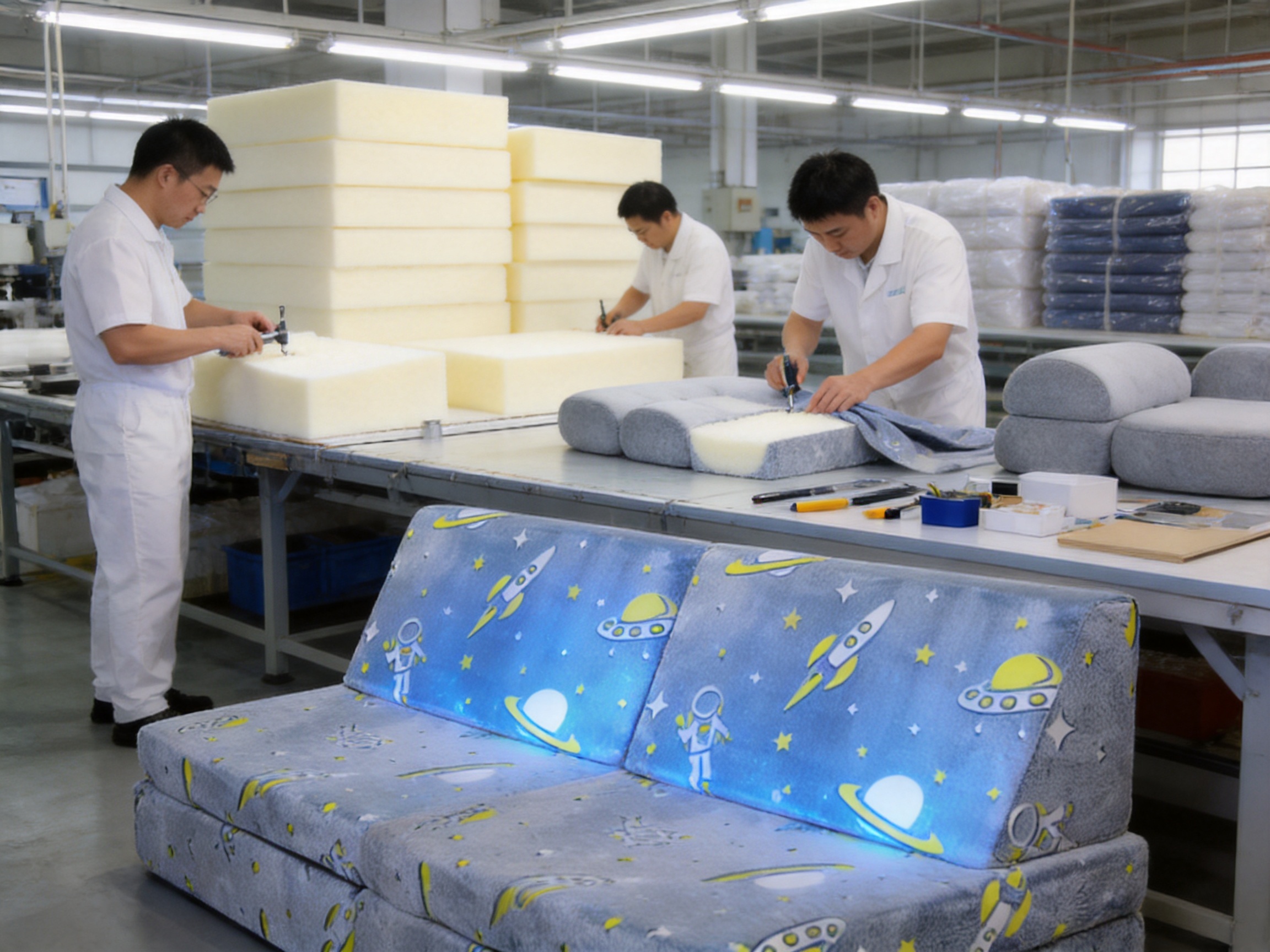
Children’s furniture must do more than look attractive. It should support changing activities, fit comfortably into limited spaces, withstand regular use, and provide parents with confidence about safety and material quality. The Fluorescent Multifunctional Children’s Sofa is designed around these practical needs. Combining a high-density memory foam core, a fully boneless structure, rounded edges, a foldable design, and a space-themed fluorescent cover, it functions as a sofa, resting bed, reading seat, play mat, and imaginative activity area in one compact product.
Unlike conventional children’s seating that depends on rigid wood or metal frames, this foldable memory foam sofa uses a soft yet supportive polyurethane foam construction. Its frameless design minimizes hard impact points, while its 360-degree rounded form helps reduce the risk of bumps during energetic play. The result is a flexible children’s product intended for bedrooms, playrooms, kindergartens, daycare environments, family activity spaces, and other areas where comfort and safety must work together.
The product is also designed to create an engaging environment. During the day, its gray-blue space-themed fabric adds a fresh and playful visual accent. Rockets, planets, and moon patterns encourage children to imagine journeys beyond the home. In darker surroundings, the fluorescent details glow subtly, creating a dreamy atmosphere that can make bedtime, quiet reading, or relaxation more appealing.
A Children’s Sofa Designed for Multiple Daily Activities
Many children’s seating products are made for only one purpose. A small chair may be suitable for sitting but not lying down. A play mat may provide floor comfort but occupy too much storage space. A compact bed may support rest but offer little value during playtime. The multifunctional design of this product addresses these limitations by allowing one piece of furniture to adapt to several routines.
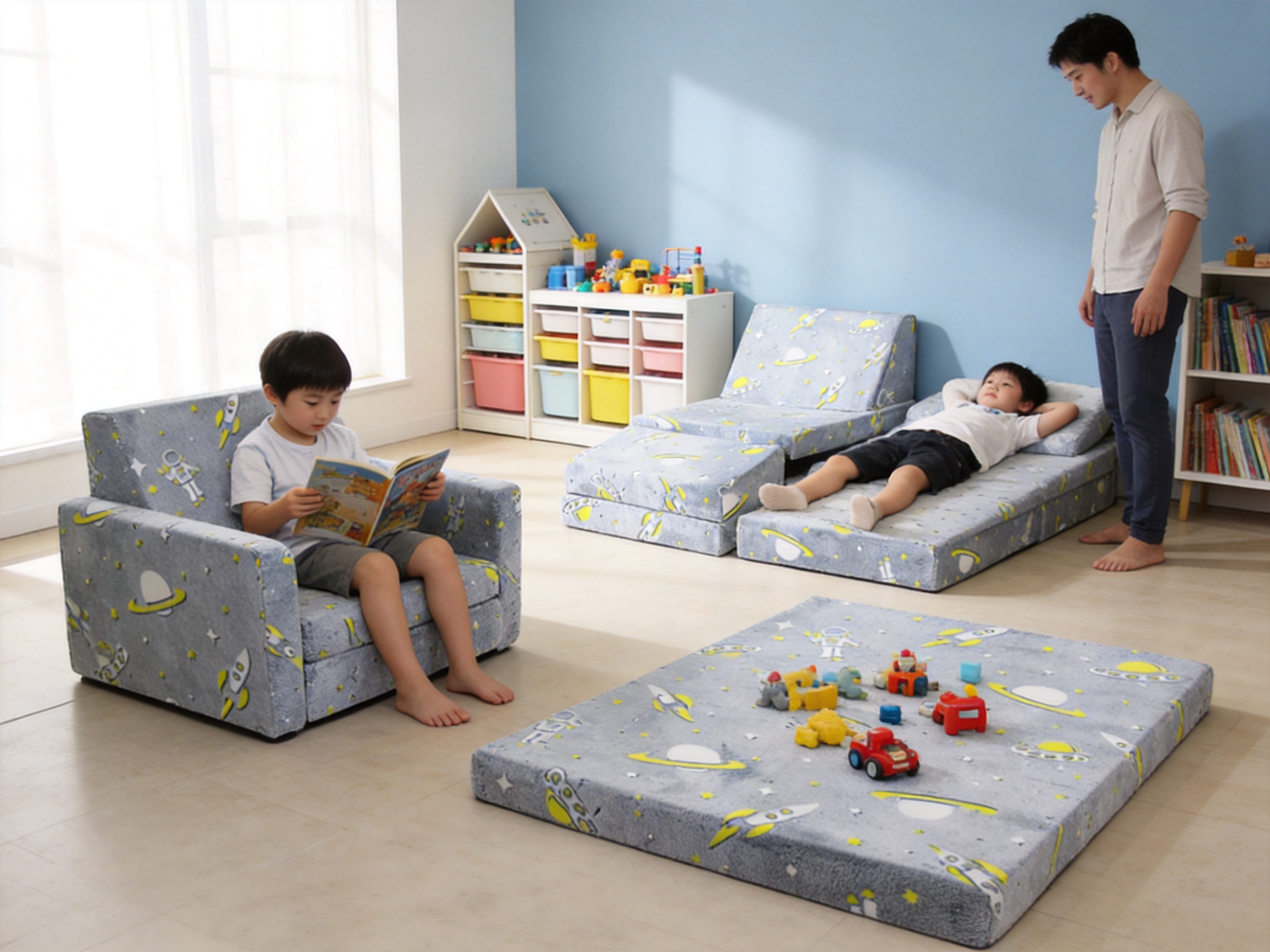
With a simple pull and fold, the product can change from a compact sofa configuration into a more extended resting surface. Children can sit upright while reading, watching educational content, drawing, or talking with family members. When the back or seating section is unfolded, the surface can be used for naps, quiet time, or supervised relaxation. It can also become a soft area for toys and floor-based activities.
This flexible use is particularly valuable in modern homes where rooms often serve several purposes. A child’s bedroom may also be a study space, playroom, and guest area. In a kindergarten or daycare setting, the same product may support story time, individual rest, imaginative play, or temporary seating. Instead of requiring separate furniture for every activity, one foldable unit helps make better use of available floor space.
The product’s dimensions are approximately 142 by 63.5 by 48.3 centimeters. This size provides a substantial surface for children while remaining compact enough for many indoor spaces. Because the sofa is lightweight and foldable, caregivers can move it when cleaning, rearranging a room, or preparing a shared activity area.
From Sofa to Bed and Play Mat
The product’s multifunctional structure is more than a marketing feature. It is a practical response to the way children use their surroundings. Young children rarely remain in one posture for long periods. They sit, kneel, lie down, lean, stretch, and move between activities. A rigid chair cannot easily accommodate this range of behavior, whereas a soft folding sofa allows children to change position more naturally.
In sofa mode, the product offers a defined seating area with supportive foam beneath the body. In a folded or extended arrangement, it can provide a larger surface for resting. When placed on the floor, it can also serve as a cushioned play mat or reading corner. Parents may place it beside a bookshelf, near a toy storage area, or in a quiet corner of a bedroom.
The flexible configuration also supports changing needs as children grow. A younger child may use it mainly for floor play and naps. An older child may prefer it as a reading lounge, gaming seat, or personal relaxation area. This longer period of usefulness can make the product more economical than furniture designed for only one age-specific activity.
High-Density Memory Foam for Soft but Stable Support
The core of the product uses high-density memory foam, with polyurethane listed as the primary filling ingredient at 100 percent. Memory foam is valued for its ability to respond gradually to body pressure. Rather than immediately collapsing under weight, it distributes pressure across a broader area and conforms to the body’s contours.
For children, this slow-rebound behavior can create a balanced sensation. The surface feels soft when a child sits or lies down, while the dense internal structure helps prevent the product from feeling unstable. It is intended to provide pressure-relieving comfort without the excessive sink associated with very soft, low-density foam.
The foam’s slow rebound also supports easy movement. When a child stands up, the material gradually returns toward its original form. According to the supplied product information, the sofa is designed to rebound quickly after use and resist sagging during prolonged sitting. This is especially important for children’s furniture because the product may be used repeatedly throughout the day by different children or for different activities.
Shape Retention and Long-Term Usability
Low-quality foam furniture may lose its structure after repeated compression. The seat can become uneven, the edges may flatten, and the product may no longer fold as intended. High-density foam is selected to improve resistance to these problems. Although all soft furnishings require appropriate use and care, a denser foam core can help the sofa maintain its intended form through regular sitting, reclining, and folding.
Shape retention also influences appearance. A sofa that quickly develops deep depressions may look worn even when the cover remains clean. By supporting more consistent recovery, the memory foam core helps the product preserve a neat profile in a child’s room, educational facility, or retail display.
The foam construction is also useful from a design perspective. Without the need for an internal rigid frame, manufacturers can shape the sofa into curved, child-friendly forms. This creates a softer visual appearance and allows the edges to be rounded throughout the product rather than adding hard structural corners beneath a thin cushion.
Fully Boneless Construction for a More Child-Friendly Form
One of the product’s main distinguishing characteristics is its fully boneless construction. The design does not rely on a metal or wooden frame inside the sofa. This reduces the presence of hard components that could become uncomfortable or create impact risks during active use.
Children often interact with furniture dynamically. They may climb onto a seat, lean against its sides, roll across the surface, or use it as part of an imaginative game. A rigid framed sofa can expose children to hard edges if they fall or collide with it. A boneless foam structure provides a more forgiving surface for ordinary indoor activities, particularly when adults supervise use appropriately.
The absence of a metal or wood frame also helps maintain the product’s lightweight and portable character. The sofa can be repositioned without the difficulty associated with heavy framed furniture. This is beneficial for parents who regularly reorganize children’s rooms and for institutions that need to prepare rooms for different daily activities.
360-Degree Rounded Edges
The sofa is formed with rounded edges on all sides rather than sharp corners. This 360-degree rounded structure is intended to reduce the possibility of painful contact points. It also contributes to the product’s soft, friendly appearance, making it visually appropriate for children’s environments.
Rounded edges cannot eliminate every risk associated with children’s play, so appropriate supervision and use remain important. However, removing sharp corners is a meaningful design advantage compared with conventional furniture that uses square wooden frames, exposed joints, or angular armrests. The rounded form is particularly useful in rooms where children move frequently between furniture and floor areas.
In addition to safety considerations, curved edges make the product easier to integrate into small rooms. The sofa has a less visually rigid profile and can be positioned beside walls, shelves, soft storage units, or other children’s furniture without creating a harsh geometric appearance.
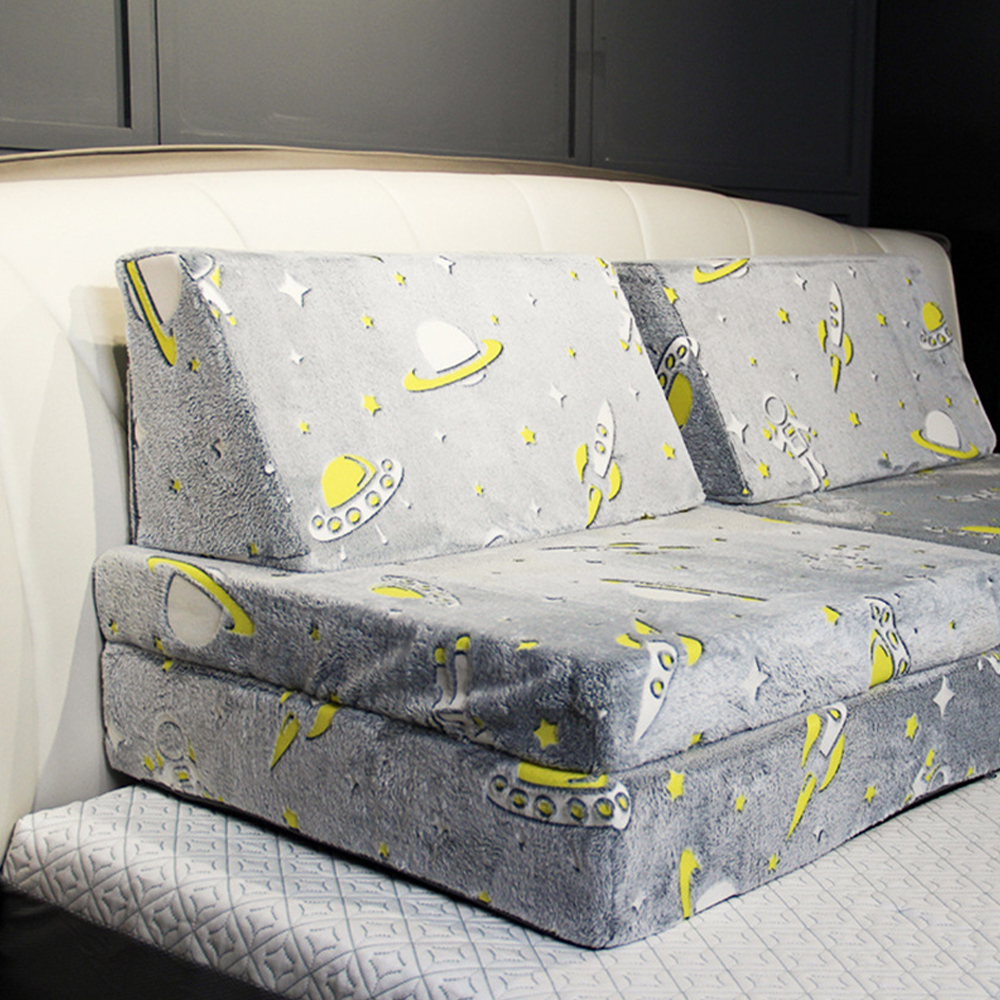
Fluorescent Multifunctional Children's Sofa
Fluorescent Space-Themed Design That Supports Imagination
Children’s furniture plays an important role in shaping the atmosphere of a room. The visual design of this sofa uses a gray-blue base and space-themed fluorescent patterns featuring rockets, planets, and the moon. The combination is intended to look fresh and playful in daylight while becoming more atmospheric in darker conditions.
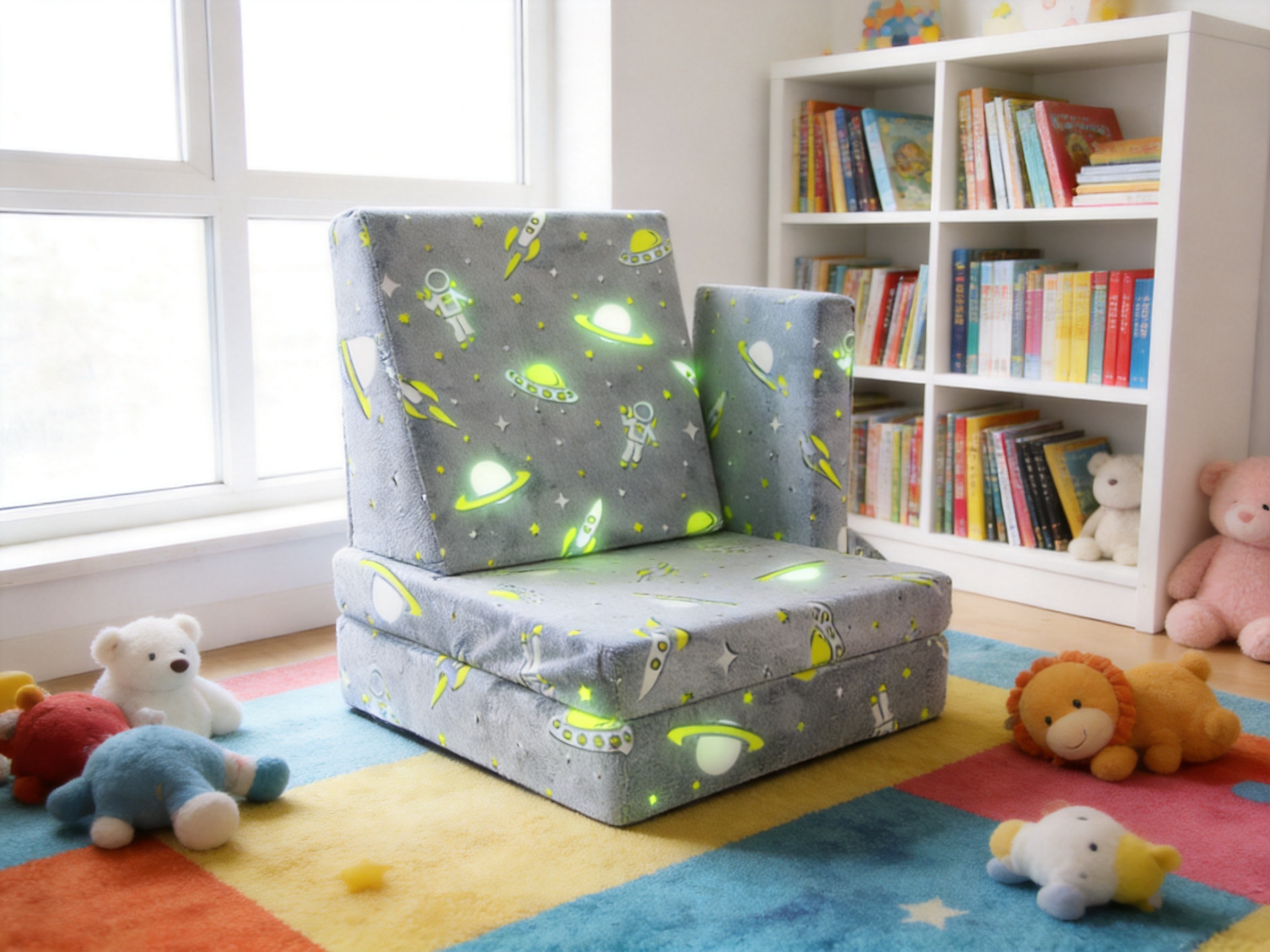
The subtle glow can create a calming night-time impression. Instead of relying on loud colors or complicated electronic features, the product uses printed fluorescent elements to bring visual interest to the room. This may make the sofa appealing as a bedtime reading seat or a quiet retreat for children who enjoy stories about space and exploration.
Space imagery also has an educational and imaginative quality. Rockets can suggest travel and discovery. Planets and moons can lead to questions about science, geography, and the wider universe. Parents and educators may use the design as a starting point for storytelling, drawing, reading, or simple discussions about astronomy.
Daytime Appeal and Nighttime Atmosphere
During daylight hours, the gray-blue color scheme gives the sofa a clean and modern appearance. It can coordinate with many children’s room themes without appearing overly bright or visually overwhelming. The printed patterns add personality while retaining a relatively calm base color.
At night, the fluorescent details provide a different visual experience. The glow is described as subtle rather than intense, which is suitable for a relaxing environment. A child can use the sofa during the day for play and reading, then continue to associate it with quiet time after the main lights are turned off.
The fluorescent design also differentiates the product from plain foam furniture. Many foldable sofas compete mainly on size and price, offering limited visual identity. This product combines functional construction with a recognizable theme, giving distributors, retailers, schools, and family-oriented hospitality spaces an option with stronger emotional appeal.
Materials Selected for Comfort and Everyday Use
The product information identifies polyurethane as the main filling material and states that the main filling ingredient content is 100 percent. Polyurethane foam is widely used in furniture because it can be engineered in different densities and firmness levels. In this product, the selected high-density memory foam is intended to combine softness, structural stability, and slow recovery.
The fabric material is listed as customizable, allowing specifications to be adjusted for different market requirements, color programs, private-label projects, or purchasing standards. The main fabric ingredient content is also listed as 100 percent, while the exact textile composition can be determined through the customization process.
The supplied information identifies the surface material as environmentally friendly printed fabric and states that the product uses OEKO-TEX® certified materials. Certification details should always be verified for the specific production batch, textile component, and applicable certificate scope, but the stated material approach reflects attention to skin contact, consumer expectations, and responsible product development.
For children’s furniture, the surface should feel comfortable during direct contact. Children may sit barefoot, lie down in lightweight clothing, or use the sofa for extended periods. A skin-friendly cover can support a more pleasant experience, while careful fabric selection can also contribute to durability, visual quality, and ease of maintenance.
Customization Opportunities
The product is marked as supporting custom processing. This creates potential for buyers who need more than a standard catalog item. Customization may involve fabric selection, thickness, colors, printed patterns, dimensions, packaging, or other production details, subject to technical evaluation and minimum order requirements.
For children’s furniture retailers, customized surface designs can help create a distinct collection. A distributor may request ocean, woodland, transport, educational, or neutral themes. Schools and childcare organizations may prefer colors that match their interior design. Hospitality buyers may require coordinated products for family rooms, children’s clubs, or indoor activity spaces.
Customization can also support different regional preferences. The product is listed for sales regions including South America, Southeast Asia, and North America. These markets can differ in preferred colors, room sizes, packaging expectations, and retail positioning. A flexible manufacturing process allows the basic product concept to be adapted without abandoning its core advantages.
Foldable and Portable Construction for Space Efficiency
Space efficiency is one of the strongest practical benefits of the sofa. The product can be folded for storage and transported more easily than a conventional rigid sofa. In homes with limited floor area, this means the furniture can be opened when needed and moved aside when a room must be used for another purpose.
Parents may fold the sofa after playtime to create more open floor space. A kindergarten may store several units against a wall before a group activity. A retailer may benefit from easier handling during warehouse operations or showroom rearrangement. The folding structure also supports more efficient use of bedrooms, playrooms, reading rooms, and parent-child activity areas.
Portability is supported by the frameless foam construction. Without heavy internal wood or metal components, the unit is easier for adults to lift and reposition. Its manageable form can be useful in homes with multiple floors, although adults should handle the product safely and keep children from carrying or dragging it without supervision.
Storage Advantages for Modern Interiors
Traditional children’s furniture can remain permanently in one position because moving it is inconvenient. A foldable sofa offers greater control over room layout. It can be placed in a reading corner during the day, folded for cleaning, and positioned in a bedroom before rest time. This adaptability is particularly useful in apartments, shared children’s rooms, and multifunctional family living spaces.
Storage efficiency also matters for institutions. Childcare centers often need to switch quickly between learning, play, meals, and quiet periods. Furniture that can be folded or moved helps staff adapt the room without maintaining a large collection of specialized items.
For commercial buyers, a foldable product can also simplify logistics. It may be easier to pack, organize, and display than a fully assembled rigid sofa. Exact packaging and shipping performance depend on the final production specification, but the basic foldable design creates opportunities for more efficient handling throughout the supply chain.
Comparison with Conventional Children’s Seating
The product has several advantages when compared with basic children’s chairs, framed mini-sofas, and ordinary floor cushions. These advantages come from combining several features rather than relying on only one selling point.
| Feature | Fluorescent Multifunctional Children’s Sofa | Basic Children’s Chair | Rigid Framed Mini-Sofa | Simple Floor Cushion |
| Primary structure | Fully boneless high-density memory foam | May use rigid plastic, wood, or light padding | Usually includes wood or metal framing | Soft filling with limited structural support |
| Use modes | Sofa, bed, reading seat, and play mat | Mainly upright seating | Primarily seating | Floor sitting or lounging |
| Edge design | Rounded form on all sides | May include hard corners | May include angular arms or frame sections | Usually soft but may lack defined support |
| Storage | Foldable and portable | Often compact but not multifunctional | Usually difficult to fold or relocate | Easy to store but not sofa-like |
| Support characteristics | High-density, slow-rebound memory foam | Varies widely by construction | Often firm but less forgiving during impact | May flatten or shift under repeated use |
| Visual appeal | Space-themed fluorescent printed fabric | Often simple or character-based | May use conventional upholstery | Usually limited to basic colors or prints |
A basic chair may be suitable for short periods of sitting, but it generally cannot become a bed or play surface. A rigid mini-sofa may offer a familiar appearance but can be heavier and less forgiving around corners. A floor cushion is flexible and portable but may not provide the same defined seating support or backrest function.
The fluorescent multifunctional sofa brings these capabilities together. It is soft without being shapeless, supportive without relying on a hard frame, and attractive without sacrificing storage convenience. This combination gives it a clear position in the children’s furniture market.
Manufacturing Strengths Behind the Product
The product is manufactured by Jiangsu Wellcare Household Articles Co., LTD., a company with a development history connected to foam research, material innovation, and sleep-related products. The company was founded in 2003 and focuses on high-performance sleep materials and healthy home products.
According to the supplied company information, the organization is supported by a doctor-led research and development team and develops more than one hundred new foam materials each year. Its portfolio includes ordinary sponge, memory foam, gel foam, temperature-insensitive memory foam, quick-dry memory foam, flame-retardant sponge, antibacterial sponge, and other specialized materials.
This breadth of material experience is relevant to the children’s sofa because performance depends heavily on foam formulation. Density, rebound speed, pressure response, resilience, firmness, dimensional stability, and processing behavior all influence the final user experience. A manufacturer that works across multiple foam categories can draw on a broader technical foundation when optimizing a specific product.
Research-Based Foam Development
The company’s history began in 1993 as a school-run scientific research enterprise. In 2003, it purchased a 12,000-square-meter factory building and jointly developed new sponge material with Huai’an Institute of Technology. In 2008, it purchased 50,000 square meters of land, supporting further expansion of manufacturing and development capabilities.
Collaboration with an academic institution can strengthen the connection between theoretical research and industrial production. In foam manufacturing, laboratory development must eventually be translated into stable production processes. A successful material is not only comfortable in a sample; it must also be repeatable across batches, compatible with cutting and forming equipment, and suitable for the intended application.
The company’s history of developing various foam types indicates experience in adjusting materials for different performance goals. For this children’s sofa, the desired balance involves soft contact comfort, slow rebound, stable support, durability, and safe integration into a frameless structure.
From Formulation to Finished Product
Manufacturing a high-quality foam sofa involves several stages. It begins with material selection and formulation. The foam must be engineered to achieve the intended density and recovery behavior. Production parameters then influence cell structure, consistency, and final dimensions.
After foam production, blocks or molded sections may be cut and shaped according to the product design. The curved profile and folding sections require accurate dimensions so that the sofa opens and closes smoothly. If the foam components are uneven, the product may not align properly, and the user experience can suffer.
The cover must also be manufactured with care. Printed fabric needs accurate pattern placement, consistent color, appropriate seam construction, and a fit that complements the foam. A space-themed design is most effective when rockets, planets, and fluorescent areas are positioned attractively across the visible surfaces.
Final assembly includes fitting the fabric cover, checking the folding function, inspecting the edges, reviewing the appearance, and confirming that the product conforms to the agreed specification. For customized orders, quality control may also include verification of the selected fabric, dimensions, printed artwork, labeling, and packaging instructions.
Production Experience in International Markets
The company’s products were supplied to cross-border supermarkets in the United States, Germany, and Japan by 2010, according to the supplied company history. Later export markets included the United Kingdom, Canada, Australia, and Kuwait. This international experience suggests familiarity with different buyer requirements, documentation expectations, packaging needs, and product quality standards.
In 2018, the company became an Alibaba-certified Gold Supplier and entered e-commerce. In 2020, it became a designated supplier for five-star hotels. These milestones indicate an ability to serve both online commercial channels and professional hospitality customers. Although the children’s sofa is a distinct product category, experience with sleep products, furniture components, and international distribution can support its development and supply.
The product information identifies Amazon as one of the main downstream platforms and lists North America, South America, and Southeast Asia among the main sales regions. These markets contain diverse consumer segments, including family households, educational institutions, children’s room retailers, online furniture stores, and hospitality businesses.
International supply capability is important for buyers who require consistent communication, customization support, export documentation, and stable production planning. The company is listed as supporting cross-border export supply and as an authorized own-brand manufacturer. Buyers should confirm current order conditions, lead times, packaging specifications, testing documents, and shipping arrangements for each project.
Sustainability and Environmental Management
Modern furniture buyers increasingly evaluate not only product comfort but also the manufacturing environment. The company states that it invests in advanced eco-friendly energy systems and improves environmental management practices. Its stated objective is to move beyond basic compliance and create long-term environmental value by integrating respect for nature into business operations.
These efforts are relevant to foam products because manufacturing can involve energy consumption, chemical management, production waste, packaging materials, and transportation. Responsible production requires attention to each stage. Improvements in energy systems may help reduce the environmental impact of factory operations, while better process management can support more consistent material use.
A foldable, multifunctional product can also support more efficient consumption from the user’s perspective. One sofa that serves as seating, a bed, a reading area, and a play mat may reduce the need to purchase several separate products. Its ability to adapt as a child’s activities change can extend the practical value of the furniture.
Environmental claims should be evaluated through current documentation and product-specific evidence. Buyers may request information about material certifications, fabric composition, packaging, factory environmental systems, and relevant testing. The stated OEKO-TEX® certification and eco-friendly manufacturing focus provide useful starting points for such discussions.
Quality and Safety Considerations for Buyers
Children’s products require careful attention to design, materials, construction, and use instructions. The rounded frameless form helps reduce hard impact points, but the product should still be used on a stable indoor surface and under age-appropriate supervision. Children should not be allowed to use the sofa in unsafe locations such as near stairs, elevated platforms, open windows, or other hazards.
Buyers should review the final technical specification before placing an order. Important details may include the exact foam density, firmness range, cover composition, zipper or closure design, seam strength, washing or cleaning instructions, fire performance requirements, applicable regional standards, and packaging method.
For institutional purchasers, additional considerations may include cleaning frequency, stain resistance, replacement cover availability, storage procedures, and inspection schedules. A sofa used by many children may experience more frequent compression and cleaning than one used in a private home.
The product is described as using skin-friendly, non-irritating materials and OEKO-TEX® certified components. Certification should be confirmed for the final materials selected, especially when a customized fabric is requested. Retailers should also ensure that product descriptions accurately reflect the supported functions and any use limitations.
Care and Maintenance
Proper care can help preserve the foam’s shape and the fabric’s appearance. The sofa should be kept dry and protected from prolonged exposure to excessive heat or direct sunlight. Spills should be addressed according to the cover manufacturer’s cleaning instructions rather than treated with harsh chemicals that may damage the print or fabric.
Because the product folds, users should avoid placing heavy objects on it while it is compressed for long periods unless the manufacturer specifically approves this practice. Folding lines and contact points should be checked periodically. If the cover is removable, it should be cleaned and reinstalled according to the recommended procedure to prevent stretching or misalignment.
Institutional users should establish a simple inspection routine. Staff can check seams, cover condition, foam alignment, folding sections, and general cleanliness. Any damaged product should be removed from use until it has been evaluated or repaired.
Applications Across Homes and Institutions
In a family home, the sofa can become a dedicated corner for reading, drawing, watching educational programs, or resting. Its playful appearance can help define a child-friendly area without requiring a complete room renovation. Because it folds, parents can also move it between a bedroom, living room, and playroom as needed.
In bedrooms, the product can provide a comfortable seat during the day and an additional resting surface at other times. In playrooms, it can act as a soft boundary between activity zones. In a reading corner, the space theme may help create a distinct atmosphere that encourages children to spend more time with books and imaginative activities.
Kindergartens and daycare facilities may use the product for story sessions, quiet time, role play, or group activities. Its lightweight form allows educators to rearrange rooms according to the daily schedule. Multiple units can be used together to create a larger soft area, provided that the layout is stable and appropriate for the facility’s safety procedures.
Family hotels, resorts, children’s clubs, and parent-child activity centers may also find the design attractive. The space theme can enhance a family-oriented interior, while the multifunctional structure gives visitors a flexible place for children to sit and relax.
Value for Retailers, Distributors, and Private-Label Buyers
For retailers, the sofa offers several strong selling points that can be communicated clearly to consumers: memory foam comfort, rounded edges, frameless construction, foldable storage, multiple use modes, and fluorescent space-themed graphics. These features create a complete product story rather than a single-function furniture item.
The product can be positioned within several categories, including children’s furniture, foldable sofas, memory foam products, playroom accessories, reading furniture, nap furniture, and family home products. This broad positioning may help retailers reach customers searching with different needs.
Private-label buyers can explore customization of fabric, thickness, dimensions, and design. A distinctive print can help a retailer establish a recognizable collection. Buyers may also combine the product with coordinating cushions, mattresses, pillows, or other foam items to create a broader children’s comfort range.
For online sales, the product’s transformation from sofa to bed or play mat provides useful visual content. Retailers can show different configurations, room applications, storage methods, and close-up fabric details. Clear instructions should explain the product’s intended age range, dimensions, care requirements, and supervision recommendations.
Why the Product Can Stand Out Online
Online buyers often compare products quickly. A plain foam sofa may be difficult to distinguish from similar listings, especially when competing products use generic photography and descriptions. The fluorescent space theme creates a strong visual identity, while the folding and multifunctional features provide practical reasons to choose the product.
Product pages can emphasize the difference between a conventional seat and an adaptable children’s activity product. Images may show the sofa in sitting, resting, reading, and play configurations. Demonstrations of the folding action can help customers understand how the product saves space.
The high-density memory foam core and boneless structure should be described accurately and supported by available technical documentation. Retailers should avoid presenting the sofa as a substitute for a certified infant sleep product or making medical claims. Its appropriate positioning is as flexible children’s furniture for supervised indoor use.
Product Specification Summary
| Product title | Fluorescent Multifunctional Children’s Sofa |
| Category | Kids’ Foldable Memory Foam Sofa |
| Item number | K005 |
| Primary filling | Polyurethane memory foam |
| Filling content | 100 percent listed main filling ingredient |
| Construction | Fully boneless, frameless foam structure |
| Approximate dimensions | 142 × 63.5 × 48.3 centimeters |
| Functions | Sofa, bed, reading area, resting surface, and play mat |
| Design | Gray-blue space theme with fluorescent rockets, planets, and moon patterns |
| Edge treatment | Rounded edges designed for child-friendly use |
| Fabric | Customizable printed fabric |
| Custom processing | Available according to project requirements |
| Brand | Wellcare |
| Primary sales regions | South America, Southeast Asia, and North America |
| Downstream platform | Amazon listed as a main platform |
| Export capability | Cross-border export supply listed |
Frequently Asked Questions
What is the main purpose of this children’s sofa?
The product is designed as multifunctional children’s furniture. It can be used as a sofa, resting bed, reading seat, quiet corner, toy mat, or play surface, depending on how it is folded and positioned.
What material is used inside the sofa?
The main filling ingredient is listed as polyurethane, with a high-density memory foam and slow-rebound construction. The foam is intended to provide soft pressure response, stable support, and improved shape retention.
Does the sofa contain a wooden or metal frame?
No. The product uses a fully boneless, frameless construction. This eliminates the internal wood or metal frame and supports a softer, lighter, more flexible design.
Is the product suitable for small rooms?
Yes. Its foldable and portable construction is intended to save space. It can be opened for use and folded or repositioned when more floor area is needed.
What makes the design attractive to children?
The sofa uses a gray-blue space-themed print with rockets, planets, and moon patterns. The fluorescent details glow subtly in the dark, creating a playful daytime appearance and a dreamy nighttime atmosphere.
Can the fabric or dimensions be customized?
The product information lists the fabric material and thickness as customizable and confirms that custom processing is available. Buyers should discuss specific materials, dimensions, artwork, minimum quantities, and production conditions with the manufacturer.
Where can the sofa be used?
It is suitable for children’s bedrooms, playrooms, reading corners, kindergartens, daycare facilities, parent-child activity areas, family hotels, and other appropriate indoor environments.
Is the product a medical or therapeutic mattress?
No. It is children’s multifunctional furniture. The memory foam is intended to provide comfort and support, but the product should not be promoted as a medical device or as a treatment for a health condition.
What should buyers verify before ordering?
Buyers should confirm the final dimensions, foam density, firmness, cover composition, certification scope, cleaning instructions, packaging, labeling, regional safety requirements, order quantity, lead time, and shipping arrangements.
How does the manufacturer support product development?
The manufacturer has experience in foam research and develops multiple foam types, including memory foam, gel foam, quick-dry foam, flame-retardant sponge, and antibacterial sponge. Its doctor-led research team and history of cooperation with an institute of technology support material development and product customization.
Does the company support international supply?
The supplied information identifies cross-border export supply as available and lists several international sales regions. Buyers should confirm current export documentation, logistics arrangements, and market-specific requirements for each order.
Conclusion
The Fluorescent Multifunctional Children’s Sofa combines comfort, safety-conscious design, imaginative styling, and space-saving practicality. Its high-density slow-rebound memory foam provides a soft yet stable foundation, while the fully boneless structure and rounded edges create a more forgiving form for children’s everyday activities.
Its ability to function as a sofa, bed, reading area, and play mat gives it an advantage over single-purpose children’s furniture. The folding design helps families and institutions manage limited space, while the fluorescent space theme gives the product a distinctive emotional and visual appeal.
Behind the product is a manufacturer with a long history of foam development, academic cooperation, international export experience, and a broad portfolio of specialized materials. Its research-led approach, customization capabilities, and stated environmental initiatives provide a foundation for serving retailers, distributors, educational organizations, hospitality buyers, and private-label customers.
For buyers seeking children’s furniture that can adapt to changing activities and interiors, this product offers a practical combination of flexible use, supportive foam performance, child-friendly form, and creative design. With appropriate customization, quality verification, and care instructions, it can become a durable and engaging part of modern children’s spaces.
References
1. Product specification and description supplied for the Fluorescent Multifunctional Children’s Sofa, item K005.
2. Company profile and manufacturing history supplied by Jiangsu Wellcare Household Articles Co., LTD.
3. General technical literature on polyurethane memory foam, density, resilience, and slow-rebound behavior.
4. General guidance on children’s furniture design, rounded edges, supervision, and indoor product safety.
5. OEKO-TEX® material certification information as referenced in the supplied product materials.
6. General industry references concerning foam furniture manufacturing, fabric customization, quality inspection, and export supply.
Product: Fluorescent Multifunctional Children's Sofa

PREV:Multifunctional Memory Foam Headrest Pillow: Ergonomic Comfort for Modern Living
NEXT:Patchwork Double Sofa: A Flexible Foam-Filled Solution for Modern Living
NEXT:Patchwork Double Sofa: A Flexible Foam-Filled Solution for Modern Living
Interested in cooperation or have questions?
Related News
WELLCARE was founded in 2003, boasting over a decade of profound and extensive experience.
Quick Links
Product
Media Centre
Contact Information
- [email protected]
- +86-517-84998062
- +86-15152354988
- No. 168 Nenjiang Road, Huaiyin District, Huai'an City, Jiangsu Province, China
Copyright © Jiangsu Wellcare Household Articles Co., LTD. All Rights Reserved.
Custom Memory Gel Mattress Manufacturers
