

 English
 日本語
 Español



Deng Caiwei — International Sales Manager

Home / Author / Deng Caiwei — International Sales Manager / Children’s Bed Railing Strip with Pockets: Soft, Stable, and Customizable Memory Foam Bed Protection
Product Category
NEW Category
Contact us
Children’s Bed Railing Strip with Pockets: Soft, Stable, and Customizable Memory Foam Bed Protection
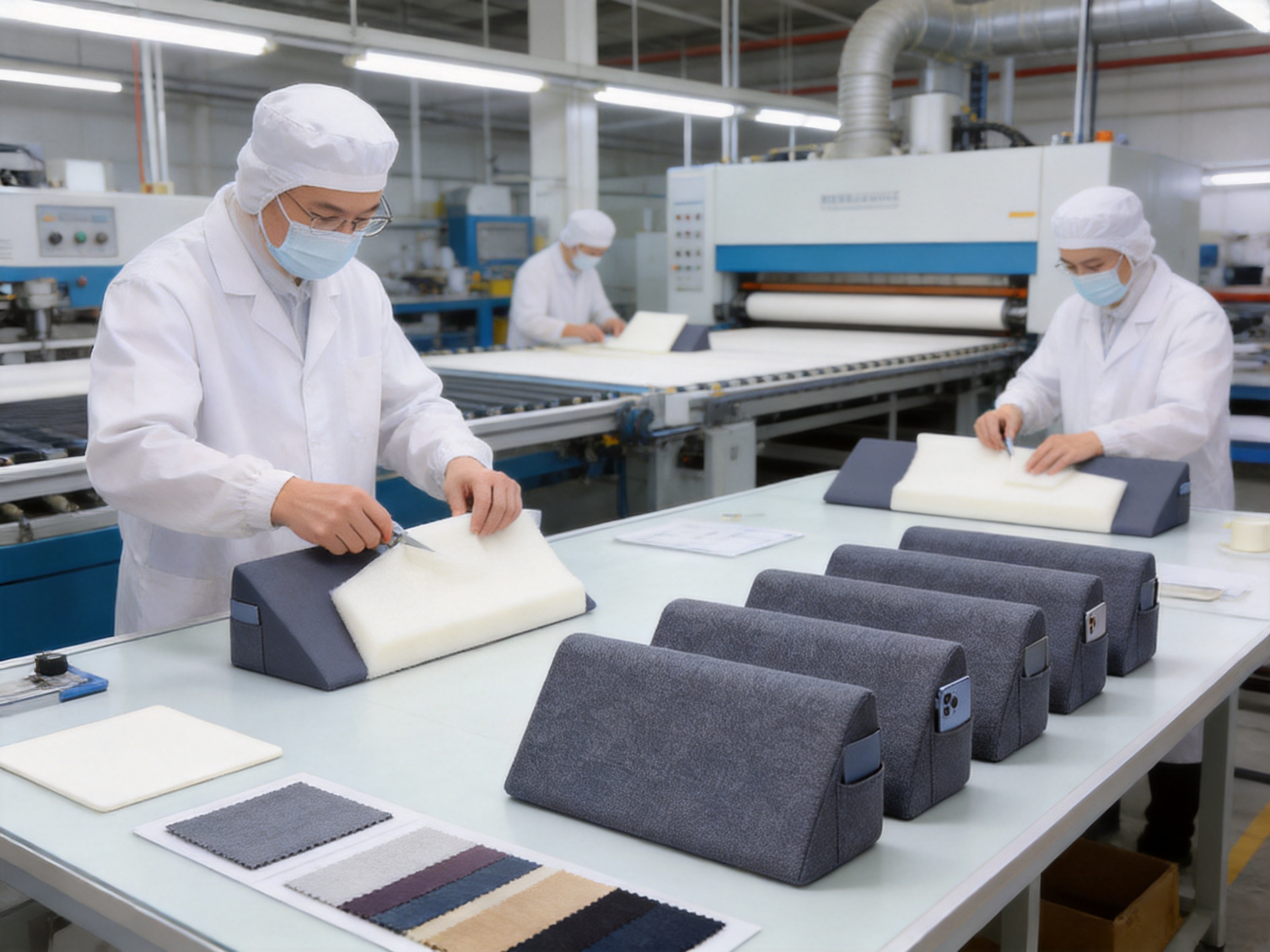
Children’s bedrooms should be comfortable, welcoming, and carefully arranged to reduce everyday risks. Beds are often the center of a child’s room, but they can also become areas where bumps, rolling, playful movement, and accidental falls occur. A well-designed bed protection product can help create a softer boundary around vulnerable areas while maintaining the comfort and appearance of the bedroom. The children’s bed railing strip with pockets is developed for this purpose, combining a high-density memory foam core, a non-slip textured surface, a triangular protective structure, and a practical side storage pocket.
Unlike rigid bed rails or hard-edged barriers, this memory foam bed guard is designed to provide cushioning rather than simply creating a physical obstruction. Its soft structure helps reduce the force of contact when a child turns, sits up, plays, or accidentally moves toward the headboard, footboard, or corner of the bed. The product is intended to offer parents greater peace of mind while preserving a gentle and comfortable sleeping environment for children.
The design also responds to practical bedroom needs. A side pocket provides a convenient location for picture books, small toys, mobile phones, or other lightweight items. The dark gray matte finish gives the product a clean and modern appearance, allowing it to blend with children’s rooms, family bedrooms, guest rooms, and other home settings. Multiple size options and customization support make the product suitable for different bed dimensions and market requirements.
Product Overview
The children’s bed railing strip with pockets is a rectangular memory foam protection product with a triangular profile. It is identified as item CD003 and is intended primarily for children’s beds and other sleeping spaces where soft edge protection is desired. The product is categorized as a memory foam bed guard and a functional pillow-style bedding accessory, although its main purpose is bed-edge and corner protection rather than ordinary sleeping support.
The protective strip is made with a memory foam filling and a polyester fiber core fabric. Its overall form is designed to sit securely against selected areas of a bed, especially the headboard, footboard, and corners. The triangular structure helps the product conform to the contour of the bed and allows multiple sections to connect into a more continuous protective barrier.
Available dimensions include approximately 99 cm × 25.4 cm × 15.2 cm, 137 cm × 25.4 cm × 15.2 cm, and a 154 cm length option with a width of approximately 25.4 cm and a height of approximately 15 cm. Since custom processing is supported, dimensions, colors, packaging, and related specifications can be adjusted for different projects and purchasing requirements.
| Product Attribute | Specification |
| Product Name | Children’s bed railing strip with pockets |
| Product Category | Memory foam bed guard |
| Item Number | CD003 |
| Filling Material | Memory foam |
| Core Fabric | Polyester fiber |
| Shape | Rectangular strip with a triangular protective profile |
| Color | Gray |
| Target User | Children |
| Approximate Height | 15–15.2 cm |
| Approximate Width | 25.4 cm |
| Available Lengths | Approximately 99 cm, 137 cm, and 154 cm options |
| Storage Feature | Side pocket for lightweight personal items |
| Customization | Size, color, and packaging customization supported |
| Certification Information | OEKO-TEX® certified material claim provided in product information |
The product should be used as a soft protective aid and should be installed according to the final application requirements. It is not a replacement for responsible supervision, an appropriately designed bed frame, or other child-safety practices. Parents and caregivers should inspect the product regularly and make sure that it remains correctly positioned and securely fitted.
High-Density Memory Foam for Softer Impact Protection
The main functional advantage of the product is its high-density memory foam core. Memory foam is a pressure-responsive material that compresses under force and gradually returns toward its original shape. In a bed protection application, this behavior creates a softer contact surface than hard plastic, wood, or metal rails.
Children often move unpredictably while sleeping. They may roll toward the headboard, change position several times during the night, or sit and play near the edge of the bed. A rigid barrier can stop movement, but it may also introduce a hard surface that causes discomfort or impact injury. The memory foam bed guard takes a different approach by combining a supportive structure with a cushioned contact zone.
The foam core can help absorb and distribute impact energy across a broader area. Rather than concentrating contact at a narrow, hard edge, the soft foam gives progressively when pressure is applied. This is particularly useful for protecting delicate skin from minor bumps and knocks. The product is described as soft and skin-friendly, with no intentionally exposed hard edges in the normal covered configuration.
High-density foam also provides dimensional stability. Very soft, low-density filling may flatten quickly or fail to preserve the shape needed for reliable positioning. A denser memory foam core can provide a more consistent triangular profile, helping the strip remain supportive when placed against a bed corner or side area. The result is a balance between cushioning and structural form.
Compared with ordinary loose fiber padding, memory foam may offer more uniform compression and recovery. Loose filling can shift inside a cover, creating uneven protection and requiring frequent adjustment. A shaped foam core is more suitable for a product that must maintain a defined profile along the length of a bed rail or corner.
The material selection is also consistent with the company’s broader experience in foam development. The manufacturer’s product portfolio includes ordinary sponge, memory foam, gel foam, temperature-insensitive memory foam, quick-dry memory foam, flame-retardant sponge, antibacterial sponge, and other specialized foam materials. This background supports a more informed approach to density, resilience, softness, surface behavior, and application-specific performance.
Triangular Structure for Bed Corners and Continuous Coverage
The triangular structure is one of the product’s most important design features. Bed corners are difficult to protect with a simple flat cushion because two directions meet at one point. A flat strip may leave a gap, shift away from the corner, or fail to provide sufficient cushioning on both adjacent surfaces. The triangular form is designed to sit more closely within the corner contour.
When used around a headboard or footboard, the triangular profile can create a more stable transition between the mattress area and the bed structure. When several sections are used together, the strips can be arranged to form a more complete protective boundary. This helps reduce exposed gaps between separate protective pieces, although the exact result depends on bed design, product length, installation method, and the number of sections used.
The shape also helps the product maintain a recognizable orientation. A shaped protective component is easier to position consistently than a loose rectangular cushion. Its angled profile indicates where the strip should meet the bed surface, while the broader padded area provides the intended contact zone for a child’s movement.
From a manufacturing perspective, a triangular foam profile requires controlled cutting, shaping, and dimensional inspection. The foam must be processed so that the angles and overall thickness remain consistent from one batch to another. Accurate shaping is important for both appearance and function. If the profile varies significantly, the product may not sit evenly against the bed frame or connect neatly with another section.
The triangular design also differentiates the product from common flat bed bumpers. A basic bumper may provide softness but offer limited corner conformity. A hard rail may provide a defined boundary but lack cushioning. This product combines a shaped structural form with memory foam softness, giving it a distinct position between traditional padded bumpers and rigid guard systems.
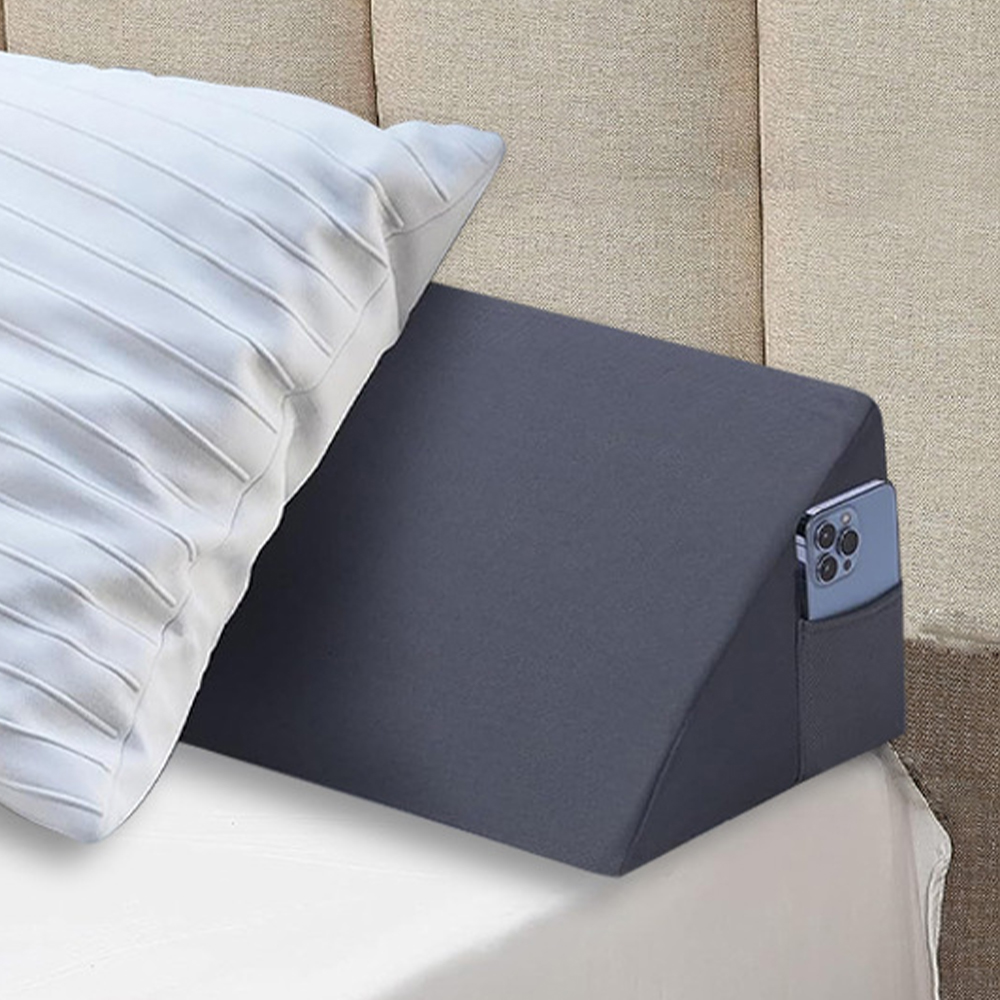
children's bed railing strip with pockets
Anti-Slip Textured Surface for Improved Stability
A protective cushion can only perform effectively if it stays in the intended position. For this reason, the product uses a non-slip textured fabric surface designed to enhance friction between the guard and the bed or surrounding materials. The textured finish helps reduce unwanted shifting during use and contributes to a more stable protective arrangement.
Children’s beds are active environments. Movement from sleeping, climbing, sitting, and playing can apply repeated horizontal and vertical forces to a bed guard. A smooth outer cover may slide more easily under these conditions, especially when placed against smooth bedding or finished bed panels. A textured surface creates additional resistance, helping the strip remain aligned.
The anti-slip surface is not intended to eliminate all movement under every condition. The performance of any bed protection product depends on the bed frame, bedding, surface materials, installation, and the child’s activity. Nevertheless, a textured exterior is a practical improvement over a smooth surface because it directly addresses one of the most common problems associated with loose protective cushions: gradual migration away from the area requiring protection.
The fabric surface also contributes to the product’s tactile quality. A matte, textured material can feel less slippery to the touch and provide a more substantial appearance than a glossy synthetic cover. The dark gray finish supports a modern, understated visual style while helping the product integrate with a range of bedding colors and furniture finishes.
For commercial buyers, surface stability can reduce customer dissatisfaction related to frequent repositioning. Retail customers generally expect a protective product to remain reasonably aligned during normal use. Including an anti-slip textile as part of the design demonstrates that the product has been developed around real household conditions rather than appearance alone.
Side Pocket Design for Everyday Convenience
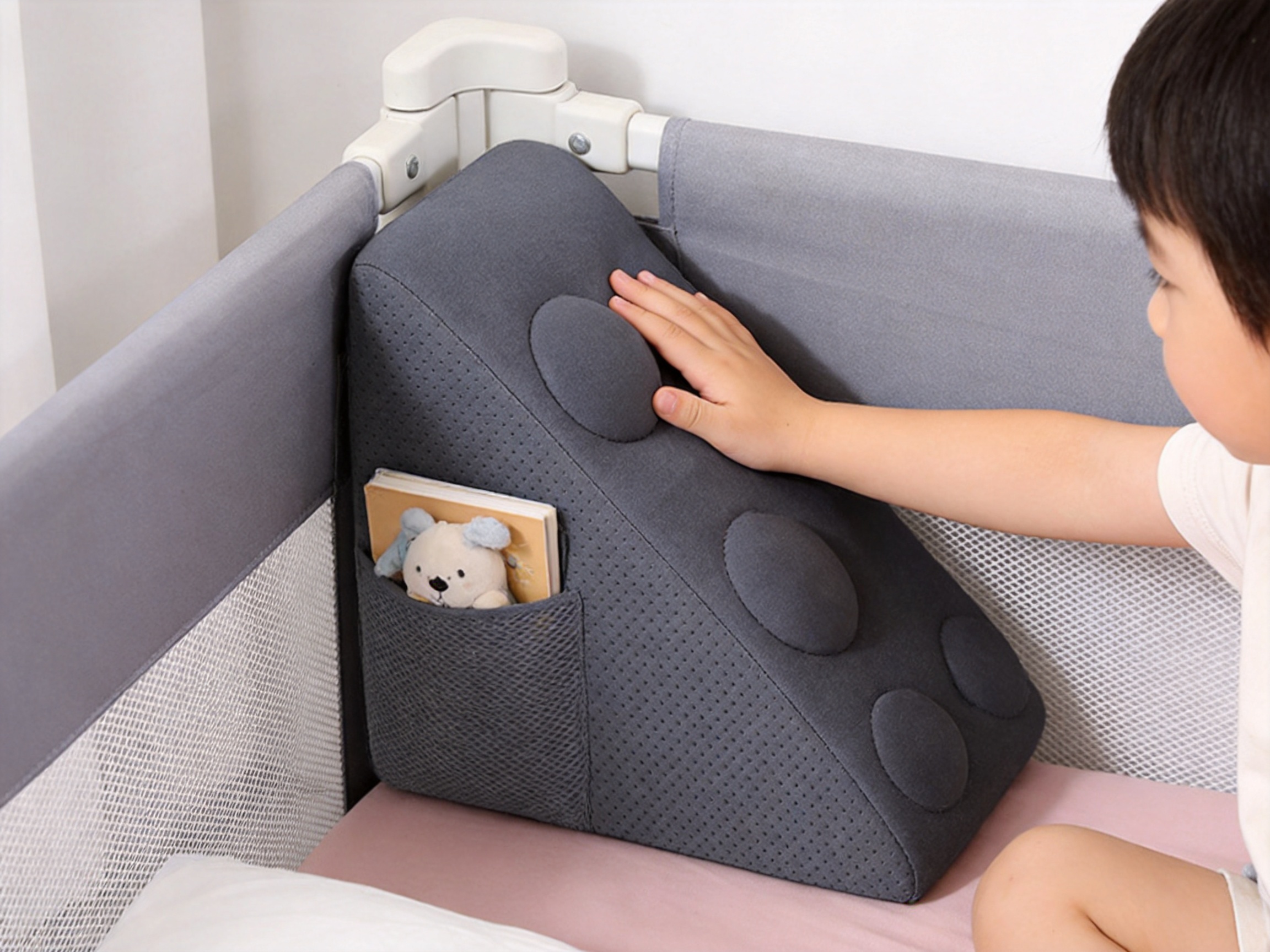
The integrated side pocket adds functionality that is not typically found on basic bed rails or plain foam bumpers. Children and parents often keep small items near the bed, including picture books, soft toys, pacifiers, reading accessories, and mobile phones. The pocket provides a dedicated storage location that keeps these items close without requiring an additional bedside organizer.
For children, the pocket can encourage simple organization. A favorite picture book or small toy can be placed in the pocket before bedtime, helping keep the sleeping area more orderly. For parents, the pocket may provide a convenient place for a phone, remote control, or other lightweight item that might otherwise be left on the mattress.
The pocket also adds commercial differentiation. Many competing bed protection products focus only on cushioning and do not offer integrated storage. A side pocket transforms a single-purpose safety accessory into a more versatile bedroom product. It combines a protective function with the organization benefits of a soft storage accessory.
The pocket should be used for lightweight items only. Heavy objects, sharp items, or objects that could create a hazard should not be stored there. Retail instructions and packaging can clearly communicate the intended use, helping customers understand that the pocket is designed for convenience rather than load-bearing storage.
From a design standpoint, the pocket must be integrated without compromising the shape and stability of the foam strip. Its attachment should be planned so that the fabric remains neat and does not create excessive bulk at the bed corner. This type of detail reflects the importance of coordinated textile and foam manufacturing rather than treating the cover as a simple afterthought.
Soft, Skin-Friendly, and Home-Oriented Design
Children’s products require careful attention to touch, surface comfort, and material presentation. The product is designed with a soft exterior and a memory foam core that avoids the exposed hard edges associated with metal or wooden barriers. This creates a gentler interface between the child and the bed protection system.
The dark gray color provides a neutral appearance suitable for both children’s rooms and shared family bedrooms. Bright colors may appeal to some children, but neutral gray can be easier to coordinate with existing furniture, mattresses, sheets, curtains, and wall colors. It also gives the product a mature appearance that remains suitable as the room’s décor changes.
The product information states that safe and environmentally friendly materials are used and that the relevant material is OEKO-TEX® certified. Buyers should review the applicable certification documentation, scope, and product configuration before making compliance claims in a particular market. When properly documented, recognized textile certification can provide additional confidence that materials have been evaluated against specified harmful-substance requirements.
A soft appearance does not mean that performance should be overlooked. The product’s comfort is supported by the combined effect of the foam density, the shaped profile, the polyester fiber cover, and the textured surface. Each component contributes to the overall user experience. The foam provides cushioning, the textile provides contact comfort, the triangular shape provides form, and the surface texture contributes to positioning stability.
This coordinated design is particularly valuable for children’s bedding because products in this category must satisfy several expectations at once. They should look appropriate in the home, feel comfortable against skin, remain practical during daily use, and be simple for caregivers to understand. The children’s bed railing strip is designed around this combination rather than focusing on only one isolated feature.
Advantages Compared with Conventional Bed Protection Products
The market includes several types of bed protection products, including rigid rails, inflatable barriers, flat foam bumpers, fabric rolls, and ordinary pillows used as improvised guards. Each type has limitations. Rigid rails may provide a strong physical boundary but can introduce hard contact points. Inflatable barriers may be lightweight but require inflation and can be vulnerable to puncture. Flat bumpers may offer softness but can move or leave corner gaps. Ordinary pillows are not designed for stable positioning or continuous protection.
The memory foam bed guard addresses these limitations through a combination of features. Its foam core provides cushioning, while its triangular structure improves corner conformity. The textured cover supports better friction, and the side pocket adds storage value. Customizable dimensions make it possible to select a more appropriate length for different bed types rather than relying on a single universal size.
| Comparison Point | Children’s Memory Foam Bed Guard | Basic Flat Bumper | Rigid Bed Rail |
| Contact Surface | Soft memory foam cushioning | Soft but may have less structural support | Hard or semi-rigid surface |
| Corner Conformity | Triangular structure designed for corners | May require folding or additional pieces | Depends on frame design |
| Surface Stability | Textured, anti-slip outer surface | May slide on smooth bedding | Usually fixed to the bed frame |
| Storage Function | Integrated side pocket | Usually unavailable | Usually unavailable |
| Comfort During Contact | Soft and cushioning | Generally soft | May be less forgiving |
| Customization | Size, color, and packaging support | Often limited | Usually based on standard frame sizes |
| Visual Style | Dark gray, matte, and modern | Varies by cover and supplier | Often more mechanical in appearance |
This comparison does not mean that one product is appropriate for every bed or child. Buyers should evaluate the bed structure, the child’s age and behavior, room layout, installation requirements, and applicable safety guidance. The advantage of this product is its balanced design: it offers softness, shape, stability, convenience, and customization in one coordinated item.
Manufacturing Strengths and Foam Material Expertise
The manufacturer, Jiangsu Wellcare Household Articles Co., LTD., was founded in 2003 and focuses on high-performance sleep materials and healthy home products. Its operations are centered on research, development, foam formulation, structural performance, and the production of products for the international sleep and home market.
The company’s R&D team is described as doctor-led and develops more than one hundred new foam materials every year. This level of material development indicates a systematic approach to testing and formulation rather than dependence on a single standard foam recipe. Different applications require different combinations of softness, resilience, density, temperature response, drying performance, flame behavior, and hygiene-related properties.
The company’s foam portfolio includes conventional sponge, memory foam, gel foam, temperature-insensitive memory foam, quick-dry memory foam, flame-retardant sponge, antibacterial sponge, and other materials. This breadth is relevant to the children’s bed guard because it provides a foundation for selecting and refining foam characteristics for a shaped protective product.
Manufacturing experience in foam materials can support better control of several production stages. These stages may include raw material preparation, formula mixing, foaming, curing, block production, cutting, profiling, inspection, cover fabrication, sewing, assembly, and packaging. Each stage affects the final product’s dimensions, feel, appearance, and consistency.
For a triangular bed guard, profile cutting is especially important. The foam must be shaped accurately so that the long edges remain visually straight, the corner angle is consistent, and the finished strip can sit properly against a bed. Dimensional control also matters when several sections are arranged together. Even relatively small differences in height or width can create visible steps or gaps between pieces.
Cover production requires a separate set of skills. The polyester fiber fabric must be cut according to the foam profile, sewn or assembled with appropriate allowances, and fitted without excessive looseness or compression. The side pocket must be positioned accurately and attached securely while preserving the product’s intended shape. A well-coordinated production process helps ensure that the outer cover complements the foam core rather than restricting it or causing deformation.
The company’s history also includes cooperation with Huai’an Institute of Technology and Qingdao University of Science and Technology. Such cooperation reflects an emphasis on technical development and material innovation. Collaboration with educational and scientific institutions can support research into foam formulations, processing behavior, performance optimization, and new product applications.
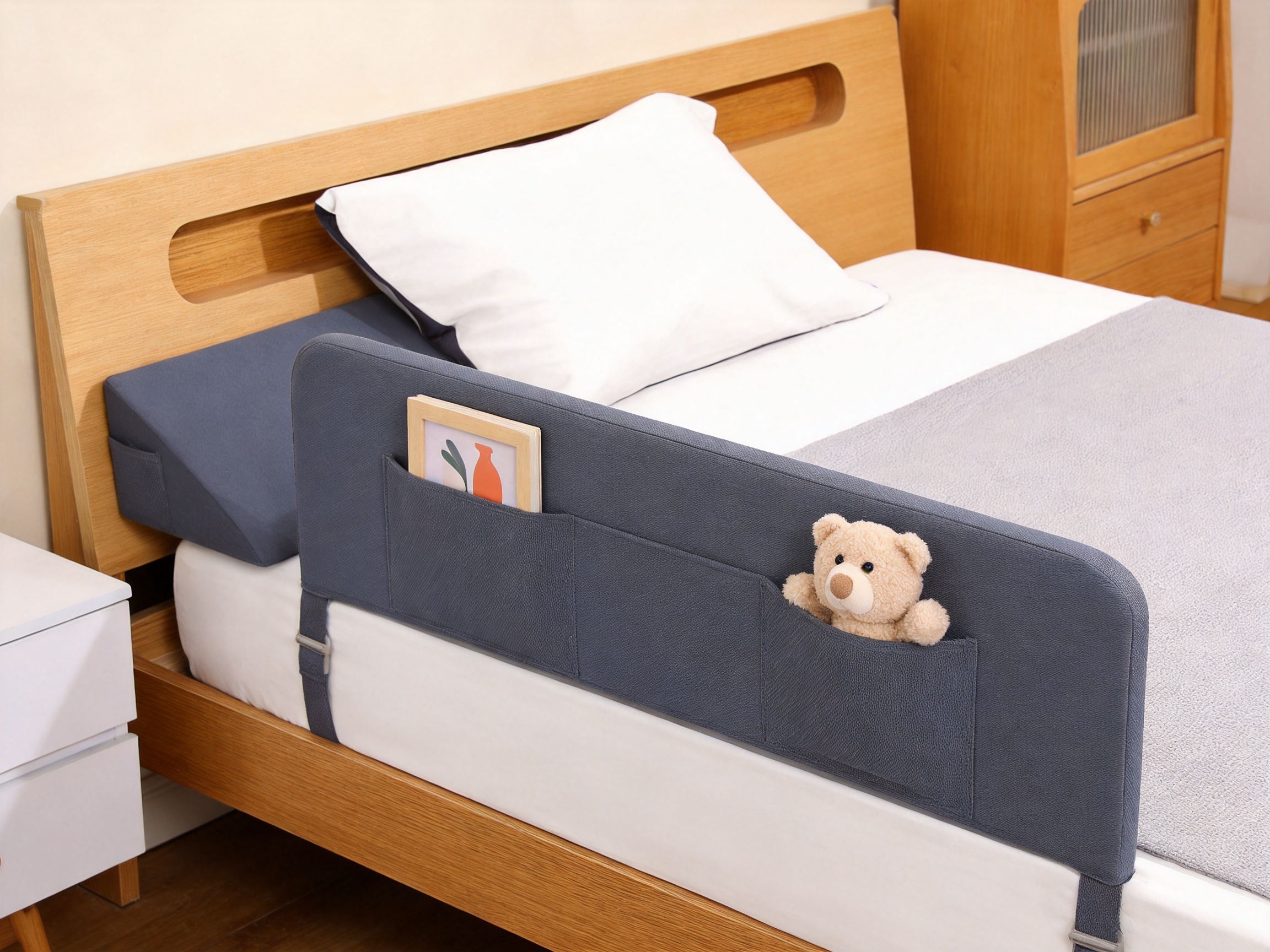
Manufacturing Development and International Supply Experience
The company’s development history began in 1993 as a school-run scientific research enterprise. In 2003, it purchased a 12,000-square-meter factory building and jointly developed a new sponge material with Huai’an Institute of Technology. In 2008, it purchased 50,000 square meters of land, expanding the foundation for production and long-term development.
By 2010, the company’s products were supplied to cross-border supermarkets in the United States, Germany, and Japan. It later exported products to the United Kingdom, Canada, Australia, and Kuwait. This international experience is useful for buyers seeking a supplier familiar with overseas product expectations, packaging requirements, communication processes, and cross-border commercial applications.
In 2018, the company became an Alibaba-certified Gold Supplier and entered e-commerce. In 2020, it became a designated supplier for five-star hotels. These milestones indicate a progression from material research and factory development toward wider commercial supply. Hotel supply in particular can require attention to repeatability, product presentation, delivery coordination, and quality consistency.
The company also supports exclusive cross-border export supply and offers an authorized own-brand option. These capabilities may be relevant to distributors, retailers, hospitality buyers, independent websites, and other businesses that require differentiated packaging or controlled brand presentation. Dropshipping is listed as unsupported, so buyers should plan for conventional wholesale, private-label, or project-based fulfillment models rather than direct one-by-one consumer dispatch from the factory.
The primary downstream platforms listed for the product include independent websites and other channels. The main sales regions include South America and North America. Customizable packaging, color, and sizing can help distributors adapt the product to local market expectations, retail presentation, and channel-specific requirements.
Quality Control Considerations for a Foam Bed Guard
Quality control for this product should address both the foam core and the finished textile assembly. Foam inspection may include checking length, width, height, profile angle, density consistency, surface condition, odor, resilience, and compression behavior. Finished products should also be checked for cover fit, seam quality, pocket attachment, color consistency, and general appearance.
Dimensional accuracy is important because the product is designed to align with bed edges and corners. A strip that is too short may not cover the intended area, while a strip that is too large may not sit correctly. Buyers ordering customized dimensions should provide clear drawings, tolerances, target bed measurements, and packaging specifications before production begins.
Foam recovery is another important consideration. Memory foam can respond differently depending on temperature, storage conditions, compression time, and formulation. If products are vacuum-packed or tightly compressed for transportation, adequate recovery time may be required after opening. Clear unpacking and recovery instructions can improve the customer experience and reduce misunderstandings about initial product shape.
Textile inspection should verify that the surface is clean, evenly textured, and free from obvious defects. Seams should be straight and secure, and the side pocket should be attached firmly enough for its intended lightweight contents. The cover should fit the foam without excessive wrinkling or distortion. Color matching is especially important for private-label programs where consistent appearance across batches is expected.
Packaging inspection should confirm that the product is protected from contamination, moisture, crushing, and damage during storage and transportation. Packaging can also include product dimensions, material information, care instructions, intended use, warnings, and customer-service details. For export orders, buyers should confirm carton dimensions, labeling language, barcode requirements, palletization, and destination-market documentation.
Customization for Different Bed Types and Markets
One of the product’s strongest commercial advantages is its customization capability. The standard length options provide a starting point, but the manufacturer supports free adjustment of size, color, and packaging to meet individual needs. This allows the product to serve more than one retail segment or bed configuration.
Size customization may be useful for single beds, children’s beds, platform beds, bunk-related applications where appropriate, daybeds, guest beds, and other specialized furniture. Buyers should measure the actual protection area rather than relying only on mattress size. Headboard thickness, footboard shape, mattress height, corner radius, and available clearance can all affect the appropriate dimensions.
Color customization can support private-label programs and coordinated bedroom collections. Gray is a versatile standard option, but retailers may request colors that match their existing bedding, nursery furniture, hotel interiors, or brand identity. A buyer should confirm available fabric options, minimum order quantities, color references, and sample approval procedures.
Packaging customization can include branded cartons, paper inserts, product labels, care instructions, multilingual warnings, and retail-ready presentation. Since the product is intended for children, packaging should communicate its purpose clearly without making unsupported claims. It should explain that the product is a soft bed protection aid and should be used with appropriate supervision and correct installation.
Brand authorization is available for buyers seeking an own-brand product. This may allow a distributor to develop a consistent product line across memory foam pillows, cushions, mattresses, pet products, and other home comfort categories. The manufacturer’s broader material portfolio may support future extensions beyond the initial bed guard order.
Applications in Retail, Hospitality, and Home Furnishing
The primary application is children’s bedroom furniture, where the product can be sold as a bed accessory for families seeking softer edge protection. It may be suitable for nursery retailers, children’s furniture stores, bedding specialists, maternity and baby product channels, home furnishing websites, and general e-commerce stores.
It can also be positioned as a practical functional home product rather than only a safety accessory. The side pocket, modern gray cover, and customizable dimensions make it relevant to adults who want a more organized bed area or a soft boundary around selected furniture edges. However, marketing should remain accurate and should not imply that the product eliminates all fall risks.
Hospitality buyers may consider the product for family-oriented accommodation, serviced apartments, vacation rentals, and hotel rooms that regularly host families with children. In those settings, the product’s appearance and storage function can be useful, but the operator should define cleaning, inspection, replacement, and installation procedures.
Furniture manufacturers can also integrate the product into children’s bed packages or bedroom collections. A coordinated package may include the bed frame, mattress, bedding, soft guard, and storage accessories. Since the guard can be customized in color and dimensions, it can be developed to complement a particular bed design.
Independent online retailers may highlight the product’s combination of memory foam cushioning, triangular corner fit, anti-slip texture, and side storage. These features provide several clear points for product photography, comparison charts, packaging copy, and customer education. Retailers should include accurate measurements and usage instructions so customers can determine compatibility before purchase.
Care, Handling, and Responsible Use
Proper care can help preserve the appearance and performance of the memory foam bed guard. The exact cleaning instructions should follow the final cover construction and supplier recommendations. In general, the outer cover should be kept clean and dry, and any removable cover should be washed according to its care label. The foam core should not be soaked unless the manufacturer specifically approves that method.
Moisture should be addressed promptly because trapped dampness can affect textiles and foam. After cleaning, the cover and foam should be allowed to dry completely before use. The product should be stored in a dry, ventilated environment away from prolonged direct heat or sunlight. Excessive heat may affect foam properties or textile color over time.
Caregivers should inspect the bed guard regularly for torn seams, damaged fabric, foam deformation, loose components, or changes in position. If any part becomes damaged or the product no longer fits securely, it should be removed from use until it is repaired or replaced. The side pocket should not be overloaded, and children should not be allowed to pull forcefully on it.
The product should be positioned according to the bed design and the supplier’s final instructions. It should not create a dangerous gap between the guard, mattress, bed frame, or wall. Parents should also consider the child’s developmental stage, mobility, climbing ability, and sleeping behavior. A soft guard can provide cushioning, but supervision and an appropriate sleep environment remain essential.
Sustainability and Environmental Responsibility
WELLCARE states that it invests in advanced eco-friendly energy systems and works to improve environmental management practices. The company’s sustainability approach is described as extending beyond basic compliance, with an aim to create lasting environmental value through more responsible operations.
For foam product buyers, sustainability can involve several areas, including material selection, production efficiency, energy use, waste reduction, packaging design, product durability, and responsible end-of-life planning. A well-made product that maintains its shape and usefulness for a longer period may reduce the frequency of replacement, although actual environmental impact depends on the complete product life cycle.
Efficient foam cutting can reduce manufacturing waste by optimizing layouts and recovering suitable offcuts for approved secondary applications. Process control can also help prevent rejected pieces caused by incorrect density, profile errors, or surface defects. Buyers interested in sustainability should request current factory information, material documentation, packaging details, and any available environmental records relevant to the order.
Packaging is another area where customization can support environmental goals. Buyers may request appropriately sized cartons, reduced unnecessary inserts, recyclable paper components where suitable, and packaging designs that protect the product without excessive material use. Packaging changes should be evaluated together with export durability, moisture protection, stacking strength, and retail presentation.
Any environmental or certification statement should be supported by current documentation. This is especially important when products are sold across multiple countries, because the meaning and acceptance of sustainability claims can vary by market. Transparent communication helps protect both the supplier and the buyer from exaggerated or unclear claims.
Why Supplier Capability Matters for This Product
A bed guard may appear simple, but its performance depends on the relationship between material formulation, foam shaping, textile construction, assembly, packaging, and quality control. A supplier that only purchases generic foam and adds a basic cover may have limited ability to refine the product when problems arise. A manufacturer with deeper foam expertise can more directly adjust the core material and structure.
WELLCARE’s focus on sleep materials and healthy home products provides a relevant manufacturing foundation. Its history of developing multiple foam categories supports an understanding of how different materials behave under pressure, temperature variation, compression, recovery, and long-term use. This experience can be applied when developing a bed guard that must be soft enough for children but stable enough to hold a triangular form.
In-house or closely coordinated production can also simplify customization. Buyers can discuss dimensions, density, cover material, pocket layout, packaging, color, and branding with a supplier that understands the interaction between these components. This can reduce the risk of receiving a cover that does not fit the foam or a foam profile that does not suit the intended bed.
International supply experience is another advantage. Export buyers often require more than the product itself. They may need samples, technical data, packaging confirmation, inspection arrangements, shipping coordination, branded documentation, and communication across different time zones and business practices. A supplier experienced in North American, South American, European, Asian, and Middle Eastern markets may be better prepared for these requirements.
The company’s product history, research activity, factory development, institutional cooperation, and export record together present a strong foundation for customized memory foam home products. For purchasers, the key benefit is not merely access to one bed guard, but access to a manufacturing partner capable of supporting product development and category expansion.
Ordering and Product Development Recommendations
Before placing a bulk order, buyers should define the intended bed types and usage environments. Measurements should include the desired length, width, height, corner profile, and any clearance around the mattress. If the product will be used with a particular bed frame, photographs or technical drawings can help the supplier evaluate fit.
Buyers should request a sample before approving mass production. The sample should be evaluated for foam feel, recovery, dimensions, corner conformity, cover appearance, surface texture, pocket construction, seams, odor, packaging, and compatibility with the target bed. Any changes should be recorded in a written specification or approved sample reference.
Material documentation should be reviewed carefully. This may include foam specifications, textile composition, certification information, color references, labeling requirements, and care instructions. If the product will be sold as a children’s item, the buyer should confirm the applicable regulations and testing requirements in each destination market.
Packaging discussions should address whether the product is shipped flat, rolled, compressed, or in another format. If compression is used, the packaging should protect the foam from damage and include clear instructions for opening and recovery. Carton strength, moisture protection, storage conditions, and container loading should also be confirmed.
For customized projects, buyers should clarify minimum order quantities, production lead times, tooling or development charges if applicable, payment terms, inspection procedures, replacement policies, and ownership of custom artwork or packaging. Clear agreements at the beginning of a project can reduce delays and support consistent repeat orders.
Frequently Asked Questions
What is the main purpose of this product?
The product is designed to provide soft cushioning and a more stable protective boundary around selected areas of a child’s bed, especially the headboard, footboard, and corners. It is a bed protection aid and should be used together with appropriate supervision and a suitable bed setup.
Why is memory foam used in the bed guard?
Memory foam provides a combination of softness, cushioning, and shape retention. It can compress under impact and distribute pressure more gently than a hard surface, while its density helps the triangular strip retain its protective profile.
What is the purpose of the triangular shape?
The triangular structure is designed to fit more closely against bed corners and adjacent surfaces. It can help create a smoother connection between sections and reduce the gaps that may occur when flat cushions are placed around corners.
Does the anti-slip fabric prevent all movement?
No product surface can guarantee that movement will never occur. The textured fabric is intended to increase friction and improve stability during normal use. Correct positioning, bed compatibility, and regular inspection remain important.
What can be placed in the side pocket?
The pocket is suitable for lightweight items such as picture books, small toys, mobile phones, or similar personal accessories. Heavy, sharp, breakable, or hazardous items should not be stored in the pocket.
What colors and sizes are available?
The standard product is described as dark gray and is available in several approximate lengths, including 99 cm, 137 cm, and 154 cm options. Custom sizing and color adjustments are supported for qualifying projects.
Can the packaging be customized?
Yes. The product information states that packaging customization is supported. Buyers can discuss branded cartons, labels, inserts, language requirements, and retail presentation with the manufacturer.
Is the product suitable for international distribution?
The manufacturer supports exclusive cross-border export supply and lists North America and South America among the main sales regions. Buyers remain responsible for confirming destination-market regulations, labeling, testing, and import requirements.
Is dropshipping available?
Dropshipping is listed as unsupported. The product is more appropriate for wholesale distribution, private-label programs, furniture packages, retail inventory, and project-based supply.
How should the product be cleaned?
Cleaning should follow the final cover’s care instructions. The cover should generally be kept clean and dry, and the foam core should not be soaked unless specifically approved by the supplier. Complete drying is important after any cleaning process.
Does the product replace adult supervision?
No. It is a soft protective aid, not a substitute for supervision or a complete child-safety system. Caregivers should inspect the product, check for gaps, consider the child’s mobility, and maintain an appropriate sleeping environment.
What makes the manufacturer suitable for customized orders?
The manufacturer has experience in foam research, memory foam development, healthy home products, export supply, and customized processing. It supports adjustments to size, color, packaging, and own-brand presentation, making it suitable for retailers and distributors seeking differentiated products.
Conclusion
The children’s bed railing strip with pockets is a thoughtfully developed memory foam bed guard that combines cushioning, structural form, surface stability, storage convenience, and modern appearance. Its high-density memory foam core provides a soft alternative to rigid protective rails, while the triangular profile is designed to conform more closely to bed corners and create a continuous protective arrangement.
The anti-slip textured fabric helps reduce shifting, and the side pocket adds practical value that is uncommon among basic bed bumpers. The dark gray matte finish gives the product broad decorative appeal, while customizable dimensions, colors, and packaging support different bed types and commercial programs.
Its strongest competitive advantage lies in the integration of these features with the manufacturer’s foam material expertise. WELLCARE’s R&D background, broad foam portfolio, factory development, international supply experience, technical cooperation, and sustainability efforts provide a solid foundation for producing and customizing this type of home comfort product.
For retailers, distributors, furniture manufacturers, hospitality buyers, and private-label brands, the product offers an opportunity to present a more functional and refined alternative to ordinary flat cushions or rigid bed rails. With appropriate specifications, quality control, responsible marketing, and correct use instructions, it can serve as a valuable addition to children’s bedding and healthy home product lines.
References
1. Product specification and feature information for the children’s bed railing strip with pockets, item CD003.
2. Manufacturer-provided information on memory foam, sponge, gel foam, temperature-insensitive foam, quick-dry foam, flame-retardant sponge, and antibacterial sponge materials.
3. Manufacturer-provided company history and development information concerning factory expansion, technical cooperation, export activity, and e-commerce development.
4. Manufacturer-provided sustainability information concerning eco-friendly energy systems and environmental management practices.
5. OEKO-TEX® standard textile certification principles and harmful-substance assessment concepts.
6. General product-development principles for foam cushioning, textile covers, dimensional inspection, packaging, and responsible children’s home-product use.
Product: children's bed railing strip with pockets

PREV:Gel Memory Foam Sponge Pillow: A Breathable, Customizable Solution for Modern Sleep
NEXT:Gray Memory Foam Leg Pillow: Ergonomic Elevation, Reliable Support, and Custom Manufacturing
NEXT:Gray Memory Foam Leg Pillow: Ergonomic Elevation, Reliable Support, and Custom Manufacturing
Interested in cooperation or have questions?
Related News
WELLCARE was founded in 2003, boasting over a decade of profound and extensive experience.
Quick Links
Product
Media Centre
Contact Information
- [email protected]
- +86-517-84998062
- +86-15152354988
- No. 168 Nenjiang Road, Huaiyin District, Huai'an City, Jiangsu Province, China
Copyright © Jiangsu Wellcare Household Articles Co., LTD. All Rights Reserved.
Custom Memory Gel Mattress Manufacturers
