

 English
 日本語
日本語 Español


Deng Caiwei — International Sales Manager

Home / Author / Deng Caiwei — International Sales Manager / Gray Memory Foam Leg Pillow: Ergonomic Elevation, Reliable Support, and Custom Manufacturing
Product Category
NEW Category
Contact us
Gray Memory Foam Leg Pillow: Ergonomic Elevation, Reliable Support, and Custom Manufacturing
A well-designed leg pillow can make a meaningful difference in daily comfort. People who spend long hours sitting at a desk, standing at work, traveling by car, or resting after physical exertion often need more than a conventional cushion. The legs require stable elevation, the calves and ankles need balanced support, and the product must remain comfortable without taking up excessive space. The gray memory foam leg pillow described in this article addresses these requirements through a semicircular shape, a slow-rebound memory foam core, a breathable polyester-fiber cover, and a compact profile suitable for home, office, travel, and recovery settings.
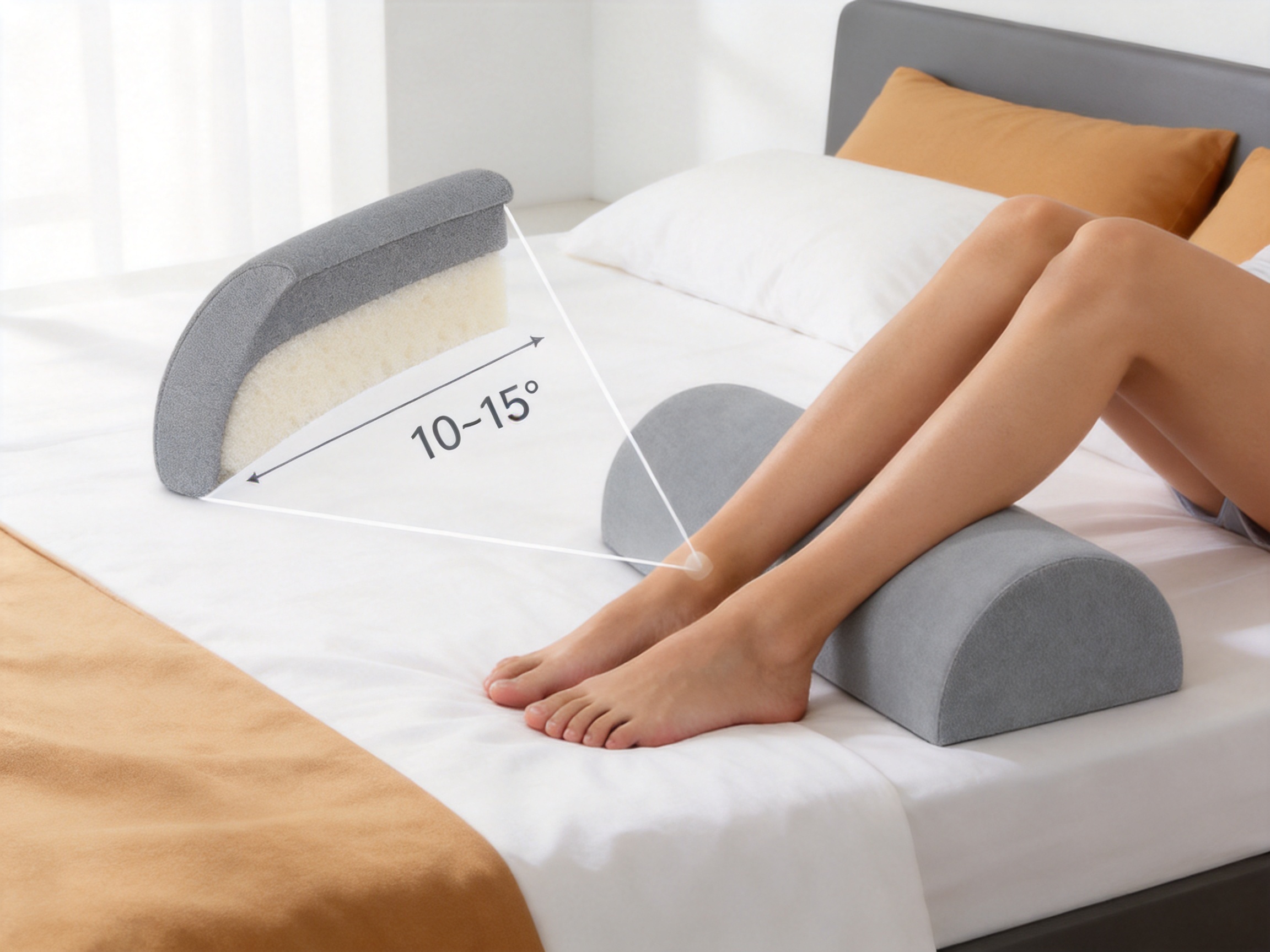
With dimensions of approximately 52 x 20 x 11 centimeters, the pillow is shaped to support the lower legs while gently raising them by about 10 to 15 degrees. Its curved structure is intended to follow the natural contour of the calves and ankles rather than forcing the legs into a rigid, flat position. This design makes the product different from ordinary rectangular cushions, which may shift easily, create pressure points, or provide inconsistent support across the length of the leg.
The product is manufactured by Jiangsu Wellcare Household Articles Co., LTD., a Chinese manufacturer with experience in foam materials, sleep products, household articles, and customized healthy-home solutions. The company’s capabilities extend from material research and formula development to foam processing, product shaping, cover selection, quality control, customization, and cross-border supply. This combination allows buyers to source not only a finished leg pillow but also a product that can be adapted for different markets, sales channels, packaging requirements, and consumer preferences.
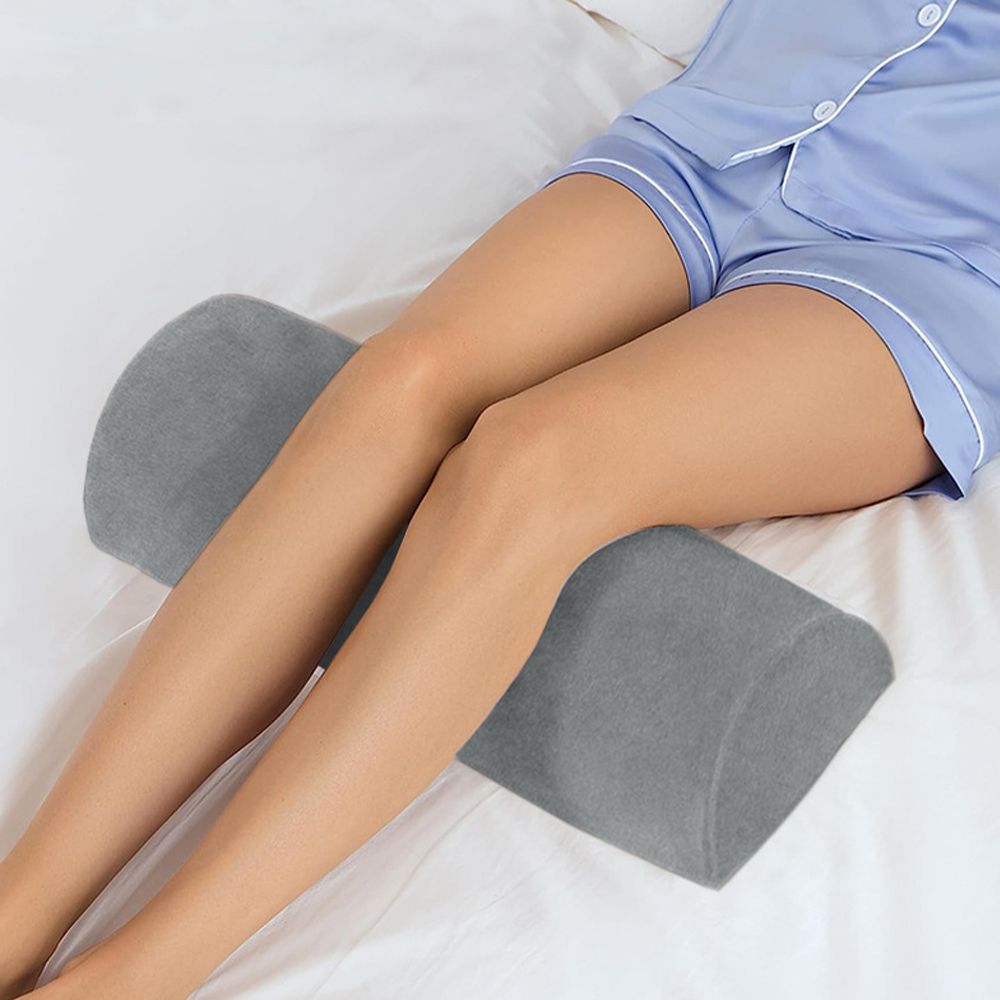
Gray memory foam leg pillow
What Makes a Memory Foam Leg Pillow Different?
Memory foam is a viscoelastic material known for responding to heat, pressure, and body weight. Instead of immediately returning to its original shape like many conventional foam cushions, slow-rebound memory foam compresses gradually and then recovers over time. This response allows the material to conform more closely to the body while distributing contact pressure across a broader area.
In a leg pillow, this property is valuable because the calves and ankles are not perfectly flat or uniform. A pillow made from a firm, inflexible material may support only a few contact points. A very soft cushion may collapse beneath the heaviest part of the leg and lose its intended elevation. Memory foam offers a middle path: it can yield around the body while retaining enough structural stability to maintain support during use.
The gray leg pillow uses a high-density slow-rebound memory foam core. Density is important because it affects durability, resilience, support, and the way the material responds under repeated loading. A properly engineered high-density foam core is less likely to become permanently compressed after short-term use. It can also provide a more consistent feel for users who rely on the pillow every day.
The pillow is not simply a block of foam covered with fabric. Its semicircular shape is part of the support system. The curved profile helps cradle the legs, while the 11-centimeter core height creates a moderate lift. This elevation is high enough to provide a noticeable change in leg position but compact enough for use in a bed, on a sofa, beneath a desk, or inside a vehicle.
Core Product Advantages
Contoured Support for the Calves and Ankles
The crescent-shaped construction provides a broader support zone than many small rectangular cushions. The legs can rest along the curved surface, allowing the calf and ankle area to remain supported without requiring the user to place the legs in a narrow, fixed channel.
This design can be useful for people who change position during rest. A pillow that is too sharply contoured may feel restrictive when the user moves. The semicircular structure provides guidance while still allowing some flexibility. It is suitable for a single adult user and can be placed on top of a mattress, sofa, lounge chair, office chair, or other stable surface.
Moderate Elevation for Everyday Use
The product raises the legs by approximately 10 to 15 degrees. This moderate angle is one of its practical advantages. A very high wedge may be effective for particular purposes but can feel uncomfortable, create pressure behind the knees, or make it difficult to maintain a natural resting position. A completely flat cushion may offer comfort but provide little elevation. The gray leg pillow is designed between these extremes.
Its moderate incline may help users achieve a more comfortable resting position after long periods of standing or sitting. It can also be placed beneath the lower legs during sleep, reading, television viewing, or computer work. The exact level of comfort depends on body size, posture, surface firmness, and individual preference, so the pillow should be considered a comfort and support product rather than a medical treatment.
Slow-Rebound Comfort
Slow-rebound memory foam responds gradually as the legs settle into the pillow. This reduces the abrupt sinking sensation associated with some soft cushions. The material conforms to the body without immediately flattening, which can help create a stable and supportive feel.
The slow response also contributes to pressure distribution. Instead of concentrating force on a small area beneath the heel or calf, the foam can adapt to the contours of the leg. This may be especially appreciated by users who dislike hard support surfaces or who experience discomfort when their legs remain in one position for extended periods.
Breathable, Skin-Friendly Cover
The pillow core is covered with a polyester-fiber fabric. The surface is described as skin-friendly and breathable, with a soft touch intended for regular contact. A removable or replaceable cover option can be discussed during customization, depending on the buyer’s requirements and production arrangement.
Fabric selection has a significant effect on the overall product experience. It influences softness, ventilation, friction, appearance, cleaning convenience, and resistance to everyday wear. The matte gray finish gives the pillow a neutral and modern appearance. Unlike highly decorative bedding accessories, it can blend with bedrooms, living rooms, offices, hotel rooms, and vehicle interiors.
Compact and Space-Saving Form
At approximately 52 x 20 x 11 centimeters, the pillow is large enough to support the lower legs while remaining relatively compact. Its slim profile makes it easier to store beside a bed, under a desk, in a closet, or in luggage. The space-saving design is a competitive advantage for customers who want functional support without adding a large orthopedic wedge or bulky lounge accessory to their home.
Compact dimensions can also simplify logistics. Products that occupy less carton volume are often easier to pack, warehouse, display, and ship. For distributors, online sellers, hotel suppliers, and private-label businesses, efficient packaging can affect storage costs and order fulfillment. Final packaging dimensions depend on the selected configuration, compression method, protective materials, and destination requirements.
Comparison with Common Alternative Cushions
Compared with a standard flat cushion, the memory foam leg pillow offers a built-in elevation angle and a more intentional support shape. A flat cushion may need to be folded, stacked, or repositioned to create lift. Those adjustments can result in uneven support or instability. The semicircular design provides its intended geometry without requiring the user to assemble multiple cushions.
Compared with a basic fiber-filled bolster, memory foam generally provides more consistent structural support. Fiber fillings can shift over time and may require frequent fluffing. Memory foam has a unified core that maintains its shape more effectively under ordinary use. This does not mean that every memory foam product is automatically superior; the final experience depends on foam density, formulation, shaping accuracy, cover construction, and quality control.
Compared with a rigid plastic or wooden leg rest, the foam pillow has a softer contact surface and can adapt to different leg shapes. Hard supports may offer a fixed angle but can feel uncomfortable around the ankles or calves. The memory foam core combines structure with cushioning, making it more suitable for users seeking a softer recovery and relaxation experience.
Compared with a tall orthopedic wedge, the product has a lower, more moderate profile. This makes it less visually intrusive and easier to integrate into ordinary furniture. It may be more practical for daily use by people who want gentle elevation rather than a pronounced incline. The proper choice depends on the user’s needs, but the gray pillow is positioned as a versatile functional cushion rather than a specialized high-rise wedge.
Compared with low-quality foam cushions, a high-density slow-rebound core may offer improved resilience and a more controlled recovery response. Material selection, density consistency, odor control, and curing conditions all influence the difference between a reliable memory foam pillow and an inexpensive imitation. This is where an experienced foam manufacturer can create value beyond the visible shape of the finished product.
Functional Applications in Daily Life
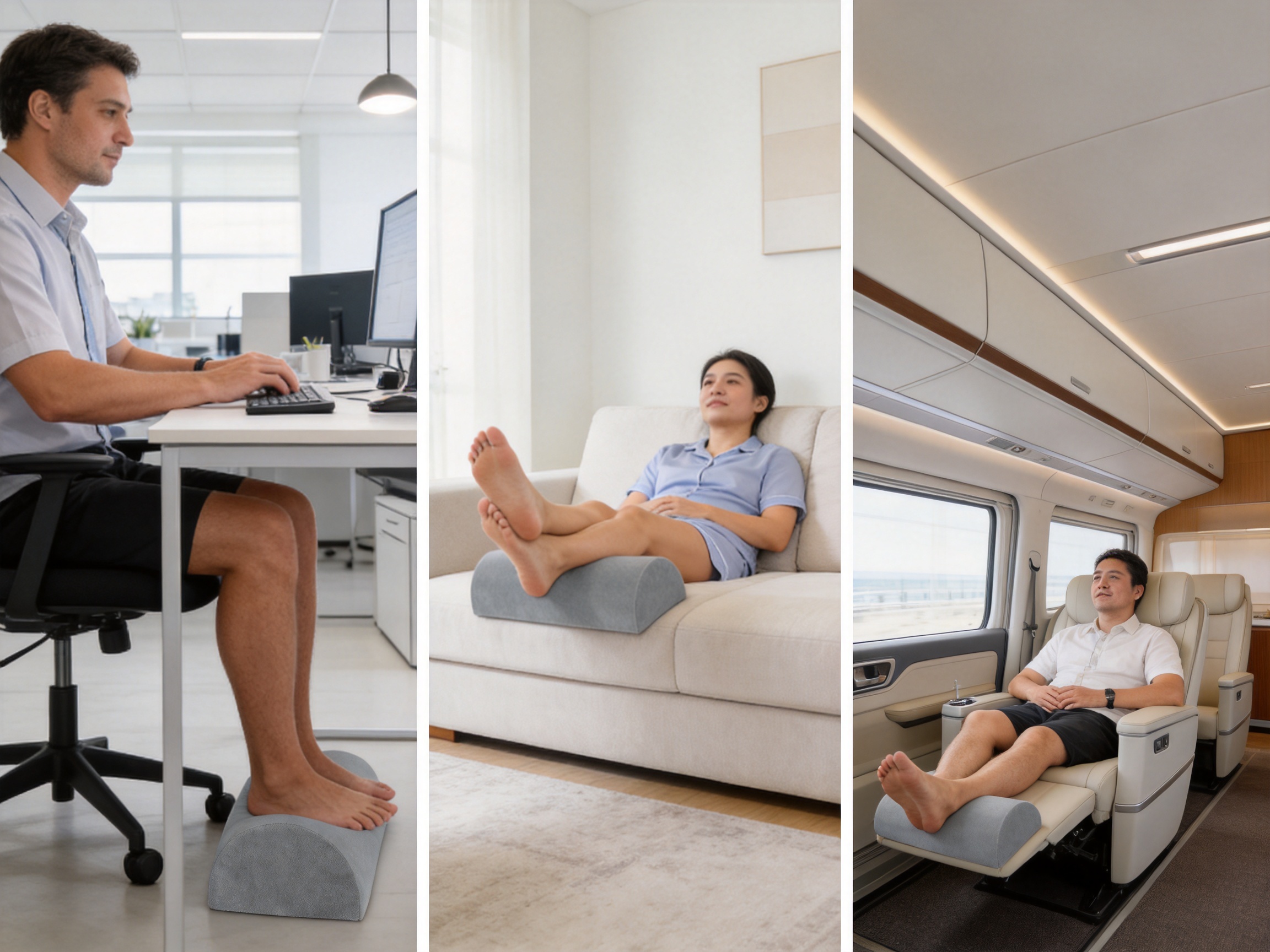
Office Leg Support
Office workers may remain seated for many hours with their feet resting on the floor and their knees bent at a fixed angle. A leg pillow can be placed beneath the lower legs during breaks or, where the desk arrangement allows, used as a supplementary support under the calves. It can encourage a change in posture and provide a softer surface than a hard footrest.
The pillow should not obstruct chair movement, interfere with desk mechanisms, or force the knees into an uncomfortable position. Users should adjust the placement according to their body size and work environment. The compact form is suitable for offices where space is limited and equipment must be stored when not in use.
Rest After Standing
Retail workers, hospitality employees, teachers, healthcare staff, warehouse personnel, and others who stand for long periods may appreciate a supportive surface during rest. Placing the leg pillow on a sofa or bed allows the lower legs to be elevated while the user relaxes. The memory foam can reduce the hard contact sensation associated with resting on a firm mattress or seat.
The product is designed for comfort and support. It should not be presented as a cure for swelling, circulation disorders, or other health conditions. Individuals with persistent swelling, pain, numbness, circulatory concerns, or post-operative restrictions should follow the advice of a qualified healthcare professional.
Sleep and Relaxation
Some sleepers prefer gentle support beneath the calves or ankles. The pillow can help create a more organized resting position without requiring a large adjustable bed or a full-length wedge. Its neutral gray color and low-profile appearance make it suitable for use in a bedroom without dominating the bedding arrangement.
Because sleeping preferences differ, users should evaluate whether the elevation angle and firmness feel comfortable throughout the night. The pillow can also be used for short periods of reading, meditation, or relaxation. The cover’s soft touch supports a more pleasant experience during direct contact.
Postpartum and Recovery Settings
The product may be used as a supportive accessory during postpartum rest or general recovery when gentle lower-leg elevation is comfortable and permitted. Its lightweight construction makes it easier to move between rooms. The foam core can provide a stable resting surface while the fabric cover creates a softer interface with clothing or skin.
For post-operative use, product suitability must be determined by the patient’s physician or care provider. Different procedures involve different positioning requirements. The pillow should never replace professional instructions, prescribed equipment, or a medical support device.
Travel and Vehicle Use
The compact dimensions make the leg pillow suitable for travel planning. It may be used in a hotel room, on a long-distance journey, or in a vehicle when the surrounding space is adequate. The gray finish is practical for travel because it is visually understated and can coordinate with different interiors.
Safety is essential in vehicle applications. The pillow should never interfere with pedals, controls, seat belts, airbags, or safe driving posture. It is most appropriate for passengers when the product can be positioned securely and comfortably. Buyers can request packaging or carrying solutions when developing a travel-oriented version.
Material Construction and Performance
The central component is memory foam, selected for its pressure-responsive behavior and slow recovery. The foam formulation can be adjusted to achieve different levels of firmness, resilience, density, temperature response, and surface feel. These parameters affect whether the product feels plush, balanced, or supportive.
The pillow core fabric is listed as polyester fiber. Polyester is commonly used in household textile applications because it can provide durability, color stability, dimensional consistency, and compatibility with various knitting and weaving techniques. The final fabric construction may be customized according to customer requirements, including color, texture, breathability, abrasion resistance, and branding needs.
The gray appearance supports a minimalist design language. Neutral colors are useful for products intended for broad international markets because they fit a range of home styles. However, the product also supports customizable colors and fabrics. Buyers can select alternative shades for private-label collections, hospitality programs, seasonal campaigns, or coordinated bedding lines.
The manufacturer identifies the materials as OEKO-TEX certified and emphasizes a non-toxic, odor-conscious product approach. Certification details should be verified for the specific material batch, product configuration, and applicable standard before marketing claims are published. Responsible documentation helps importers and retailers communicate material safety accurately.
Engineering the Semicircular Shape
Shape engineering begins with the intended support zone. The pillow must accommodate the lower legs while maintaining enough width to remain stable on a bed or sofa. The 52-centimeter length provides a longitudinal support area, while the 20-centimeter width contributes to compactness and positioning. The 11-centimeter core height determines the approximate maximum elevation at the upper part of the contour.
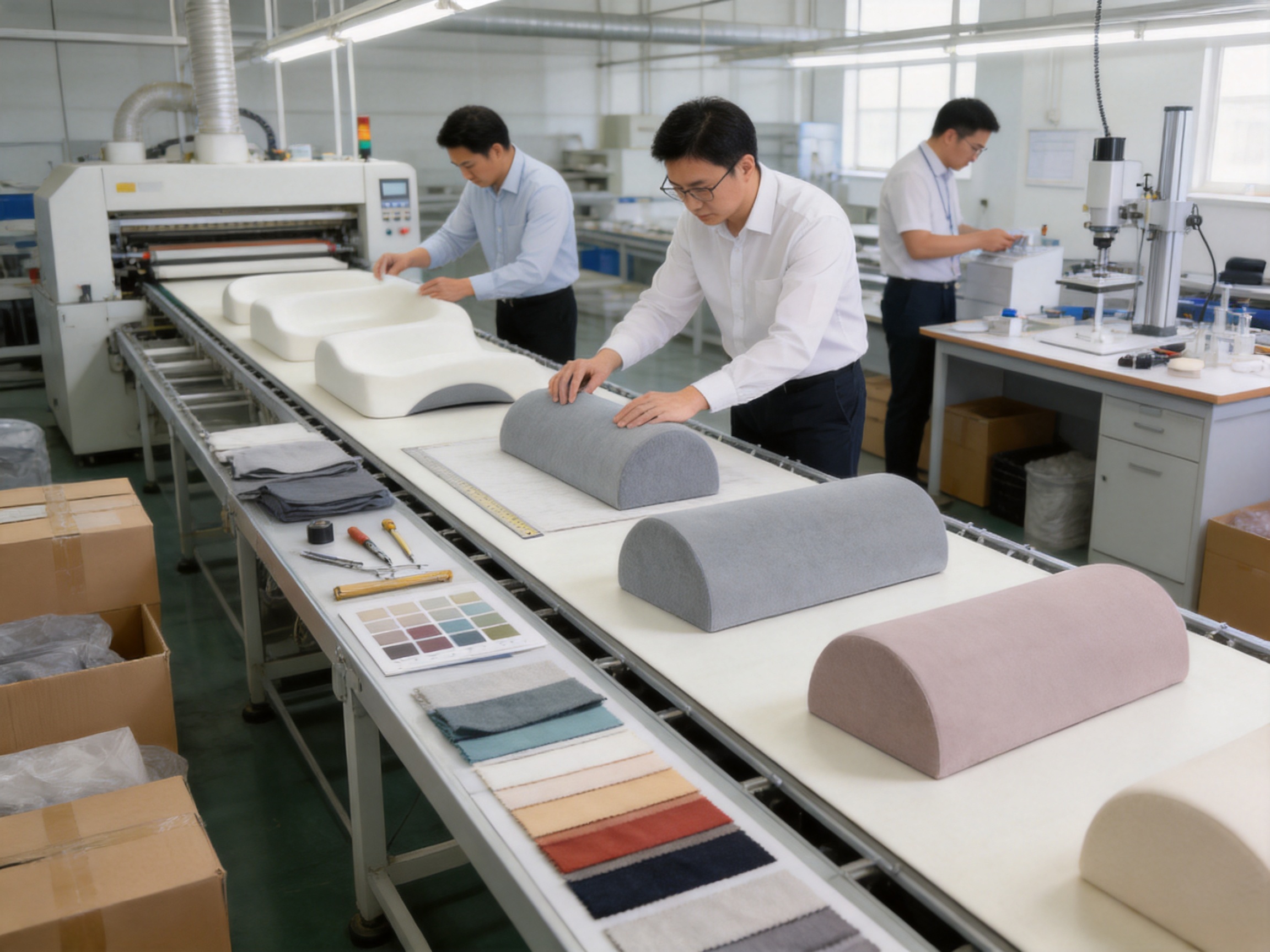
Foam shaping may involve molding, cutting, contouring, profiling, or a combination of these processes. Each method can influence surface precision, edge quality, production efficiency, and customization flexibility. For a semicircular functional pillow, dimensional accuracy is important because small differences in height or curvature can change the user’s posture and comfort experience.
Experienced foam manufacturers typically control the relationship between foam density, mold design, cutting tolerance, compression recovery, and cover dimensions. If the cover is too tight, it may make the pillow feel firmer than intended. If it is too loose, wrinkles may form and the product may appear less refined. Coordinating the core and cover specifications is therefore essential.
The manufacturing process should also account for foam curing and ventilation. Newly produced foam may require appropriate time and handling before final packing. Proper procedures can help reduce residual odor and improve dimensional stability. Packaging design must allow the product to arrive in good condition after transport while supporting efficient carton utilization.
Advanced Foam Research and Manufacturing Strengths
Jiangsu Wellcare Household Articles Co., LTD. has developed its business around sleep materials, foam products, and healthy-home applications. The company’s history includes research cooperation with academic institutions and the development of multiple foam material categories. This background is relevant because a functional leg pillow is not only a textile product; its performance depends heavily on the formulation and processing of the foam core.
The company states that it has a doctor-led research and development team and develops more than one hundred new foam materials each year. This research activity can support experimentation with density, recovery speed, resilience, support level, temperature sensitivity, flame resistance, antibacterial performance, and other material characteristics. Not every development will be used in every product, but a broad material library gives buyers more options during product design.
The manufacturer’s portfolio includes ordinary sponge, memory foam, gel foam, temperature-insensitive memory foam, quick-dry memory foam, flame-retardant sponge, antibacterial sponge, and other foam solutions. This range can be valuable for customers serving different climates, regulations, hospitality environments, healthcare-related markets, outdoor settings, or premium sleep categories.
Temperature response is one area where material research may create a meaningful distinction. Some memory foams become softer in warmer conditions and firmer in cooler conditions. A temperature-insensitive formulation may provide a more consistent experience across different climates. This is especially relevant for international customers selling in North America, South America, Southeast Asia, and other regions with varying ambient temperatures.
Quick-dry foam technologies may be considered for products used in humid climates or environments where moisture management is important. Flame-retardant materials may be relevant to markets with specific safety requirements. Antibacterial sponge options may be considered for selected applications, subject to valid test reports and compliant marketing language. These alternatives demonstrate how a manufacturer’s broader R&D system can support product specialization.
Development History and Industrial Experience
The company’s development originated in 1993 as a school-run scientific research enterprise. In 2003, it purchased a 12,000-square-meter factory building and jointly developed new sponge material with Huai’an Institute of Technology. In 2008, it purchased 50,000 square meters of land. These milestones indicate a long-term approach to production infrastructure and technical development.
By 2010, the company reported supplying products to cross-border supermarkets in the United States, Germany, and Japan and cooperating with Qingdao University of Science and Technology. It later expanded exports to the United Kingdom, Canada, Australia, and Kuwait. This international experience can help the company understand the importance of packaging, product consistency, export documentation, customer communication, and market-specific requirements.
In 2018, the company became an Alibaba-certified Gold Supplier and entered e-commerce. In 2020, it became a designated supplier for five-star hotels. These experiences are relevant to buyers looking for a supplier that can support both online retail and commercial hospitality orders. Hotel supply often requires stable quality, repeatability, packaging coordination, delivery planning, and responsiveness to customized specifications.
Integrated Customization Capability
The leg pillow supports custom processing, customizable size, and selectable color and fabric. Buyers can therefore develop a standard gray version or request a tailored model. Possible development variables include pillow length, width, height, curvature, foam density, cover material, zipper configuration, label placement, logo application, packaging format, and carton markings.
Customization should begin with a clear technical brief. The buyer should define the target customer, intended use, preferred firmness, size range, cover requirements, packaging method, order quantity, and destination market. A sample can then be evaluated for comfort, dimensions, surface appearance, odor, rebound behavior, cover fit, and packaging performance.
The ability to provide authorized own-brand products is another advantage for private-label buyers. Rather than selling a generic item with limited differentiation, a retailer can build a coordinated product line around selected fabrics, colors, packaging, and communication themes. The manufacturer can support the product development process while the buyer controls brand positioning and market presentation.
Quality Control Considerations
Quality control for a memory foam leg pillow should cover both raw materials and finished goods. Foam density, hardness, rebound time, compression recovery, dimensions, and visible defects should be evaluated according to an agreed specification. Testing methods and acceptable tolerances should be documented before mass production.
Dimensional inspection is particularly important for a contoured product. The length, width, height, curvature, edge profile, and symmetry should remain within the approved range. Inconsistent dimensions can result in uneven elevation or an unstable appearance. Templates, gauges, digital measurement tools, and controlled cutting or molding procedures may be used to improve repeatability.
Cover inspection should include fabric weight, color consistency, stitching, seams, zipper function if applicable, label placement, and overall fit. The cover should not have excessive wrinkles, loose threads, staining, or uneven tension. Since the fabric is part of the user’s direct experience, visual and tactile quality can strongly influence product reviews and repeat purchases.
Odor management is another important consideration for foam goods. Foam products may have a characteristic odor after production, particularly when packed soon after manufacturing. Proper curing, ventilation, storage, and packaging procedures can help manage this issue. Buyers should establish an agreed odor evaluation method and provide clear unpacking and airing instructions when appropriate.
Packaging inspections should confirm that the product is protected from dust, moisture, compression damage, and deformation during handling. If compression packaging is used, the supplier and buyer should agree on the recovery period and the instructions provided to end users. The pillow should be evaluated after unpacking to confirm that it returns to the approved shape.
Why Manufacturing Expertise Matters to Buyers
For importers and distributors, buying a functional pillow from a specialized foam manufacturer can reduce the gap between product concept and production reality. A trading company may be able to source a finished cushion, but a material-focused manufacturer can often explain how foam density, shape, cover tension, and processing conditions affect the final result.
Manufacturing expertise can also make it easier to solve problems during sampling. If a prototype feels too soft, the foam formulation or density can be adjusted. If the elevation is too high, the profile can be redesigned. If the cover feels warm, a different textile construction may be considered. If shipping volume is excessive, packaging can be optimized. These adjustments are more efficient when the supplier has technical control over multiple stages.
WELLCARE’s experience with different foam categories offers a foundation for these discussions. Customers can compare ordinary sponge and memory foam, evaluate different recovery speeds, or explore specialized options for climate and regulatory needs. The goal is not to add unnecessary features but to match the material to the product’s intended use and price position.
The company’s cross-border export orientation is also relevant to online sellers. The product is listed as supporting dropshipping and is associated with Amazon as a downstream platform. Buyers should confirm current fulfillment, labeling, carton, barcode, and documentation requirements for each target market. A supplier’s familiarity with e-commerce does not eliminate the need for buyer-side compliance review, but it can simplify communication and order preparation.
Product Specification Table
| Attribute | Specification |
| Product Name | Gray Memory Foam Leg Pillow |
| Product Category | Memory Foam Leg Pillow |
| Core Material | Slow-rebound memory foam |
| Pillow Core Fabric | Polyester fiber |
| Shape | Semicircular or crescent-shaped |
| Standard Dimensions | Approximately 52 x 20 x 11 centimeters |
| Elevation | Approximately 10 to 15 degrees |
| Weight Range | Approximately 0.55 to 1 kilogram |
| Color | Gray standard appearance; customizable |
| Fabric | Customizable according to requirements |
| Target User | Adults |
| Recommended User Count | Single person |
| Design Style | Minimalist and comfortable |
| Product Item Number | TZ006 |
| Customization | Size, color, fabric, and custom processing supported |
| Private Label | Authorized own-brand availability |
| Sales Support | Dropshipping and cross-border export supply supported |
| Primary Sales Regions | South America, Southeast Asia, and North America |
Design Benefits for Retail and E-Commerce
The product has several characteristics that make it suitable for online retail. Its purpose is easy to understand, its compact dimensions simplify product photography and packaging, and its neutral gray appearance appeals to a wide range of interior styles. The crescent shape also creates a recognizable visual identity that can distinguish it from ordinary cushions in an online catalog.
Product pages should explain the shape, dimensions, material, intended use, care instructions, and unpacking process clearly. Buyers should avoid overstating health benefits or suggesting that the pillow treats a disease. A responsible product description can emphasize comfort, support, gentle elevation, pressure distribution, and versatility while directing users with medical concerns to professional advice.
Photographs should show the pillow from multiple angles and include a scale reference where appropriate. Images can communicate the semicircular structure, surface texture, cover quality, and compact size more effectively than text alone. Buyers may also request customized photography samples or packaging designs for private-label campaigns.
For marketplace sales, the product can be positioned under several practical themes: office comfort, lower-leg support, relaxation, travel convenience, postpartum rest, recovery support, and sleep accessories. The most effective theme depends on the target customer and local advertising rules. Product claims should be supported by evidence and adapted to the regulations of the destination country.
Environmental and Responsible Manufacturing Focus
Modern buyers increasingly evaluate products not only by comfort and price but also by how they are manufactured. WELLCARE describes a commitment to eco-friendly energy systems and improved environmental management practices. The company’s stated objective is to integrate respect for nature into its operations and create long-term environmental value.
Foam production involves chemical materials, energy use, cutting waste, packaging, and transportation. Responsible manufacturing requires attention to each stage. Process efficiency can reduce material waste, while careful formulation and production control can improve yield. Packaging optimization can reduce unnecessary volume and lower the resources required for storage and transportation.
Certification and testing provide an important part of responsible sourcing. The listed OEKO-TEX certification can help buyers assess textile and material safety, but the exact certificate scope should be checked. Buyers may also request documentation related to restricted substances, factory quality systems, fire performance where applicable, packaging materials, and environmental management.
Sustainability claims should remain precise. A product should not be described as fully sustainable unless the relevant evidence supports that statement. More accurate language may refer to selected certified materials, waste reduction efforts, energy improvements, or environmentally conscious manufacturing practices. Clear communication protects both the supplier and the customer.
Customization Options for Different Markets
Size and Support Profile
Although the standard size is approximately 52 x 20 x 11 centimeters, buyers can request alternative dimensions. A shorter version may suit compact office spaces or travel kits. A wider version may provide more lateral stability. A higher profile may create stronger elevation, while a lower profile may be preferred for ordinary sleeping or sitting.
Any size change should be evaluated together with foam density and firmness. Increasing the height without adjusting the base may affect stability. Increasing the width may improve support but also raise packaging volume. A professional supplier can help balance comfort, structural performance, manufacturing feasibility, and shipping efficiency.
Fabric and Color
Gray is an adaptable standard color, but custom colors can support a retailer’s identity. Buyers may choose warm neutrals for home collections, darker tones for travel products, bright colors for children’s or family lines, or coordinated colors for hotel and healthcare environments. Fabric texture can also be adapted to achieve a smoother, softer, more breathable, or more durable surface.
Branding and Packaging
Private-label opportunities may include woven labels, printed labels, embroidered marks, branded cartons, instruction cards, polybags, dust bags, and coordinated outer packaging. Branding should be planned early because it can affect cover construction, minimum order quantities, production time, and inspection procedures.
Packaging may be designed for retail shelves, direct-to-consumer shipment, wholesale cartons, or dropshipping. Buyers should consider whether the product will be vacuum compressed, rolled, folded, or shipped in its natural shape. Each method affects recovery, appearance, shipping volume, and customer instructions.
Material Alternatives
Customers with specialized requirements may explore gel-infused memory foam, temperature-insensitive memory foam, quick-dry foam, flame-retardant foam, or antibacterial sponge materials. These options should be selected according to actual market needs rather than added solely for marketing appeal. Each alternative may change price, production conditions, testing requirements, and performance characteristics.
Recommended Buyer Evaluation Process
A buyer should begin by defining the product’s intended market and use case. An office-support product may require a compact profile and durable cover. A sleep-oriented product may prioritize softness and quiet movement. A hotel product may require strong repeatability and easy-care fabrics. A travel product may prioritize low weight and reduced packaging volume.
The next step is sample approval. The sample should be assessed by several users with different body sizes and sitting or sleeping preferences. Feedback should address firmness, height, angle, stability, contact comfort, cover feel, odor, appearance, and ease of movement. A single tester may not represent the full target audience.
Buyers should also examine recovery after packaging. If the pillow is compressed, it should be opened according to the supplier’s instructions and observed for shape restoration. The recovery time should be recorded. The product should be checked for permanent creases, uneven edges, cover distortion, or a change in support feel.
Before mass production, the buyer and supplier should approve a written specification. This document may include foam type, density range, firmness range, dimensions, tolerances, cover composition, color standard, stitching details, labels, packaging, carton quantity, inspection method, and applicable documents. Written specifications reduce ambiguity and make repeat orders more consistent.
For international orders, buyers should confirm export packaging, shipping marks, product labeling, country-of-origin requirements, tariff classification, customs documents, and destination-market regulations. These details vary by country and sales channel. Early planning can prevent delays after production is complete.
Care and Use Guidance
The leg pillow should be placed on a clean, dry, and stable surface. Users can position the calves along the curved portion and adjust the pillow until the legs feel supported without excessive pressure. The pillow should not be placed where it can slide into a hazardous position or obstruct movement.
Users should follow the care instructions supplied with the selected cover. If the cover is removable, washing instructions should be followed carefully to prevent shrinkage or damage. The memory foam core should generally be protected from excessive water and should not be machine washed unless the manufacturer specifically approves that method.
Foam products benefit from ventilation. If the pillow has a noticeable new-product odor after unpacking, it may be placed in a well-ventilated area according to the supplier’s instructions. Direct exposure to intense heat or prolonged sunlight should be avoided unless specifically recommended, because extreme conditions may affect the cover and foam.
The pillow is intended for adult comfort and support. It should not be used as a toy, climbing aid, or substitute for prescribed medical equipment. Children, older adults, or individuals with mobility limitations should use it in an environment where the risk of slipping or awkward positioning is minimized.
Supplier Strengths at a Glance
The manufacturer combines long-term foam industry experience with product customization and export capabilities. Its history of research cooperation, factory expansion, foam material development, international supply, e-commerce participation, and hotel cooperation creates a foundation for serving different types of buyers.
Its technical strengths include access to multiple foam categories, experience with memory foam products, the ability to adjust product dimensions and fabrics, and support for private-label development. These advantages can help buyers create a product that is more differentiated than an off-the-shelf cushion.
Its commercial strengths include dropshipping support, cross-border export supply, authorized own-brand availability, and experience serving overseas markets. The stated main sales regions include South America, Southeast Asia, and North America, although customers should confirm current shipping capacity and market-specific service conditions before ordering.
Its sustainability-oriented strengths include investment in eco-friendly energy systems and environmental management practices. Buyers should request current supporting documents when sustainability, certification, or material safety is central to a purchasing decision.
Q&A
What is the main purpose of this leg pillow?
The main purpose is to provide comfortable lower-leg support and gentle elevation. Its semicircular shape and slow-rebound memory foam core are designed to support the calves and ankles during rest, office breaks, sleep, travel, postpartum recovery, or general relaxation.
What are the standard dimensions?
The listed standard dimensions are approximately 52 x 20 x 11 centimeters. Custom sizes are available, subject to design confirmation, tooling or processing requirements, minimum order quantities, and production feasibility.
How high does the pillow elevate the legs?
The curved structure is designed to raise the legs by approximately 10 to 15 degrees. The exact elevation experienced by a user depends on placement, body size, mattress or seat firmness, and the shape of the lower legs.
Is the product suitable for sleeping?
It can be used as a sleep-support accessory for adults who find gentle lower-leg elevation comfortable. Users should stop using it if it causes pain, numbness, pressure, or discomfort. People with medical conditions should consult a qualified healthcare professional before using an elevation product during sleep.
Can it be used after surgery?
It may be suitable for some recovery situations, but post-operative positioning must be approved by the treating clinician. The pillow is a household comfort product and should not replace prescribed medical supports or professional recovery instructions.
Is the cover customizable?
Yes. The product supports custom fabric and color selection. Buyers can discuss textile composition, texture, breathability, appearance, branding, zipper options, and care requirements with the manufacturer.
Can the dimensions and foam feel be changed?
Custom processing is supported. Buyers may discuss height, length, width, curvature, foam density, firmness, rebound speed, and other product characteristics. A sample approval process is recommended before mass production.
What makes memory foam suitable for this application?
Slow-rebound memory foam can conform to the contours of the legs, distribute pressure, and retain a supportive shape under ordinary use. Its performance depends on formulation, density, processing quality, temperature, and cover construction.
Is the product available for private-label sales?
Authorized own-brand availability is listed as a product option. Buyers can discuss labels, packaging, colorways, fabric selections, product inserts, and other private-label requirements with the manufacturer.
Can the pillow be sold through dropshipping?
Dropshipping support is listed in the product information. Buyers should confirm current order procedures, packaging standards, shipping destinations, handling times, return processes, and marketplace requirements before launching a dropshipping program.
Is the product only available in gray?
Gray is the standard appearance described for the product, but the color is customizable. Alternative colors can be selected for private-label collections, seasonal products, hospitality programs, and coordinated home accessories.
How should the foam core be cleaned?
Care depends on the selected cover and product configuration. The cover should be cleaned according to its label instructions. The foam core should be protected from excessive water and should not be machine washed unless the manufacturer specifically provides approval.
Does the product have an environmental or material certification?
The product information identifies OEKO-TEX certification and describes the materials as safe and environmentally responsible. Buyers should request the relevant current certificate and verify that it applies to the exact material and finished-product configuration being purchased.
What markets does the manufacturer serve?
The listed main sales regions are South America, Southeast Asia, and North America. The company also reports experience supplying customers in Europe, Australia, Canada, Japan, Germany, the United Kingdom, and Kuwait. Current availability, documentation, and shipping terms should be confirmed for each order.
What is the product item number?
The listed item number is TZ006. Buyers should use this number during quotation, sampling, purchase-order preparation, and specification confirmation to reduce the risk of product confusion.
Conclusion
The gray memory foam leg pillow combines ergonomic contouring, moderate elevation, slow-rebound support, breathable fabric, and compact dimensions in a practical functional cushion. Its semicircular profile gives it a clear advantage over flat cushions that lack built-in elevation, while the memory foam core provides a more adaptive feel than many rigid or loosely filled alternatives.
Its value extends beyond the finished product. The manufacturer’s experience in foam research, material development, factory expansion, international supply, e-commerce, hospitality, and customized production gives buyers a broader development resource. Customers can request changes to size, fabric, color, foam properties, packaging, and branding, allowing the product to serve different retail, private-label, office, travel, hospitality, and healthy-home applications.
For buyers seeking a versatile leg-support product, the key strengths are its balanced elevation, stable calf and ankle support, minimalist appearance, manageable shipping size, and customization potential. For responsible sourcing, buyers should confirm specifications, certification documents, quality standards, packaging details, and destination-market compliance before placing a production order. When these factors are carefully managed, the memory foam leg pillow can become a practical addition to a modern comfort-product portfolio.
References
1. WELLCARE product information for the gray memory foam leg pillow, including dimensions, materials, applications, customization options, and item number TZ006.
2. WELLCARE company profile and manufacturing history, including foam research, factory development, export experience, and healthy-home product manufacturing.
3. General technical literature on viscoelastic polyurethane memory foam, pressure distribution, compression recovery, and density-related performance.
4. General ergonomic guidance on supported sitting, lower-leg positioning, posture variation, and the use of foot and leg supports.
5. OEKO-TEX certification principles concerning the assessment of harmful substances in textiles and selected consumer-product materials.
6. General quality-control practices for foam cushions, including dimensional inspection, density testing, firmness evaluation, cover inspection, odor management, and packaging recovery.
Product: Gray memory foam leg pillow

PREV:Children’s Bed Railing Strip with Pockets: Soft, Stable, and Customizable Memory Foam Bed Protection
NEXT:Multifunctional Tri-Fold Memory Foam Pad: Flexible Comfort for Modern Living
NEXT:Multifunctional Tri-Fold Memory Foam Pad: Flexible Comfort for Modern Living
Interested in cooperation or have questions?
Related News
WELLCARE was founded in 2003, boasting over a decade of profound and extensive experience.
Quick Links
Product
Media Centre
Contact Information
- [email protected]
- +86-517-84998062
- +86-15152354988
- No. 168 Nenjiang Road, Huaiyin District, Huai'an City, Jiangsu Province, China
Copyright © Jiangsu Wellcare Household Articles Co., LTD. All Rights Reserved.
Custom Memory Gel Mattress Manufacturers
