

 English
 日本語
 Español



Shen Yueqiao — After-Sales Quality Support Supervisor

Home / Author / Shen Yueqiao — After-Sales Quality Support Supervisor / Anti-Slip Memory Foam Bed Rail Strips for Safer Children’s Sleep
Product Category
NEW Category
Contact us
Anti-Slip Memory Foam Bed Rail Strips for Safer Children’s Sleep
Introduction
Children move frequently while sleeping. They may roll from one side of the bed to the other, turn suddenly, sit up during the night, or play on the mattress before bedtime. For families using a crib, children’s bed, widened bed, or shared sleeping surface, these movements can create a risk of falls, bumps, and uncomfortable contact with hard bed structures. Anti-slip children’s bed railing strips are designed to provide a soft, stable, and protective barrier around the sleeping area.
This product combines a high-density memory foam core with a textured, non-slip outer fabric. The result is a cushioned protective strip that follows the contours of the bed while helping to reduce movement during use. Its rectangular construction, soft surface, pure white appearance, and customizable specifications make it suitable for household use as well as professional bedding, children’s furniture, and home-product distribution channels.
Unlike rigid wooden, plastic, or metal bed guards, a memory foam railing strip provides a softer contact surface. It is designed to cushion impacts rather than introduce another hard edge into the child’s sleeping environment. Compared with basic foam rolls or loosely placed cushions, its structured shape, friction-enhancing fabric, and enclosed protective design provide a more organized solution for manufacturers, retailers, and families seeking improved comfort and stability.
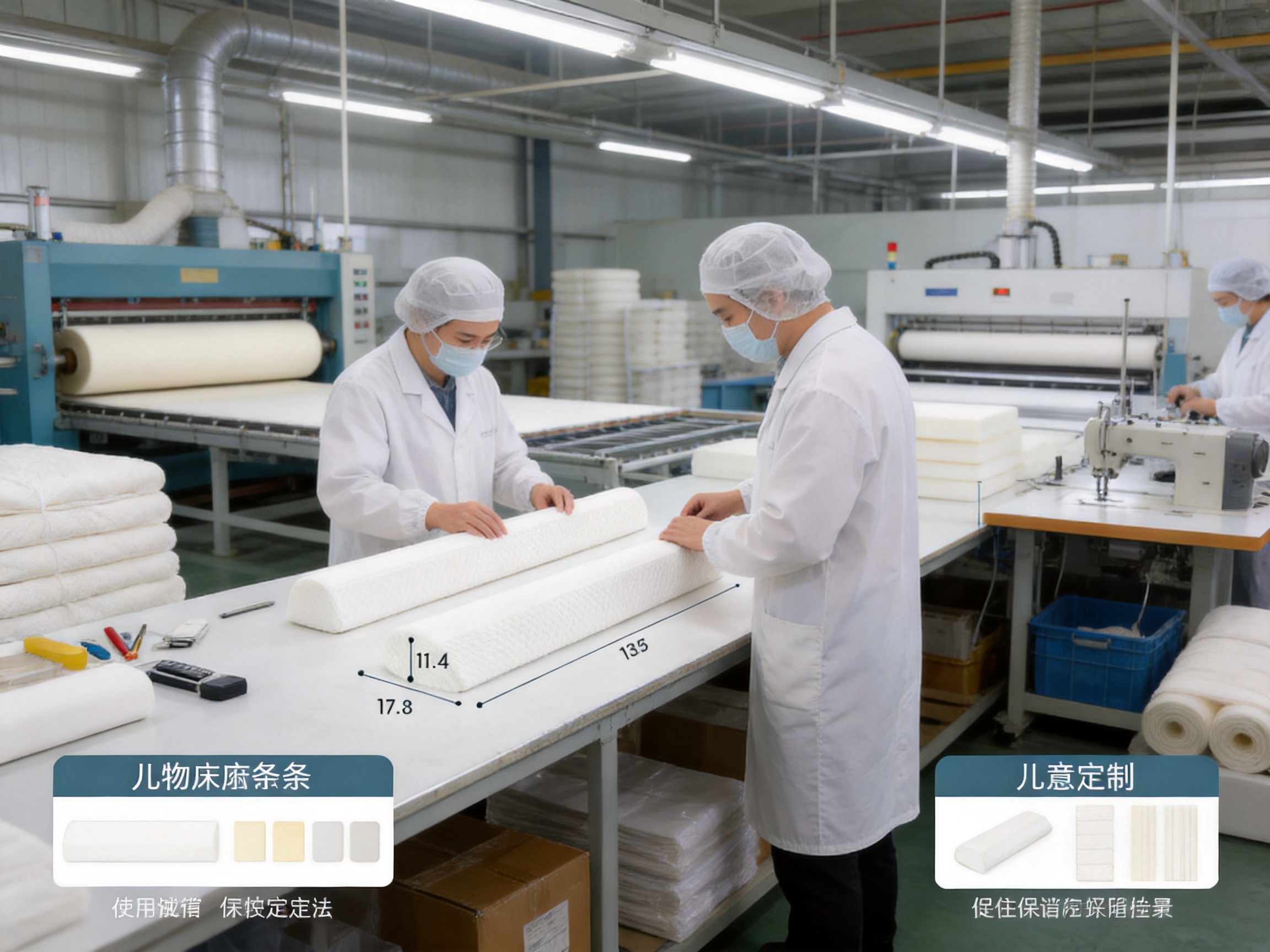
The product is manufactured by Jiangsu Wellcare Household Articles Co., LTD., a company with long-term experience in foam research, sleep materials, and healthy home products. Through material development, foam formulation, cutting, shaping, fabric processing, quality inspection, and customization support, the manufacturer provides a complete supply capability for customers serving domestic and international markets.
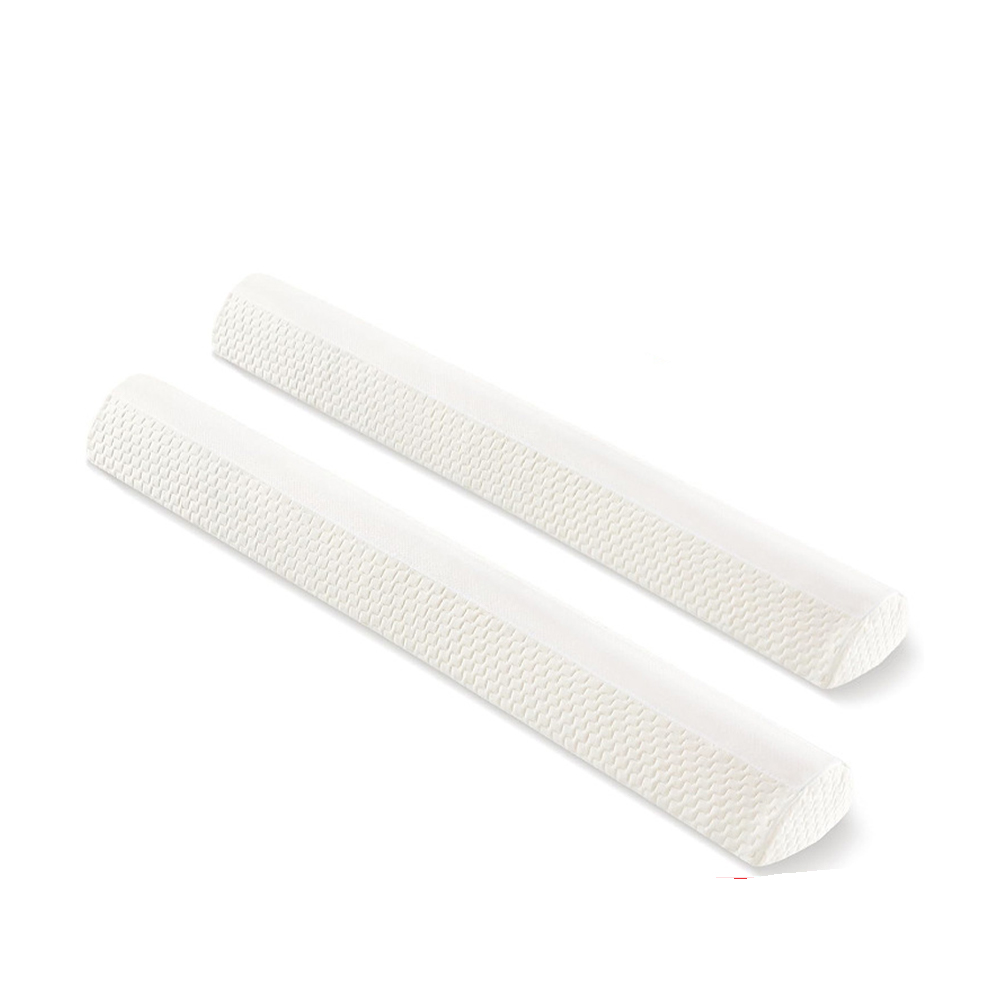
Anti-slip children's bed railing strips
Product Overview
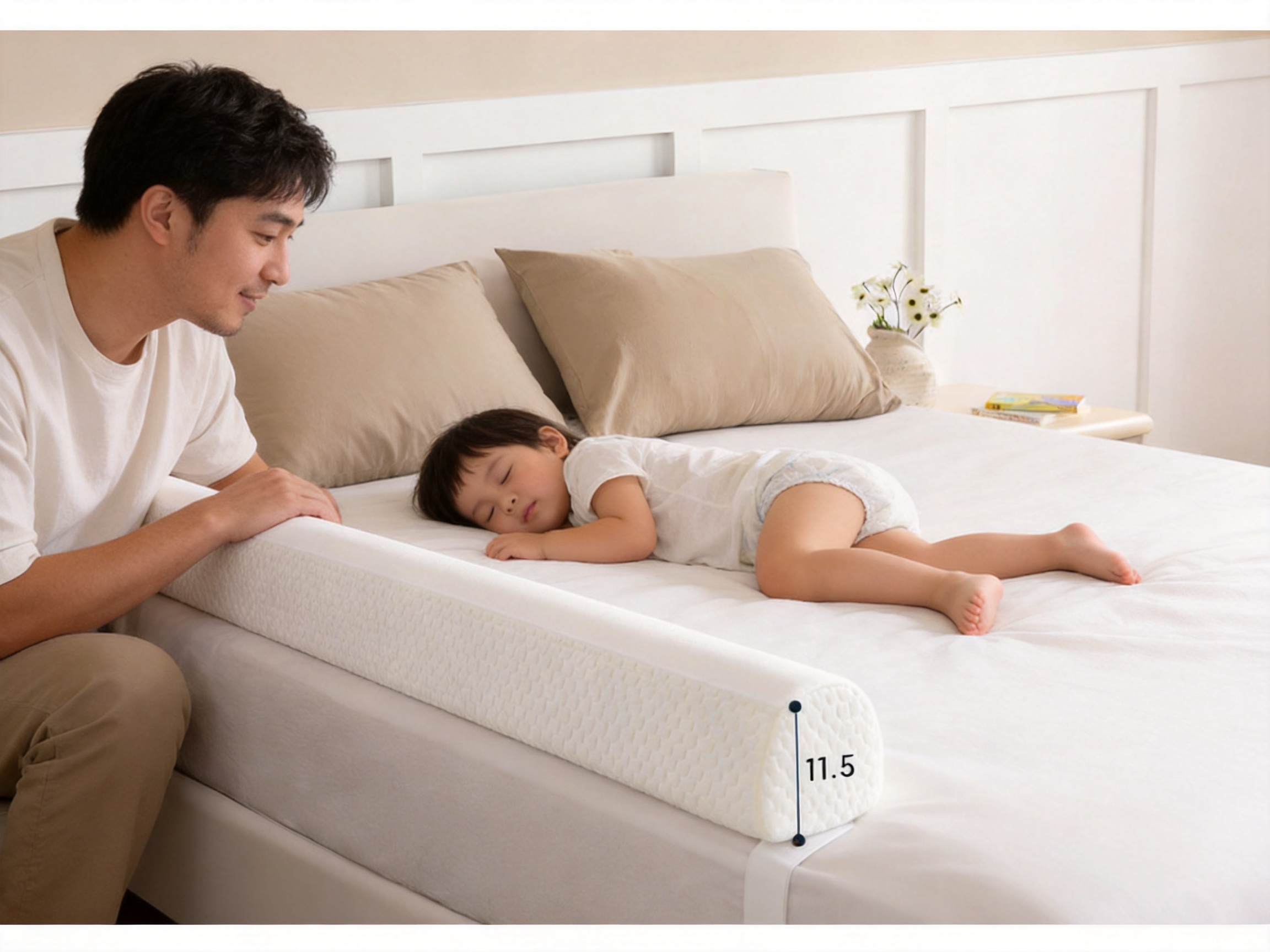
The anti-slip children’s bed railing strip is a rectangular protective component made for use along the edge of a bed. Its principal function is to form a soft barrier between the child and the edge of the mattress or bed frame. It can help reduce the likelihood of a child rolling directly onto the floor and can soften contact when a child turns, sits, or moves against the side of the bed.
The product uses memory foam as its primary filling material. Memory foam is valued for its ability to compress under pressure and gradually recover its original shape. In a bed rail application, this characteristic allows the strip to absorb part of the force produced by ordinary contact. The foam feels softer than hard guardrail materials and provides a more comfortable surface for children who rest against it during sleep.
The outer cover uses polyester fiber fabric with a textured surface. The texture is intended to increase friction between the strip and the surrounding bedding or mattress area. This helps limit unwanted shifting, although the product should always be installed and used according to the final bed design, mounting method, and applicable safety instructions. The surface also provides a practical layer between the foam core and the child.
The standard reference dimensions are 132 centimeters in length, 17.8 centimeters in width, and 11.4 centimeters in height. The listed core height is approximately 12.7 centimeters, and the supplied product information notes that the actual height may vary. This difference reflects the possibility of compression, fabric construction, measurement method, or customized production. Customers should confirm final dimensions before placing a production order, especially when the railing strip is intended for a specific mattress or bed frame.
| Product Attribute | Specification |
| Product Type | Children’s bed railing strip |
| Product Category | Memory foam bed guard |
| Filling Material | Memory foam |
| Outer Fabric | Polyester fiber |
| Reference Dimensions | 132 cm × 17.8 cm × 11.4 cm |
| Reference Core Height | 12.7 cm |
| Color | White |
| Shape | Rectangular |
| Target User | Children |
| Item Number | CD008 |
| Customization | Size, packaging, and fabric options supported |
| Reference Markets | North America and South America |
| Primary Sales Channels | Amazon, independent websites, and other platforms |
Why a Soft Bed Rail Matters for Children
A child’s sleeping environment should be comfortable as well as protective. A bed rail that is too hard may prevent a fall but can create an uncomfortable or potentially painful contact point. Children often sleep in changing positions, and they may press their shoulders, arms, legs, or head against the side of the bed. A soft foam barrier provides a gentler alternative to exposed rigid materials.
Memory foam responds to localized pressure. When a child moves toward the edge, the foam can compress at the point of contact and distribute some of the pressure over a wider area. This cushioning effect may help reduce the severity of minor bumps associated with normal movement. It is not a replacement for adult supervision, correct installation, or a properly designed certified child-safety system, but it can contribute to a more comfortable protective arrangement.
The foam surface also reduces the presence of hard corners and sharp-feeling edges. The enclosed structure is designed to create a continuous barrier instead of leaving gaps between several unrelated cushions. A more continuous form can provide a cleaner appearance and help parents arrange the sleeping area more consistently.
For children transitioning from a crib to a larger bed, the product can support the adjustment to a new sleeping environment. The child may be accustomed to enclosed sides and may feel more secure when a soft boundary remains along the bed edge. For parents, the railing strip can provide additional peace of mind during ordinary sleep, while still maintaining a simple and visually unobtrusive design.
Key Product Advantages
High-Density Memory Foam Cushioning
The central advantage of this product is its memory foam core. High-density foam offers a balance between softness and structural support. Very soft foam may flatten quickly or fail to maintain a useful barrier, while excessively firm foam may feel harsh. The selected memory foam construction is intended to offer cushioning, resilience, and a stable shape for regular household use.
Memory foam also supports a premium product position. Retailers can present the bed rail as more than a basic filler or fabric-covered bolster. It is a purpose-oriented protective component based on a material widely recognized in bedding and sleep products. This makes it suitable for brands that want to build a coordinated children’s sleep collection, including mattresses, pillows, cushions, and other foam products.
Non-Slip Textured Surface
Movement is a common weakness of simple bed-edge cushions. When a child rolls against a loose cushion, the cushion may move away from the intended position. This product addresses that issue with a textured fabric surface designed to enhance friction. The additional surface grip helps the strip remain more stable against the bed or mattress during ordinary use.
The anti-slip surface is particularly valuable for products sold to families who prioritize practical installation and daily convenience. A surface that resists sliding can reduce the need for repeated repositioning. It also helps maintain a more consistent protective line along the bed edge. Actual stability depends on the mattress type, bed construction, installation method, and amount of pressure applied, so product instructions and suitable installation hardware should be considered for the final application.
Soft and Skin-Friendly Contact
Children’s skin is sensitive, and bedding products are used for long periods. The outer fabric is designed to provide a soft, comfortable contact surface without exposed hard edges. The supplied product information identifies the materials as OEKO-TEX® certified, supporting a positioning focused on safer, non-toxic, and odor-conscious home use.
Material certification should be supported by current documentation for the exact production batch, fabric, foam, and finished product configuration. For buyers, this provides an important quality-control point. It also gives retailers a stronger basis for communicating material safety than relying only on general descriptions.
Enclosed Protective Design
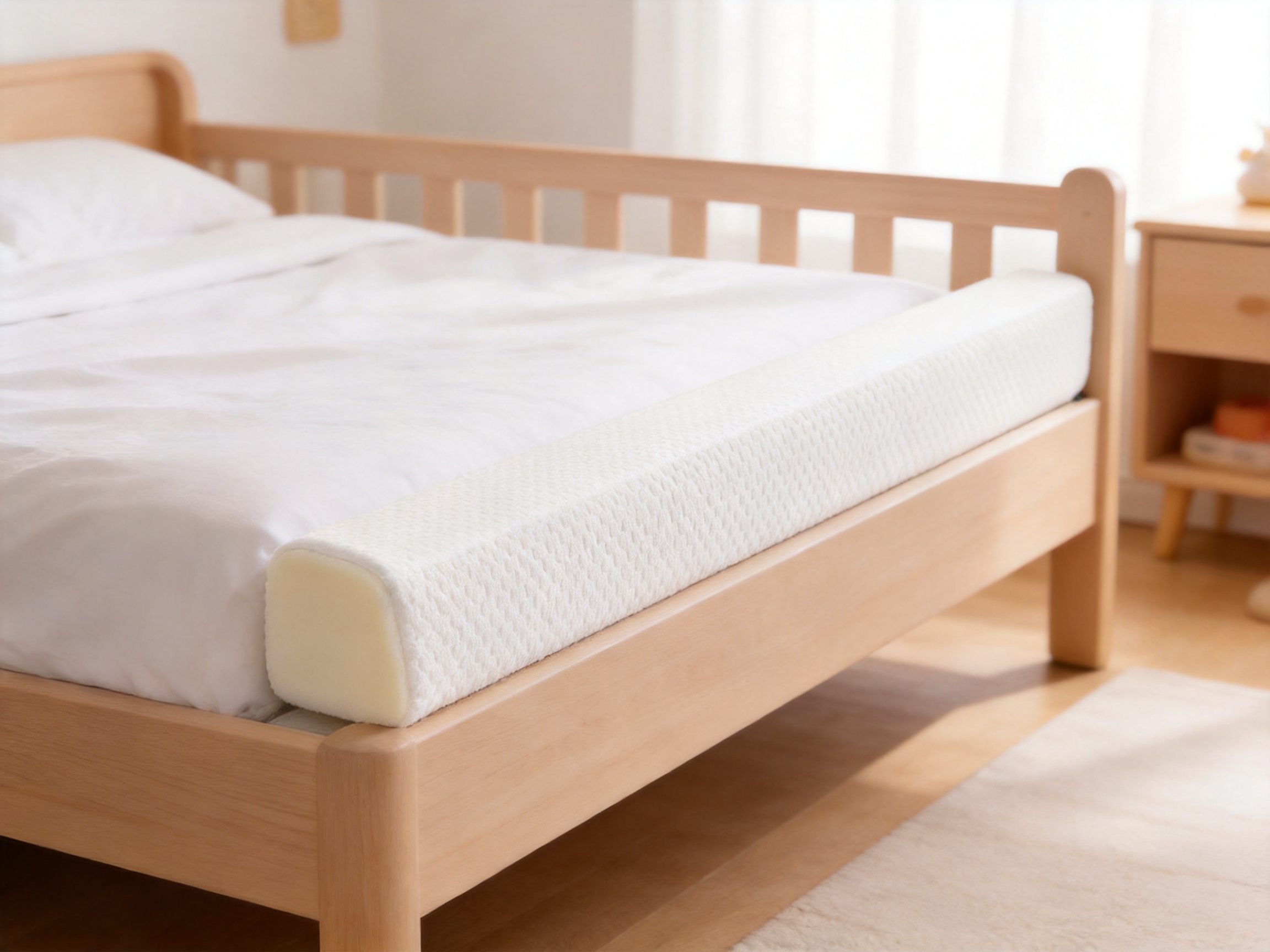
The product is designed as a complete strip rather than a collection of small loose pieces. Its enclosed shape helps form a continuous protective barrier along the edge of the bed. The structure follows the bed’s contours and can be positioned to support a tidy, coordinated sleeping area.
A continuous design may also reduce visual clutter. Parents do not need to combine several unrelated pillows or blankets to create a temporary edge barrier. The pure white exterior provides a clean appearance that can blend with modern children’s rooms, neutral nurseries, hospitality rooms, and minimalist home interiors.
Flexible Customization
Different beds require different dimensions. A single standard size may not fit a narrow toddler bed, an extended single bed, a platform bed, or a customized children’s furniture system. The manufacturer supports customization of size, packaging, and fabric, allowing buyers to develop a more suitable product for their target market.
Customization can include length, width, height, cover material, color, labeling, carton design, and packing quantity, subject to production feasibility and confirmed order specifications. This is especially valuable for distributors and private-label brands that need products aligned with their own assortment strategy.
Comparison with Common Bed-Guard Alternatives
The market includes several types of bed-edge protection. Each category has a different balance of softness, stability, visual appeal, installation complexity, and cost. The following comparison explains how a memory foam railing strip can compete within this product landscape.
| Alternative | Typical Strength | Potential Limitation | Memory Foam Strip Advantage |
| Metal bed rail | Rigid structural support | Hard contact surface and more visible hardware | Offers softer contact and a quieter, more home-friendly appearance |
| Plastic bed guard | Lightweight and easy to clean | Can feel hard and may look less integrated with bedding | Provides cushioning and a textile-covered finish |
| Loose pillow barrier | Low cost and widely available | May shift, flatten, or leave gaps | Uses a purpose-designed shape and anti-slip surface |
| Basic foam roll | Soft and flexible | May lack dimensional stability and finished presentation | Combines structured memory foam with a finished cover |
| Wooden side rail | Strong and traditional | Hard edges, heavier construction, and more complex finishing | Is lighter in visual character and softer at the contact point |
| Inflatable barrier | Compact when stored | Requires inflation and may lose firmness | Ready-to-use foam construction with no inflation process |
The main competitive opportunity is the combination of safety-oriented design and bedding-level comfort. Many rigid guards focus primarily on preventing a fall, while simple pillows focus primarily on softness. This product is positioned between those categories by combining a shaped barrier, cushioning foam, friction-enhancing fabric, and a finished appearance.
Another advantage is manufacturing flexibility. Some competing products are sold only in fixed dimensions because their construction depends on standardized plastic or metal components. A foam-based product can be cut, shaped, and covered in different specifications. This gives importers and brand owners more room to serve regional bed sizes and specialized furniture programs.
Applications and Suitable Users
Cribs and Toddler Beds
The railing strip can be considered for cribs and toddler beds where a soft side barrier is appropriate for the specific product configuration. The dimensions should be checked carefully to avoid creating unsafe gaps or an unsuitable enclosure. The final use must comply with applicable regulations and safety requirements for children’s sleeping products.
Children’s Single Beds
For a child using a single bed, the strip can be positioned along the exposed side of the mattress. The 132-centimeter reference length may suit certain bed layouts, although buyers should measure the intended mattress and frame before selecting the final specification. Multiple strips may be considered for longer beds when the design and installation method allow it.
Widened or Shared Beds
Some families use widened beds or shared sleeping arrangements. In these environments, a soft railing strip may be placed along an exposed edge to create an additional protective boundary. Custom lengths can help match extended mattress configurations and reduce the need to combine mismatched cushions.
Children’s Furniture and Hospitality Rooms
Furniture manufacturers can integrate the product into children’s room packages, transitional beds, or modular sleeping furniture. Hotels, serviced apartments, and family-oriented accommodations may also consider customized versions for rooms designed for guests with young children. Packaging and labeling can be adapted for institutional or retail supply programs.
Private-Label Bedding Collections
Retail brands offering memory foam mattresses, children’s pillows, cushions, and nursery accessories can add the railing strip as a complementary product. A unified foam-material collection helps create cross-selling opportunities and allows customers to purchase coordinated products from one brand.
Manufacturing Expertise and Material Development
The manufacturer behind this product has been active in sleep materials and healthy home products since 2003. Its development history is connected to foam research and industrial production, with experience covering ordinary sponge, memory foam, gel foam, temperature-insensitive memory foam, quick-dry memory foam, flame-retardant sponge, antibacterial sponge, and other specialized materials.
This broad material portfolio is important because bed rail performance depends on more than the name of the foam. Density, resilience, compression behavior, recovery speed, cell structure, firmness, odor control, and compatibility with the outer cover all influence the final user experience. A manufacturer with experience in multiple foam formulations is better positioned to adjust these variables for different applications.
The company reports that its doctor-led research and development team creates more than one hundred new foam materials each year. Continuous material development can support product improvement in areas such as comfort, durability, processing efficiency, environmental performance, and application-specific behavior. For customers, this may provide access to a wider range of foam solutions instead of a single fixed formulation.
The company’s earlier development began in 1993 as a school-run scientific research enterprise. In 2003, it acquired a 12,000-square-meter factory building and cooperated with Huai’an Institute of Technology on new sponge material development. In 2008, it acquired 50,000 square meters of land, expanding the foundation for later manufacturing activities.
This combination of research cooperation and factory investment supports a vertically informed production model. Although individual customers should verify the exact manufacturing scope and certifications for each order, the company’s history indicates long-term involvement in foam technology rather than simple product trading.
Production Process for the Bed Railing Strip
1. Requirement Confirmation
Production begins with a review of the intended application. Buyers should provide the target bed type, required length, width, height, installation method, fabric preference, color, packaging style, and expected order quantity. This stage helps prevent problems caused by unclear dimensions or differences between reference drawings and final production requirements.
For children’s products, the review should also consider potential gaps, compression, edge exposure, cleaning requirements, and age-related use conditions. A finished bed rail must be assessed as part of the complete bed system rather than as an isolated foam object.
2. Foam Formulation and Material Selection
The foam core is selected or formulated according to the required softness, resilience, support, and recovery behavior. Memory foam must be compatible with the intended environment, including room temperature, humidity, expected loading, and duration of use. A formulation that performs well in a mattress may require adjustment when used in a compact protective strip.
Material selection also includes consideration of odor, surface contact, processing stability, and compliance documentation. Where an OEKO-TEX® certified material is specified, the certification status and scope should be checked against the final component or finished item being supplied.
3. Foam Molding, Cutting, or Shaping
Depending on the order design, the foam may be produced in a block and then cut to size, or shaped through a more specialized process. Cutting equipment must maintain dimensional accuracy along the length and height of the strip. Consistent dimensions help the product fit more closely against the intended bed structure.
Edges and corners are checked to ensure that the finished strip does not include unwanted hard spots, torn sections, excessive irregularities, or exposed foam damage. The shaping process is also important for maintaining the visual quality expected from a children’s home product.
4. Fabric Preparation
The polyester fiber cover is cut according to the foam dimensions and sewing allowance. The textured surface is selected to support friction and provide a soft outer finish. Fabric color, weight, stretch, breathability, seam position, zipper configuration, and cleaning instructions should be confirmed before bulk production.
White fabric requires careful handling because dust, oil, marks, and inconsistent dye lots are more visible. Production areas, cutting tables, packaging stations, and inspection procedures must be managed to protect the clean appearance of the finished item.
5. Cover Sewing and Assembly
The fabric panels are sewn into a cover that fits the foam core. Seams should be constructed to balance durability and comfort. Excessive seam thickness may create an uncomfortable ridge, while weak stitching may reduce the service life of the cover. The opening method should allow the cover to be fitted efficiently and, where designed, removed for cleaning.
During assembly, the foam is inserted carefully to avoid tearing, folding, or excessive compression. The cover is then aligned so that the surface texture, seams, corners, and overall shape appear uniform. A well-fitted cover contributes to both product durability and retail presentation.
6. Final Inspection
Inspection may include dimensional measurement, appearance review, cover alignment, seam quality, foam recovery, odor assessment, fabric condition, label verification, and packaging checks. Special attention should be given to the ends of the strip because end deformation can affect how the product meets another rail or bed surface.
For customized orders, inspection should compare the finished product with the approved sample, drawing, or specification sheet. Any changes to fabric, foam density, dimensions, packaging, or labeling should be documented to maintain consistency between production batches.
7. Packaging and Shipment
Packaging protects the railing strip from dust, moisture, compression damage, and staining during storage and transportation. The packaging format can be adapted for e-commerce, wholesale cartons, private-label retail, or bulk export. Buyers should confirm whether compression packing is suitable for the selected foam formulation and whether sufficient recovery time is required before sale.
Clear packaging information can include product dimensions, material composition, care guidance, installation notes, warnings, batch information, and country-specific compliance details. Well-planned packaging also improves warehouse efficiency and reduces confusion when several customized sizes are handled together.
Quality, Safety, and Compliance Considerations
A bed railing strip intended for children should be treated as a safety-related home product. The foam and cover should be selected with attention to material safety, cleanliness, odor, durability, and contact comfort. The supplied product information identifies OEKO-TEX® certification, which is a valuable material-safety feature when supported by current documentation.
Certification is only one part of responsible product development. Buyers should also evaluate the product in its intended bed configuration. The railing should not create dangerous openings, become trapped between the mattress and frame, or be positioned in a way that compromises ventilation or access. Installation instructions should be clear, and parents should be advised to inspect the product regularly.
Children’s products may be subject to different requirements in different countries and sales channels. North American and South American markets can have different labeling rules, flammability requirements, chemical restrictions, packaging expectations, and age-grade considerations. Importers and brand owners are responsible for identifying the requirements that apply to their specific product and destination.
Product claims should also be presented accurately. The railing strip can be described as a cushioning bed-edge barrier that helps reduce the risk of bumps and falls during ordinary movement. It should not be described as an absolute guarantee against injury or as a substitute for supervision. Responsible claims protect consumers and support long-term brand credibility.
Advantages for Importers and Brand Owners
Custom Product Development
The ability to adjust dimensions, fabric, packaging, and related specifications gives importers greater control over product positioning. A retailer serving compact urban apartments may need a shorter strip, while a furniture manufacturer may require a longer version with a specific cover design. Custom processing allows the item to be adapted rather than forcing every customer into one standard format.
Private-Label Potential
The product can be developed for authorized own-brand programs. Private-label customers may request branded labels, instruction sheets, product cards, color boxes, barcode placement, and coordinated packaging. This makes the railing strip suitable for companies building a complete children’s sleep range.
Complementary Product Opportunities
The manufacturer’s wider product capabilities include memory foam mattresses, pillows, cushions, pet products, children’s foam products, and other sleep-related materials. A buyer can therefore explore a broader range of products through one experienced foam supplier. This may simplify development, sampling, quality communication, and logistics.
International Market Experience
The company reports that its products have been supplied to markets including the United States, Germany, Japan, the United Kingdom, Canada, Australia, and Kuwait. It also reports experience with cross-border supermarkets and e-commerce development. This international exposure can be useful for customers who need export-oriented communication, packaging coordination, and product adaptation.
Manufacturing Stability
Long-term factory investment and continued research activity can support more stable sourcing than an occasional trading arrangement. Buyers should still conduct their own audits and inspections, but a company with established production infrastructure may offer stronger continuity for repeat orders, custom specifications, and product improvements.
Design and Merchandising Recommendations
The pure white exterior creates a neutral foundation for merchandising. It can be presented in nursery collections with soft gray, beige, blue, green, or natural wood themes. White also communicates cleanliness and allows the product to fit a wide range of children’s room styles without competing with colorful bedding.
Retail photography should show the product in a realistic bed setting and should make the dimensions easy to understand. Packaging should explain the function of the memory foam core, the textured surface, the intended bed applications, and the availability of customized sizes. Diagrams can be useful for showing positioning and basic installation principles.
Online listings should distinguish between the reference dimensions and customized dimensions. The supplied standard reference is 132 centimeters long, 17.8 centimeters wide, and 11.4 centimeters high, while the product information also lists a 12.7-centimeter core height. This should be clarified in the final listing so consumers are not confused by differences between total product height and internal core height.
Retailers should avoid presenting the item as an ordinary pillow, despite some product database attributes describing it with pillow-related terms such as rectangular shape, pillow core fabric, and functional pillow type. Its intended commercial identity is a memory foam bed guard or children’s bed railing strip. Accurate categorization helps customers find the product and reduces incorrect use.
Care and Use Guidance
The finished product should be placed on a suitable bed surface according to the supplied instructions. Before use, the purchaser should check the cover, seams, foam shape, and contact areas. The strip should be inspected regularly for damage, excessive compression, tearing, loose threads, or movement during use.
Cleaning instructions depend on the final cover construction. If the cover is removable, the washing temperature, drying method, and detergent recommendations should be followed carefully. The memory foam core should not normally be soaked unless the manufacturer specifically approves that method. Moisture trapped inside foam can affect hygiene, odor, and recovery performance.
When the product is newly unpacked, it may require time to recover its full shape, particularly if it has been compressed for shipment. It should be allowed to expand in a clean, ventilated area according to the supplier’s instructions. Strong chemical cleaners, high heat, and sharp objects should be avoided because they may damage the fabric or foam.
Parents should make sure that the bed rail is not used in a configuration that creates an unsafe gap. The mattress should fit the bed frame properly, and the product should not be stacked with unrelated cushions in a way that could interfere with the child’s breathing or movement. The specific age suitability should be determined by the final product design and applicable regulations.
Environmental and Sustainability Considerations
Foam products should be evaluated not only for comfort and performance but also for resource use, manufacturing waste, packaging, and service life. A durable product that maintains its shape can reduce the frequency of replacement. Efficient cutting plans can help reduce offcuts, while suitable packaging can limit unnecessary material use without sacrificing protection.
The manufacturer reports investment in environmentally friendly energy systems and improved environmental management practices. These efforts indicate an intention to integrate sustainability into factory operations. Buyers seeking environmental claims should request current, product-specific evidence and should distinguish between factory-level initiatives and the environmental profile of the finished bed rail.
Material selection can also influence sustainability. Polyester covers may provide durability and consistent production, while memory foam offers a long-established performance profile in bedding applications. Future product development may explore recycled content, lower-emission formulations, improved recyclability, and packaging reduction, subject to safety and performance requirements.
Why Choose an Experienced Foam Manufacturer
Foam products may appear simple from the outside, but their performance depends on formulation, density, cutting accuracy, recovery behavior, cover fit, sewing quality, and storage conditions. Working with an experienced foam manufacturer gives buyers access to technical knowledge across these stages.
A manufacturer with its own research and development capability can help evaluate whether a proposed foam is appropriate for a bed rail, mattress, pillow, cushion, or other application. It can also assist with changes when a buyer needs a softer contact feel, greater shape retention, improved temperature behavior, faster recovery, or a different compression response.
Wellcare’s product history includes ordinary sponge, memory foam, gel foam, temperature-insensitive memory foam, quick-dry memory foam, flame-retardant sponge, and antibacterial sponge. This breadth may help customers compare materials instead of selecting a solution based only on price. A more suitable material can improve customer satisfaction and reduce quality complaints over the product’s selling life.
The company’s experience with cross-border supply, e-commerce, supermarkets, hotels, and export markets also supports a diversified commercial foundation. Customers can discuss not only production but also packaging, private labeling, platform sales, and regional market needs.
Frequently Asked Questions
What is the main purpose of this product?
The main purpose is to create a soft, cushioned barrier along an exposed bed edge. It is designed to help reduce the risk of children rolling off the bed and to soften contact with the side of the sleeping area during ordinary movement.
What is the product filled with?
The product uses memory foam as its filling material. The foam provides cushioning, resilience, and a soft contact feel compared with rigid metal, plastic, or wooden bed rails.
Does the surface help prevent movement?
Yes. The outer fabric has a textured, non-slip surface designed to increase friction and improve stability. Actual performance depends on the mattress, bed frame, installation method, product dimensions, and force applied during use.
What are the reference dimensions?
The listed reference dimensions are 132 centimeters in length, 17.8 centimeters in width, and 11.4 centimeters in height. The supplied information also identifies a 12.7-centimeter core height and notes that actual height may vary. Final dimensions should be confirmed for each order.
Can the product be customized?
Yes. Customization is supported for dimensions, packaging, and fabric. Buyers should provide detailed technical requirements and approve a sample or specification before bulk production.
Is the product suitable for all children’s beds?
No product should be assumed to fit every bed. The mattress size, frame design, exposed edges, installation method, and applicable safety requirements must be checked before use. Buyers should confirm the final configuration with the manufacturer and follow the supplied instructions.
Is the product a substitute for supervision?
No. It is a cushioning bed-edge product and should not be presented as a complete substitute for supervision or a guarantee against injury. Parents and caregivers should inspect the installation and monitor the child’s sleeping environment.
Is the material certified?
The supplied product information identifies OEKO-TEX® certification. Buyers should request current certification documentation covering the specific materials and finished configuration supplied in their order.
Can the cover be washed?
Care depends on the final cover design. If the cover is removable, buyers should follow the washing and drying instructions supplied with the exact product. The foam core should not be soaked unless specifically approved by the manufacturer.
Who manufactures the product?
The product is manufactured by Jiangsu Wellcare Household Articles Co., LTD., a Chinese manufacturer specializing in foam materials, sleep products, and healthy home products. The company supports customized processing and authorized own-brand programs.
Does the company support dropshipping?
The supplied product information states that dropshipping is not supported. The product is more suitable for importers, distributors, retailers, private-label brands, and other customers purchasing through conventional wholesale or customized production arrangements.
Which markets are identified for the product?
The listed main sales regions are North America and South America. The company also reports wider export experience in several international markets. Buyers remain responsible for checking the regulations and labeling requirements of their specific destination.
Conclusion
The anti-slip memory foam children’s bed railing strip offers a practical combination of cushioning, stability, comfort, and clean design. Its high-density memory foam core helps soften contact, while the textured polyester cover is designed to increase friction and reduce unwanted shifting. The enclosed rectangular structure creates a more organized barrier than loose pillows or basic foam rolls, and the white exterior blends easily with contemporary children’s rooms.
Its strongest competitive advantage is the balance between softness and structure. Rigid bed rails may provide a firm boundary but can introduce hard contact points. Loose cushions may feel soft but may shift or lose their shape. This product is designed to bridge those needs through shaped memory foam, a finished cover, and customizable production.
The manufacturer adds further value through long-term foam experience, research and development capabilities, international supply experience, private-label support, and customization options. Its history in memory foam, gel foam, quick-dry foam, flame-retardant foam, antibacterial foam, and other specialized materials provides a technical foundation for developing products beyond standard bedding components.
For families, the product can contribute to a softer and more comfortable sleeping environment. For retailers and brand owners, it provides an opportunity to expand children’s sleep collections with a specialized protective accessory. For importers and furniture manufacturers, customized dimensions, packaging, fabric, and branding create flexibility for different markets and bed designs.
As with every child-related sleep product, correct installation, suitable dimensions, regular inspection, accurate claims, and compliance with local safety requirements are essential. When these factors are addressed, the memory foam bed railing strip can serve as a useful addition to modern children’s bedding and home-furnishing programs.
References
1. Product specification sheet for Anti-Slip Children’s Bed Railing Strips, item number CD008, supplied manufacturer information.
2. Material and product information concerning memory foam cores, polyester fiber covers, textured anti-slip surfaces, and reference dimensions.
3. OEKO-TEX® textile and material safety certification principles, general reference material.
4. Manufacturer history and company information for Jiangsu Wellcare Household Articles Co., LTD.
5. General product-development principles for children’s bedding, foam cushioning, bed-edge protection, and home-product quality control.
6. General guidance concerning children’s sleep environments, product inspection, installation suitability, and responsible safety claims.
Product: Anti-slip children's bed railing strips

PREV:Why Foldable Memory Foam Sofas Are Transforming Children’s Flexible Spaces
NEXT:Advanced Gel Memory Foam Bun Pillow for Cooler, More Supportive Sleep
NEXT:Advanced Gel Memory Foam Bun Pillow for Cooler, More Supportive Sleep
Interested in cooperation or have questions?
Related News
WELLCARE was founded in 2003, boasting over a decade of profound and extensive experience.
Quick Links
Product
Media Centre
Contact Information
- [email protected]
- +86-517-84998062
- +86-15152354988
- No. 168 Nenjiang Road, Huaiyin District, Huai'an City, Jiangsu Province, China
Copyright © Jiangsu Wellcare Household Articles Co., LTD. All Rights Reserved.
Custom Memory Gel Mattress Manufacturers
