

 English
 日本語
 Español



Pan Ruoxi — Product Sales Consultant

Home / Author / Pan Ruoxi — Product Sales Consultant / Eight-Piece Foldable Children's Building Block Sofa Set: A Flexible, Safe, and Creative Seating Solution
Product Category
NEW Category
Contact us
Eight-Piece Foldable Children's Building Block Sofa Set: A Flexible, Safe, and Creative Seating Solution
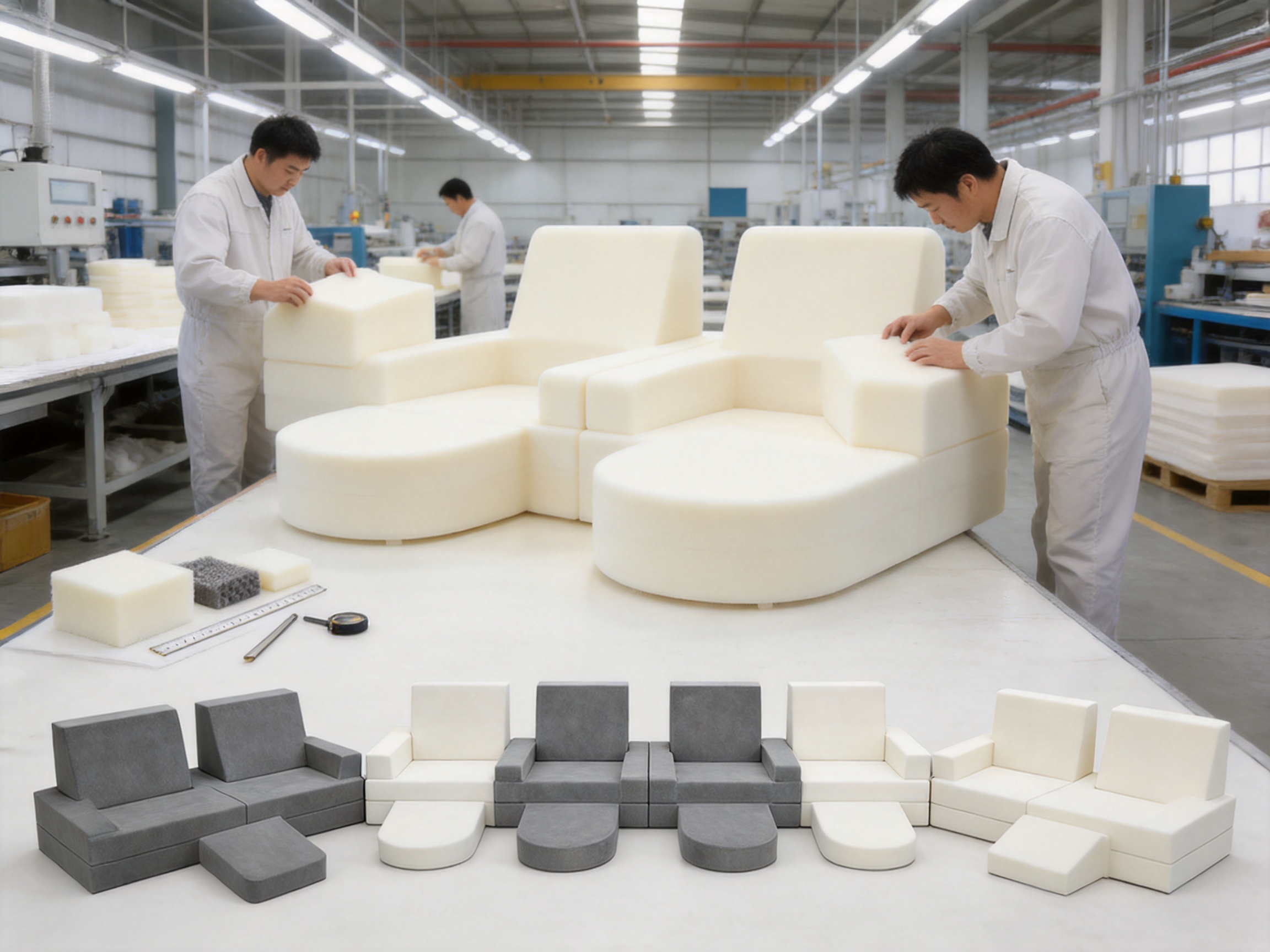
Children's furniture must do more than provide a place to sit. It should support play, rest, reading, social interaction, movement, and discovery while remaining comfortable, safe, durable, and easy for adults to manage. The eight-piece foldable children's building block sofa set is designed around this broader understanding of childhood use. Instead of functioning as a fixed miniature sofa, it works as a modular soft-play system that can be rearranged into a sofa, playbed, tunnel, fortress, reading corner, climbing area, or imaginative construction.
Its design combines high-density foam support, slow-rebound comfort, frameless construction, rounded edges, lightweight modules, and a neutral gray and off-white appearance. These characteristics make the set suitable for children's bedrooms, living rooms, playrooms, daycare centers, kindergartens, reading areas, and other educational or family environments. The product is also practical for homes where space is limited because the individual pieces can be moved, stacked, rearranged, and stored more easily than conventional framed furniture.
Manufactured by Jiangsu Wellcare Household Articles Co., LTD., the product reflects a wider manufacturing background in foam materials, memory foam, healthy home products, and sleep-related applications. The company has developed foam technologies for many years and maintains capabilities in material research, product development, manufacturing, and international supply. This combination of product flexibility and material expertise gives the sofa set a strong position in the children's furniture market.
A Modular Product Built for More Than Sitting
The central feature of the set is its eight-piece modular structure. Each component can be used independently or combined with other components. This allows parents, teachers, and children to change the configuration according to the activity, available floor space, or developmental needs of the child.
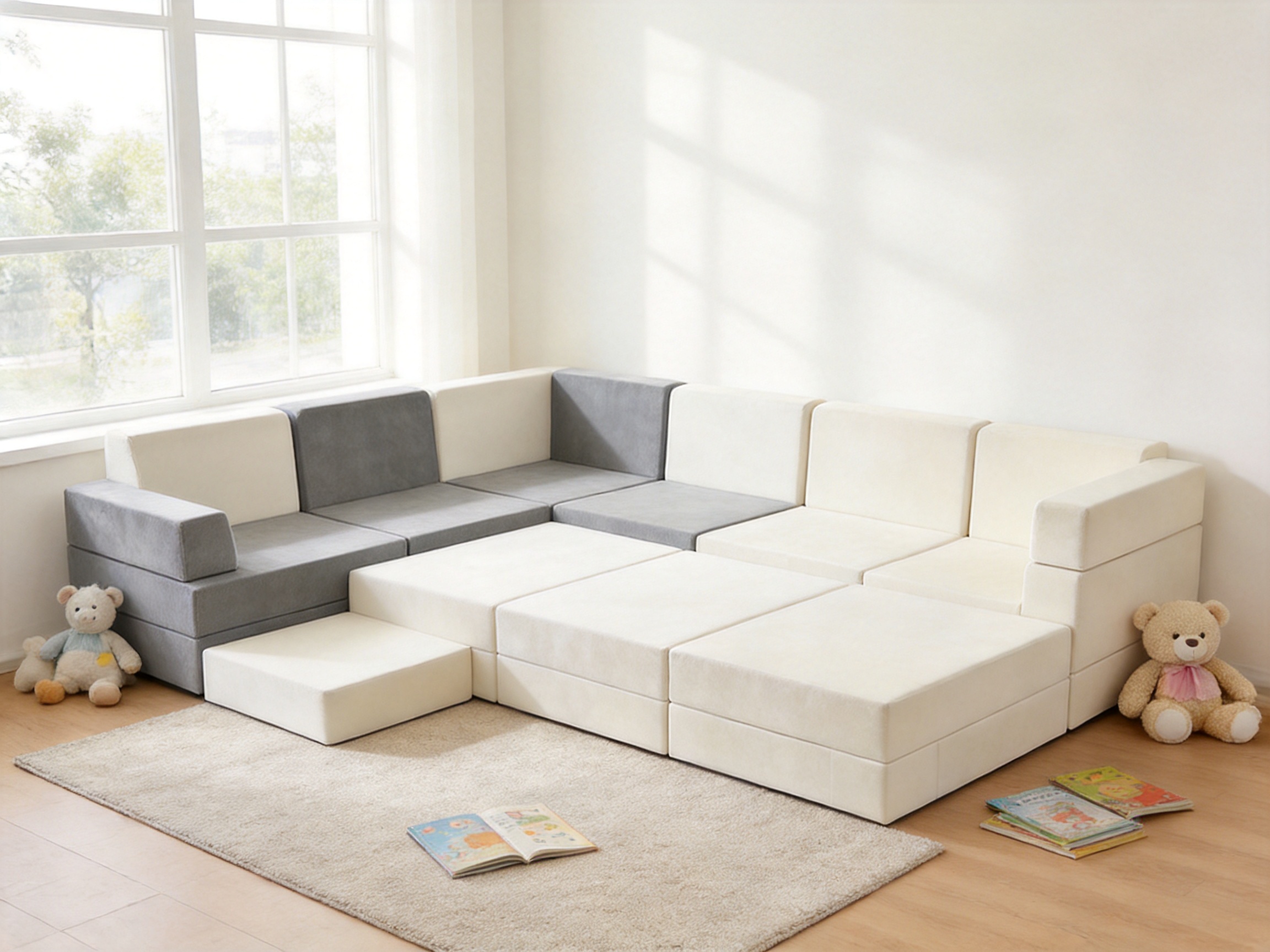
In its most conventional arrangement, the pieces can form a low children's sofa. This configuration provides a comfortable location for sitting, watching, talking, drawing, or reading. When the modules are placed side by side, they can also create a larger resting surface or a low playbed. This is useful for quiet time, afternoon naps, storytelling, and indoor relaxation.
Children can also use the components as construction elements. By arranging the blocks around an open space, they can create a small fortress, pretend house, tunnel, shop, stage, or reading nook. The product therefore encourages open-ended play instead of prescribing only one activity. The same pieces may be used differently from one day to the next, helping children develop imagination, planning skills, cooperation, and spatial awareness.
The modular concept also supports different ages and abilities. Younger children may use the pieces as low, simple seating or soft floor cushions. Older children may combine them into more complex structures. Adults can select simpler arrangements for supervised play and more imaginative configurations when children have become familiar with safe handling and movement around the product.
Unlike a fixed sofa, this product can adapt as a room changes. A family may place it in a playroom during the day, move it to a living room for family activities, and store it against a wall when additional floor space is needed. Educational institutions can use it for group reading in the morning, movement activities in the afternoon, and temporary rest areas at other times.
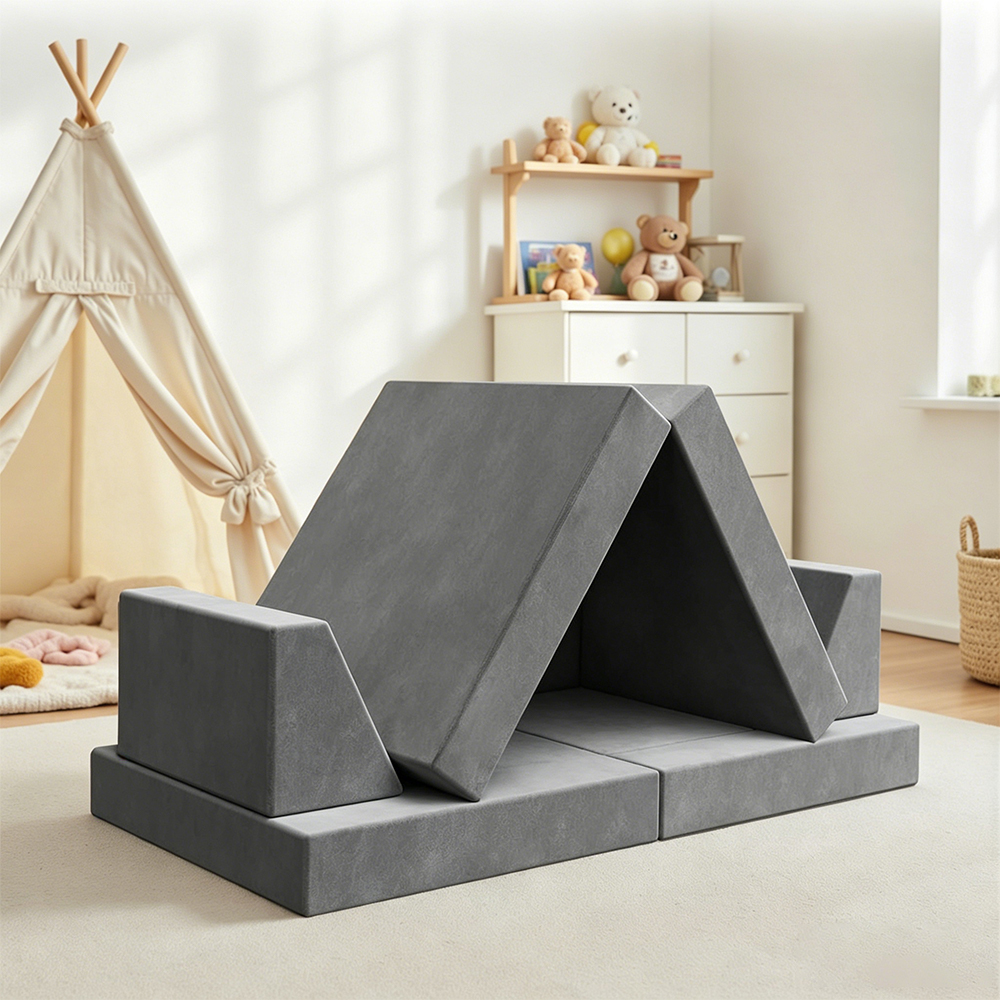
Eight-piece foldable children's building block sofa set
High-Density Foam Support and Slow-Rebound Comfort
The internal filling is high-density sponge, with the product concept emphasizing memory foam and slow-rebound support. This type of foam is valued for its ability to respond gradually to pressure. When a child sits or leans against the sofa, the material distributes pressure across a broader area rather than reacting like a hard, rigid surface.
Slow-rebound behavior contributes to a more comfortable seating experience. The foam gently yields under the body and then gradually returns toward its original shape after the load is removed. This combination of softness and resilience is important in children's furniture because the product must feel comfortable without becoming unstable or easily flattened.
High-density foam also provides structural support without requiring a metal or wooden frame. A lower-density filling may feel soft at first but can lose its shape more quickly under repeated use. High-density material is better suited to a product that children may sit on, lie across, crawl over, lean against, and rearrange frequently. Its internal structure helps the modules maintain their form during everyday use.
The product is not designed as a rigid adult sofa scaled down for children. Its support system is intentionally softer and more forgiving. Children often change position rapidly, move from sitting to kneeling, or use furniture as part of an imaginative game. A resilient foam core can accommodate these movements more comfortably than hard furniture surfaces.
At the same time, comfort should not be confused with unlimited climbing or unsupervised high-impact use. The modular design is intended for ordinary children's sitting, lying, crawling, and low-level play. Parents and institutional caregivers should position the modules on a stable, clear floor and supervise activities that involve climbing, jumping, or building taller structures.
Why Foam Construction Offers a Competitive Advantage
Many children's sofas use a rigid internal frame covered by padding and upholstery. Although framed construction can provide a familiar sofa shape, it may introduce hard corners, rigid edges, and hidden structural components. A fully boneless design takes a different approach by using foam as the main structural and cushioning material.
The absence of a metal or wooden frame eliminates exposed hard components within the seating structure. The result is a softer product that is easier to move and more suitable for floor-level children's environments. Rounded foam surfaces also reduce the sharp, rigid contact points associated with conventional furniture.
Compared with ordinary loose cushions, high-density foam modules offer greater stability and shape retention. Loose cushions may slide apart or collapse under repeated movement, while purpose-built modules are designed to work together as a coordinated system. Compared with a single-piece foam sofa, the eight-piece layout offers much greater flexibility because each part can be repositioned.
The product therefore occupies a useful middle ground between children's furniture and soft-play equipment. It provides the comfort of upholstered seating, the flexibility of building blocks, and the cushioning qualities of foam play products. This combination is a significant advantage for buyers who want one product to serve several functions.
Frameless Construction for a Softer Children's Environment
Safety is a primary consideration in any product intended for children. The sofa set uses a fully boneless structure, meaning that it does not rely on a metal or wooden frame inside the soft modules. This design reduces the possibility of children striking hard structural parts during normal use.
The 360-degree rounded-edge concept further supports a child-friendly form. Children may approach the modules from different directions, crawl around them, lean on them, or incorporate them into a game. Rounded surfaces are more forgiving than sharp corners and help create a visually softer environment.
Because the product sits low to the ground, it is also easier for children to get on and off than a tall chair or high sofa. A low profile can support more independent use while reducing the distance of a potential fall. The listed overall specification is 140 by 70 by 52 centimeters, although buyers should confirm the exact configuration, module dimensions, and final packed measurements with the supplier before ordering.
Safety also depends on the environment surrounding the sofa. The product should be used on a level, clean surface away from stairs, heaters, sharp furniture, glass, and unstable objects. Caregivers should inspect the modules periodically for damage, loose coverings, excessive compression, or contamination. Children should not be allowed to use the product as a substitute for climbing equipment or a high platform.
The frameless structure is particularly valuable in settings where several children share the same space. In a reading room or daycare environment, soft rounded modules can reduce the visual and physical harshness of the room. The furniture becomes part of a calmer environment in which children can transition between active and quiet activities.
Fabric, Color, and Everyday Interior Compatibility
The outer surface is described as skin-friendly short-pile fabric. Short-pile textiles offer a soft tactile experience while presenting a relatively clean, modern appearance. The light gray and off-white color scheme creates a neutral visual foundation that can work with a wide range of interior styles.
Many children's products use very bright colors or cartoon graphics. These designs can be attractive, but they may not suit every home, classroom, hotel, therapy space, or modern living room. The restrained gray color gives buyers more freedom to combine the sofa with wood furniture, pastel accessories, colorful toys, neutral walls, or contemporary interiors.
The modern minimalist appearance also helps the product transition between age groups. A highly themed children's sofa may quickly appear too young as a child grows. A simple geometric design can remain useful for a longer period because it does not depend on a particular cartoon character or temporary trend.
Short-pile fabric can also be easier to maintain than longer, shaggy textiles that trap more crumbs, dust, and fibers. Nevertheless, the specific cleaning method depends on the fabric construction and whether the covers are removable. Buyers should ask for care instructions before placing the product in a high-use environment. Routine vacuuming, prompt treatment of spills, and avoidance of excessive moisture can help preserve the surface.
Design for Homes and Institutions
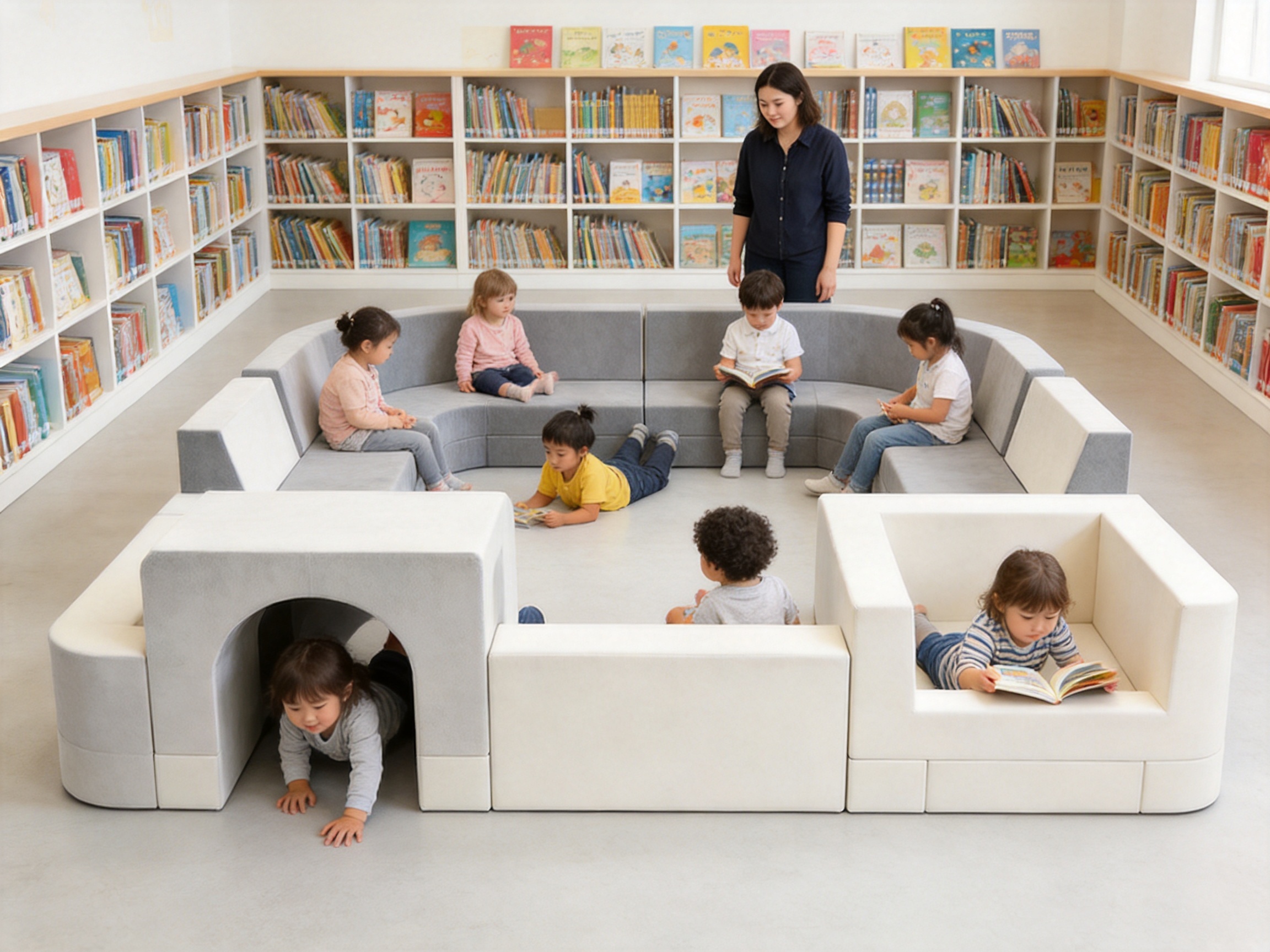
The set is identified as suitable for living-room use, but its applications extend beyond the home. It can be placed in children's bedrooms, family rooms, play areas, preschools, kindergartens, libraries, early childhood education centers, waiting areas, parent-child activity rooms, and indoor recreation spaces.
For residential buyers, the most important benefits may be portability, storage, and multifunctionality. A single set can replace a small children's sofa, floor cushions, a reading nook, and certain low-level play structures. This can be valuable in apartments or rooms where every square meter must serve several purposes.
For institutional buyers, the modular format allows the furniture layout to change quickly. Staff can create a semicircle for group discussion, a line of seats for story time, a larger mat-like surface for rest, or separated activity zones for small groups. The modules can be moved without the effort normally associated with heavy framed furniture.
The neutral appearance may also support professional interior design requirements. Schools, childcare providers, clinics, hotels, and commercial family spaces often want children's furniture that is welcoming without appearing visually chaotic. The gray and off-white palette provides a calm base while children's books, toys, artwork, and learning materials add color.
Supporting Imagination, Movement, and Development
Open-ended physical play is one of the defining advantages of a building block sofa. Children are not limited to using the product in the way adults initially arrange it. They can experiment with balance, enclosure, pathways, and shape while using the modules as soft construction elements.
Building a tunnel or small fortress requires children to make decisions about position and sequence. They must consider which modules will form a wall, where an entrance should be placed, and how much space is needed inside. These simple activities can encourage problem-solving and early spatial reasoning.
When children work together, the set can also support communication and social development. One child may propose a design, another may move a module, and a third may decorate or assign a role within the pretend space. This type of cooperative play can help children practice negotiation, turn-taking, listening, and shared decision-making.
The modules can support movement in a controlled indoor environment. Children may crawl through a low passage, step across a series of soft blocks, or move from one section to another. Such activities encourage body awareness and coordination. The product should always be used according to the child's age, ability, and the supervision level available.
Quiet activities are equally important. A group of modules can form a comfortable reading corner where children look through books, listen to stories, or rest after active play. A small enclosed arrangement may provide a sense of personal space without isolating the child completely from caregivers.
Because the configuration can be changed, the product helps prevent the room from becoming repetitive. Adults can introduce new arrangements periodically, while children can be invited to design their own layouts. This transforms furniture from a passive object into an active part of the learning environment.
Portable, Foldable, and Space-Efficient Operation
Each module is lightweight and portable, which is one of the most practical differences between this product and conventional children's sofas. A fixed sofa may require two adults to move and can remain in one location for years. Individual foam modules can be carried, stacked, separated, and repositioned more easily.
The foldable and stackable concept is especially helpful for homes with limited storage. When the sofa is not being used, the modules can be organized into a compact arrangement rather than occupying the entire center of the room. In educational spaces, staff can clear the floor for cleaning, group activities, or emergency access.
Portability also benefits families who change rooms or move homes. The set is easier to transport than large rigid furniture. It can be used in a child's bedroom during the early years, then moved to a family room or playroom as needs change.
Storage should be carried out in a dry, ventilated environment. Foam products should not be compressed excessively for extended periods unless the supplier specifically confirms that the method is suitable. After unpacking or long-term storage, the modules should be allowed to recover their shape and air out according to the manufacturer's instructions.
The absence of installation service is consistent with the product's simple modular format. There is no complex frame assembly or permanent installation requirement. Users should still inspect the package, confirm that all eight modules are present, and follow any provided instructions regarding expansion, placement, cleaning, and use.
Material Safety and Quality Considerations
The product information identifies the materials as skin-friendly and environmentally responsible, with OEKO-TEX® certification referenced in the product description. Textile certification can provide useful assurance that tested materials meet defined requirements concerning certain harmful substances. However, buyers should request current certification documents, the applicable product scope, and testing details for the exact production batch or material combination.
For children's furniture, material safety involves more than the foam core. The outer fabric, thread, dyes, zippers, adhesives, labels, packaging, and any treatment applied to the material may all be relevant. Responsible sourcing and clear documentation help importers and distributors evaluate whether the product meets the requirements of the destination market.
Foam density, rebound behavior, compression performance, odor, flame performance, and durability can also influence product quality. A professional manufacturer should be able to explain its material specifications and quality-control procedures. Buyers supplying schools, hotels, or retailers may need additional testing based on local regulations and intended use.
The company behind the product has a broad foam-material portfolio that includes ordinary sponge, memory foam, gel foam, temperature-insensitive memory foam, quick-dry memory foam, flame-retardant sponge, and antibacterial sponge. This range indicates experience with adjusting foam characteristics for different applications. Product-specific documentation remains important, but a wide material platform can support more informed design and formulation decisions.
Parents and caregivers should allow newly unpacked foam products to ventilate if they have a temporary manufacturing or packaging odor. The product should be kept away from open flames and intense heat, and cleaning agents should be tested carefully on an inconspicuous area. The supplier's care and safety guidance should take priority over general recommendations.
Manufacturing and Research Strengths
Jiangsu Wellcare Household Articles Co., LTD. was founded in 2003 and focuses on high-performance sleep materials and healthy home products. Its development is connected with foam research and production, making the company relevant to a children's sofa that depends on the performance of its internal cushioning material.
The company describes a doctor-led research and development team that develops more than one hundred new foam materials each year. Such a development program suggests an emphasis on formulation, testing, and continuous optimization rather than reliance on a single standard foam recipe.
Its reported product portfolio includes multiple foam types with different performance characteristics. Ordinary sponge may be appropriate for general cushioning, while memory foam can be developed for pressure response, gel foam for modified comfort and thermal behavior, quick-dry foam for moisture-sensitive applications, and flame-retardant or antibacterial materials for specialized requirements.
This material diversity can support product customization at the engineering level even though the listed sofa itself is not customizable. A manufacturer with experience across multiple foam families may be better positioned to evaluate density, hardness, resilience, recovery time, surface feel, and durability for a particular application.
The company's history also includes cooperation with Huai'an Institute of Technology and Qingdao University of Science and Technology. Cooperation with academic and technical institutions can provide access to research resources, testing knowledge, and material-development expertise. It may also help connect practical manufacturing needs with laboratory investigation.
The company reports that its history began in 1993 as a school-run scientific research enterprise. In 2003, it purchased a 12,000-square-meter factory building and jointly developed a new sponge material with Huai'an Institute of Technology. In 2008, it purchased 50,000 square meters of land. These developments indicate a long-term investment in production capacity and material infrastructure.
By 2010, the company's products were supplied to cross-border supermarkets in the United States, Germany, and Japan. It later expanded exports to the United Kingdom, Canada, Australia, and Kuwait. International supply experience can be valuable for buyers because it may involve familiarity with export packaging, documentation, communication across markets, and the expectations of overseas customers.
Process Control from Foam Development to Finished Product
A foam furniture product requires coordination between material development and physical construction. The foam must be produced or selected with the required density and resilience. It must then be cut, shaped, assembled, covered, inspected, packed, and shipped without compromising its intended performance.
At the material stage, manufacturers may evaluate density, hardness, compression behavior, rebound speed, dimensional recovery, and long-term deformation. For a modular children's sofa, these properties influence whether the pieces feel stable enough for sitting while remaining soft enough for comfortable play.
At the cutting and shaping stage, accurate dimensions are important. Modules that are intended to combine into a sofa, bed, tunnel, or fortress should fit together consistently. Uneven cuts or inconsistent sizes can affect the appearance and stability of the final configuration.
At the upholstery stage, the fabric must be fitted securely and evenly. Seams should be checked for strength, and the covering should not create uncomfortable wrinkles or exposed fastening points. The rounded design requires careful control around corners so that the finished surface remains smooth.
At the final inspection stage, the manufacturer can verify appearance, dimensions, fabric condition, module quantity, labeling, packaging, and overall workmanship. Buyers may request inspection standards, sampling procedures, and quality records when purchasing for distribution or institutional use.
Packaging is another important part of the process. Foam can be compressed for transport, but the package must protect the fabric and prevent contamination or damage. Clear unpacking and recovery instructions help customers achieve the intended final shape after delivery.
Competitive Advantages for Buyers and Distributors
The product has several advantages over ordinary fixed children's sofas. First, its eight-piece construction offers far more configuration options. A fixed sofa generally provides one seating shape, while this set can become furniture, play equipment, and a rest surface.
Second, the fully boneless structure creates a softer overall product. It avoids the rigid internal frame used in many traditional sofas and is therefore better aligned with floor-level children's activities.
Third, high-density foam gives the modules more supportive performance than basic low-density cushions. The slow-rebound feature adds a distinctive comfort experience and can help the product recover after repeated seating and play.
Fourth, the lightweight pieces are easier to transport and store. This creates value for both households and institutions. Buyers can change the layout without specialized equipment, while retailers can present the product as a space-saving multifunctional solution.
Fifth, the understated appearance gives the set a broader market appeal. It can fit modern homes and professional educational environments without requiring a highly themed design. The product may therefore appeal to parents, childcare operators, interior designers, hospitality businesses, and distributors seeking versatile children's furniture.
Sixth, the manufacturer's background in foam research offers a technical advantage. A company that develops multiple foam materials and works with research institutions may have stronger capabilities in formulation, performance evaluation, and product improvement than a supplier that only assembles finished furniture.
Finally, the product is suitable for cross-border supply. The listed downstream platforms include eBay, Amazon, Wish, AliExpress, independent websites, Lazada, and other channels. The company also identifies Europe, Southeast Asia, North America, and the Middle East as major sales regions. Distributors should still verify market-specific compliance, packaging, labeling, and shipping requirements before listing the product.
| Feature | Benefit for Children and Families | Benefit for Institutions and Distributors |
| Eight-piece modular design | Supports sofa, bed, tunnel, fortress, and reading-corner arrangements | Allows flexible room layouts and multiple product-use scenarios |
| High-density foam filling | Provides supportive cushioning and improved shape retention | Creates a more durable and differentiated product specification |
| Slow-rebound comfort | Offers gradual pressure response and comfortable seating | Supports premium positioning in the children's furniture market |
| Frameless construction | Reduces hard structural contact points | Provides a clear safety-oriented design advantage |
| Rounded edges | Creates a softer surface for ordinary play and movement | Helps the product fit child-focused interiors |
| Lightweight modules | Children and adults can use the space more flexibly | Facilitates relocation, cleaning, storage, and room reconfiguration |
| Neutral gray and off-white colors | Blends with bedrooms and family rooms | Matches modern homes, schools, hotels, and commercial spaces |
| Foam-material research background | Supports consistent comfort and material development | Provides a stronger manufacturing and R&D foundation |
Product Information at a Glance
| Product Name | Eight-Piece Foldable Children's Building Block Sofa Set |
| Product Type | Kids Sofa |
| Category | Kids' Foldable Memory Foam Sofa |
| Model and Item Number | CH011 |
| Brand | wellcare |
| Target User | Children |
| Style | Modular and modern minimalist |
| Frame | Frameless |
| Material | Sponge and high-density sponge filling |
| Color | Gray, with a light gray and off-white appearance |
| Listed Dimensions | 140 cm × 70 cm × 52 cm |
| Function | Multifunctional |
| Installation Service | Not provided; modular use does not require complex installation |
| Customization | Not available for the listed product |
| Applicable Scenario | Living room and other child-focused spaces |
| Home Delivery | Not included |
How to Use the Set Effectively
For a sofa arrangement, place the larger or supporting modules on a level surface and align the pieces so that the seating surface is even. The arrangement should leave enough space around the sofa for children to enter and exit safely. Keep the configuration away from unstable shelves, windows, and sharp table edges.
For a reading corner, position the modules against a wall or in a quiet corner, leaving an open entrance. Add age-appropriate books, a soft lamp positioned safely away from the foam, and a small basket for reading materials. The neutral appearance of the sofa can support a calm environment without overwhelming the room.
For a play tunnel or fortress, use low arrangements with wide openings. Make sure the structure is stable and does not block doors, corridors, ventilation points, or emergency routes. Taller constructions should be avoided unless the activity is specifically designed and supervised by an adult.
For a rest surface, place the modules closely together so there are no unnecessary gaps. Check that the surface is clean and that the child is comfortable. The product can support short periods of quiet rest, but caregivers should follow safe sleep practices appropriate to the child's age and should not treat a children's play sofa as a replacement for a certified infant sleep product.
For cleaning and maintenance, remove loose dirt regularly and follow the supplier's textile-care instructions. Avoid soaking the foam. If a spill occurs, absorb it promptly with a clean cloth and use only a compatible cleaning solution. Strong solvents, excessive heat, and abrasive tools may damage the fabric or foam.
Purchasing and Quality-Verification Guidance
Retailers, importers, and institutional purchasers should confirm the exact contents of the eight-piece set before placing an order. The listing identifies an eight-module design, but the dimensions of individual modules, the final assembled size, and the packing configuration should be documented in the purchase specification.
Buyers should request material information for the foam and cover, including density, hardness, compression performance, rebound behavior, fabric composition, and applicable certifications. If the product is intended for a regulated market, the buyer should identify the relevant children's furniture, textile, chemical, flammability, and consumer-product requirements before shipment.
It is also useful to confirm whether the covers are removable, whether replacement covers are available, how stains should be treated, and whether the product can be compressed during transport. These details influence the product's long-term maintenance cost and customer experience.
For online sales, accurate photography and clear configuration diagrams are important. Customers should understand that the product is modular and that the appearance may vary according to arrangement. Product pages should clearly state the number of pieces, measurements, material information, color, recommended use, delivery terms, and any supervision guidance.
For institutional orders, buyers may request pre-shipment inspection, carton markings, pallet requirements, spare packaging, and batch identification. A written quality agreement can define acceptable tolerances for dimensions, color variation, fabric defects, compression recovery, and packaging condition.
Manufacturing Sustainability and Long-Term Responsibility
Modern foam manufacturing must address both performance and environmental responsibility. The company describes investment in environmentally friendly energy systems and improvements in environmental management practices. These efforts are relevant to buyers who evaluate suppliers according to broader sustainability criteria.
Sustainability in this product category can involve responsible energy use, production efficiency, waste reduction, optimized cutting patterns, packaging design, material safety, and product longevity. A durable modular product may remain useful for several activities and life stages, reducing the need to purchase separate furniture for every function.
The ability to use one set as seating, a rest surface, and play equipment may also reduce material consumption at the household level. Instead of buying a sofa, floor cushions, a small play tunnel, and a separate reading lounger, families may use the modular set for several purposes. The environmental benefit depends on actual product lifespan, maintenance, and eventual disposal, but multifunctionality can be an important part of a more efficient purchasing decision.
Buyers seeking detailed sustainability information should ask for current environmental policies, production data, packaging details, and material declarations. They should distinguish between general company-level commitments and product-specific evidence. Transparent documentation helps ensure that sustainability claims are meaningful and verifiable.
Frequently Asked Questions
What is included in the product?
The product is described as an eight-piece modular children's building block sofa set. Buyers should confirm the exact module shapes, quantity, dimensions, covers, and accessories included in the shipment before ordering.
Can the modules be arranged into different shapes?
Yes. The modules are designed to be freely combined. Suggested uses include a sofa, playbed, tunnel, fortress, reading corner, and small low-level climbing or movement area. The final arrangement should always be stable and appropriate for the child's age and abilities.
Is the sofa suitable for adults?
The product is designed for children. Adults may use it briefly for supervision or interaction, but it should not be assumed to have the same load capacity, seating dimensions, or long-term support characteristics as an adult sofa.
Does the product have a metal or wooden frame?
No. The product uses a fully boneless, frameless construction based on foam support. This creates a softer structure and eliminates hard internal frame components.
What type of filling is used?
The listed information identifies sponge and high-density sponge filling, while the product description emphasizes high-density memory foam with slow-rebound properties. Buyers should request the precise foam specification for the production model and purchase batch.
Is the fabric safe for children?
The product description identifies the fabric as skin-friendly and references OEKO-TEX® certification. Buyers should request current certification and testing documentation for the exact fabric and product configuration, especially when selling into regulated markets.
Can the product be folded and stored?
Yes. The design is described as foldable, portable, and stackable. The modules can be organized to save space. Long-term compression should be carried out only according to the manufacturer's instructions.
Does the product require installation?
No complex installation is described, and installation service is not provided. The product is intended to be used by arranging the individual modules. Users should check the shipment and follow any unpacking or setup instructions.
Where can the sofa be used?
It is suitable for living rooms, children's bedrooms, playrooms, reading areas, early childhood education spaces, daycare centers, and other appropriate indoor environments. It should be placed on a clean, level, stable surface.
How should the sofa be cleaned?
Follow the supplier's instructions for the short-pile fabric and foam. Regularly remove dust and debris, treat spills promptly, and avoid soaking the foam or using harsh solvents. Confirm whether the covers are removable before washing.
Is the product customizable?
The listed product is marked as not customizable. Buyers seeking different colors, dimensions, fabrics, or foam specifications should discuss whether another model or separate development program is available.
What makes this sofa different from a conventional children's sofa?
Its main differences are the eight-piece modular design, fully boneless structure, slow-rebound high-density foam concept, rounded edges, lightweight construction, foldable storage, and ability to support both seating and imaginative play.
Can it be sold internationally?
The company identifies cross-border export supply and several international sales regions. Importers and distributors must still verify destination-market requirements, labeling, testing, packaging, taxes, delivery terms, and consumer-safety obligations before commercial sale.
Conclusion
The eight-piece foldable children's building block sofa set is designed as a multifunctional environment rather than a single-purpose seat. Its modular structure allows children to sit, rest, read, crawl, build, imagine, and interact in many different ways. High-density foam and slow-rebound comfort provide a balance between softness and support, while the frameless body and rounded edges create a gentler alternative to rigid furniture.
For parents, the product offers portability, storage efficiency, and flexible use in changing home environments. For childcare centers and educational institutions, it provides a practical way to create adaptable activity areas. For distributors, its combination of modular functionality, neutral design, foam expertise, and international supply capability creates a strong product proposition.
The manufacturing background of Jiangsu Wellcare Household Articles Co., LTD. adds further value. The company's long-term involvement in foam research, material development, healthy home products, academic cooperation, export manufacturing, and environmental improvement provides a foundation for producing specialized foam furniture. Buyers should confirm product-specific specifications and compliance documents, but the overall design and manufacturing profile make this sofa set a compelling option for modern children's spaces.
References
1. Product specification and descriptive materials for the Eight-Piece Foldable Children's Building Block Sofa Set, Model CH011.
2. Company profile and manufacturing history of Jiangsu Wellcare Household Articles Co., LTD.
3. General technical literature on high-density polyurethane foam and slow-rebound cushioning materials.
4. General guidance on textile safety certification and restricted-substance testing for children's products.
5. General principles of children's furniture safety, indoor play-space supervision, and product maintenance.
6. General references on modular furniture design, open-ended play, and early childhood spatial development.
Product: Eight-piece foldable children's building block sofa set

PREV:No previous article
NEXT:Why Anti-Slip Pet Stairs Make Everyday Mobility Safer and More Comfortable
NEXT:Why Anti-Slip Pet Stairs Make Everyday Mobility Safer and More Comfortable
Interested in cooperation or have questions?
Related News
WELLCARE was founded in 2003, boasting over a decade of profound and extensive experience.
Quick Links
Product
Media Centre
Contact Information
- [email protected]
- +86-517-84998062
- +86-15152354988
- No. 168 Nenjiang Road, Huaiyin District, Huai'an City, Jiangsu Province, China
Copyright © Jiangsu Wellcare Household Articles Co., LTD. All Rights Reserved.
Custom Memory Gel Mattress Manufacturers
