

 English
 日本語
日本語 Español


Industry News

Home / Media Centre / Industry News / How does a boneless sofa compare to a traditional sofa in terms of back and neck support?
Product Category
NEW Category
Contact us
How does a boneless sofa compare to a traditional sofa in terms of back and neck support?
Living Room & Seating Guide
Boneless Sofa vs. Traditional Sofa
A close look at how each seating format actually treats your back and neck — and what that means for the way you sit, work, and unwind.
Direct Answer: Boneless Sofas Offer Less Structured Support
The boneless sofa, often built as an armless sofa couch without an internal wood or metal frame, generally provides softer, more adaptive support than a traditional sofa but falls short in dedicated back and neck alignment. Traditional sofas rely on rigid frames, sprung seat decks, and fixed backrests engineered to hold a consistent shape and angle. A boneless sofa depends almost entirely on foam density, filling distribution, and cover tension to hold its shape, which means the support it gives changes as you sit, shift, or lean over time. For short-to-moderate sitting sessions, most users find the softness comfortable and even relaxing. For extended periods, especially working from a laptop or watching long movies, the lack of firm lumbar and neck structure becomes more noticeable, particularly for people with pre-existing back sensitivity.
The trade-off is between even pressure distribution and structural alignment support — and which one matters more depends heavily on how the sofa will actually be used.
That said, this is not a simple case of "worse support across the board." Boneless designs distribute pressure more evenly across the body, which reduces pressure points on the hips and thighs compared to some firm traditional sofas.
How the Two Support Systems Actually Work
Traditional sofas typically use one of three internal support systems: sinuous springs, eight-way hand-tied coil springs, or webbing straps, topped with foam or fiber cushioning. These systems are designed to push back against body weight at specific points, keeping the spine in a more neutral position while seated. The backrest is usually angled and fixed, offering consistent recline support for the lumbar region.
boneless sofa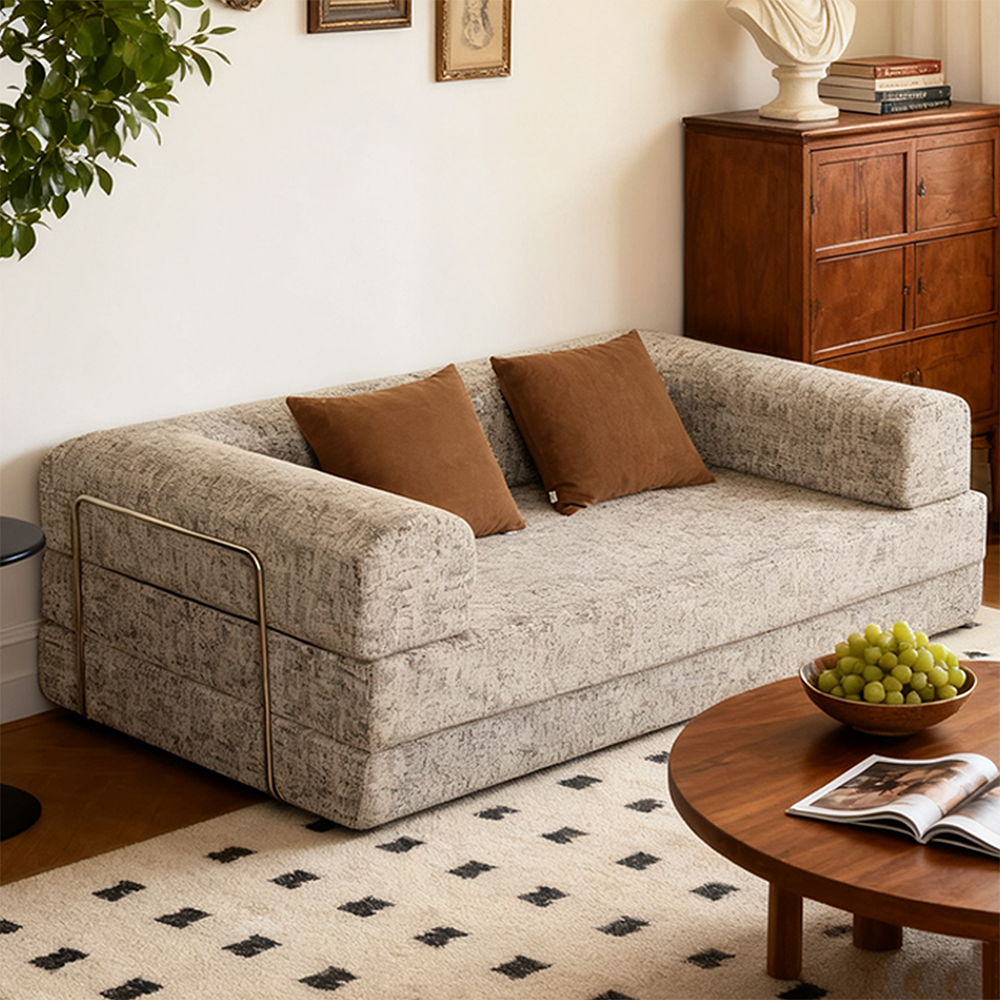
A boneless sofa, by contrast, is built around dense foam blocks or foam-and-fiber blends stitched or zipped into fabric covers, with no internal spring system and often no wood frame at all. Many models sold as an armless modular sofa use interlocking foam sections that can be rearranged into different configurations. This modularity is a major selling point for flexible layouts, but it also means each section supports weight independently rather than as part of one continuous structural system. The result is a seat that conforms closely to the body's shape, which feels comfortable initially, but offers less resistance to correct slouching or forward head posture over time.
Foam Density Makes a Measurable Difference
Not all boneless sofas perform the same way. Foam density, measured in pounds per cubic foot (PCF), is the single biggest factor in how much support a boneless design can offer. Foam in the 1.8 to 2.5 PCF range tends to feel plush but compresses quickly under sustained weight, offering minimal spinal support after 20-30 minutes of sitting. Foam in the 2.8 to 3.5 PCF range holds its shape considerably longer and provides firmer resistance, closer to what a mid-range traditional sofa cushion delivers. Buyers focused on back support should treat foam density as a priority spec, not an afterthought.
Info
Foam density (PCF) is the clearest single indicator of how a boneless sofa will feel after 30 minutes, not just on first sit.
Neck Support: Where the Gap Is Widest
Neck support is the area where the difference between the two sofa types is most pronounced. Traditional sofas, particularly those with high backs or attached headrests, are built to support the head and neck when reclining. Boneless sofas, especially low-profile or floor-style models, typically top out at shoulder height or slightly above, offering no dedicated headrest at all. This isn't necessarily a flaw — many boneless designs are intentionally low and casual, meant for lounging rather than upright, formal seating — but it does mean users who want neck support have to compensate with separate cushions or bolsters.
Some manufacturers address this with taller backrest sections or add-on neck pillows sold as accessories. If neck support is a priority, checking the backrest height relative to your own seated height before purchasing is a more reliable method than relying on product photos, which often use models seated in ways that flatter the design rather than reflect typical use.
Warning
Product photography rarely reflects true backrest height. Measure your own seated shoulder-to-crown height before buying.
Comparing Support Across Common Use Scenarios
Support needs change depending on how the sofa is used day to day. The table below breaks down typical scenarios and how each sofa type tends to perform based on user-reported comfort patterns.
| Scenario | Traditional Sofa | Boneless Sofa |
|---|---|---|
| Upright work/reading (1-2 hrs) | Strong lumbar and back support | Support declines after 30-45 min |
| Reclining/lounging | Depends on recline mechanism | Comfortable, body-conforming |
| Napping | Firm, may feel restrictive | Generally favored for softness |
| Formal seating/guests | Consistent, upright posture | Less structured, casual feel |
The pattern that emerges is fairly consistent: boneless sofas tend to outperform for relaxed, low-duration lounging, while traditional sofas maintain an advantage for longer upright sitting where consistent spinal support matters more.
Why Space and Layout Also Affect the Support Conversation
Support isn't purely about materials — seating posture is also shaped by how a sofa fits into a room. A small armless sofa placed in a compact living room or studio apartment often ends up positioned closer to a wall, which some users use as informal backrest reinforcement, effectively adding support the sofa itself doesn't provide. This workaround is common enough that it's worth factoring into a buying decision: if a boneless sofa will sit against a solid wall, the practical support experience improves compared to placing the same sofa in an open floor layout with no back reinforcement.
Modular and sectional boneless designs also allow users to rearrange sections to create taller stacked backrests, which is not possible with a fixed-frame traditional sofa. This flexibility partially offsets the lack of built-in neck and back structure, since users can build a temporary higher-support configuration when needed and revert to a low lounging layout otherwise.
Who Benefits Most From Each Type
Support needs vary significantly by body type, age, and daily habits. The following breakdown reflects patterns commonly reported by users choosing between the two formats.
- People who sit for long stretches doing focused work generally report better outcomes with traditional sofas or firmer boneless models with high-density foam.
- People prioritizing casual lounging, movie nights, or flexible seating for guests tend to prefer the softness and adaptability of an armless modular sofa.
- Older adults or those with existing back conditions are generally better served by traditional seating with firmer, consistent support unless a high-density boneless option is specifically chosen.
- Renters and people in smaller homes often favor a small armless sofa for its lighter weight, easier reconfiguration, and lower shipping and moving costs, accepting reduced back support as a trade-off for flexibility.
Practical Ways to Improve Support on a Boneless Sofa
Choosing a boneless sofa doesn't mean accepting poor support by default. A few adjustments can meaningfully close the gap with traditional seating:
- Add a firm lumbar cushion or bolster behind the lower back to maintain spinal alignment during longer sitting sessions.
- Choose foam-filled models over loose bead-filled versions, since foam holds its shape far longer under repeated use.
- Rotate or fluff foam sections periodically to prevent uneven compression from settling into one seating position.
- Position taller sections or extra modules behind the head and neck area when using the sofa for extended reclining.
- Check the manufacturer's foam density specification before buying, since this single number is one of the most reliable indicators of long-term support quality.
Success
Pairing a foam-filled boneless sofa with a dedicated lumbar bolster closes most of the gap with traditional seating for everyday use.
Final Takeaway
A boneless sofa is not a direct substitute for a traditional sofa when back and neck support is the top priority, but it isn't a poor option either — it simply serves a different purpose. For short, relaxed sitting and flexible room layouts, a boneless design performs well and often more comfortably than a firm traditional couch. For extended upright use or dedicated neck support, a traditional sofa or a high-density foam boneless model with added lumbar and neck support will generally deliver a more consistent experience.
Danger
Skipping the foam density check is the single most common reason buyers regret a boneless sofa purchase within the first year.
The right choice ultimately depends less on which sofa type is objectively "better" and more on matching the sofa's support profile to how it will actually be used day to day.
PREV:Does memory foam retain body heat more than innerspring or hybrid mattresses?
NEXT:Are memory foam pillows actually good for you compared to traditional feather pillows?
NEXT:Are memory foam pillows actually good for you compared to traditional feather pillows?
Interested in cooperation or have questions?
Related News
WELLCARE was founded in 2003, boasting over a decade of profound and extensive experience.
Quick Links
Product
Media Centre
Contact Information
- [email protected]
- +86-517-84998062
- +86-15152354988
- No. 168 Nenjiang Road, Huaiyin District, Huai'an City, Jiangsu Province, China
Copyright © Jiangsu Wellcare Household Articles Co., LTD. All Rights Reserved.
Custom Memory Gel Mattress Manufacturers
