

 English
 日本語
日本語 Español


Luo Jinyi — Senior After-Sales Service Specialist

Home / Author / Luo Jinyi — Senior After-Sales Service Specialist / Gel Memory Foam Sponge Pillow: Breathable Support, Custom Comfort, and Reliable Manufacturing
Product Category
NEW Category
Contact us
Gel Memory Foam Sponge Pillow: Breathable Support, Custom Comfort, and Reliable Manufacturing
Choosing the right pillow is an important part of creating a comfortable and supportive sleep environment. A pillow must do more than feel soft when first touched. It should help maintain a natural relationship between the head, neck, and shoulders, provide consistent support throughout the night, manage heat and moisture, and remain comfortable after repeated use. It should also be easy to integrate into different bedroom settings, hospitality projects, retail programs, and customized bedding collections.
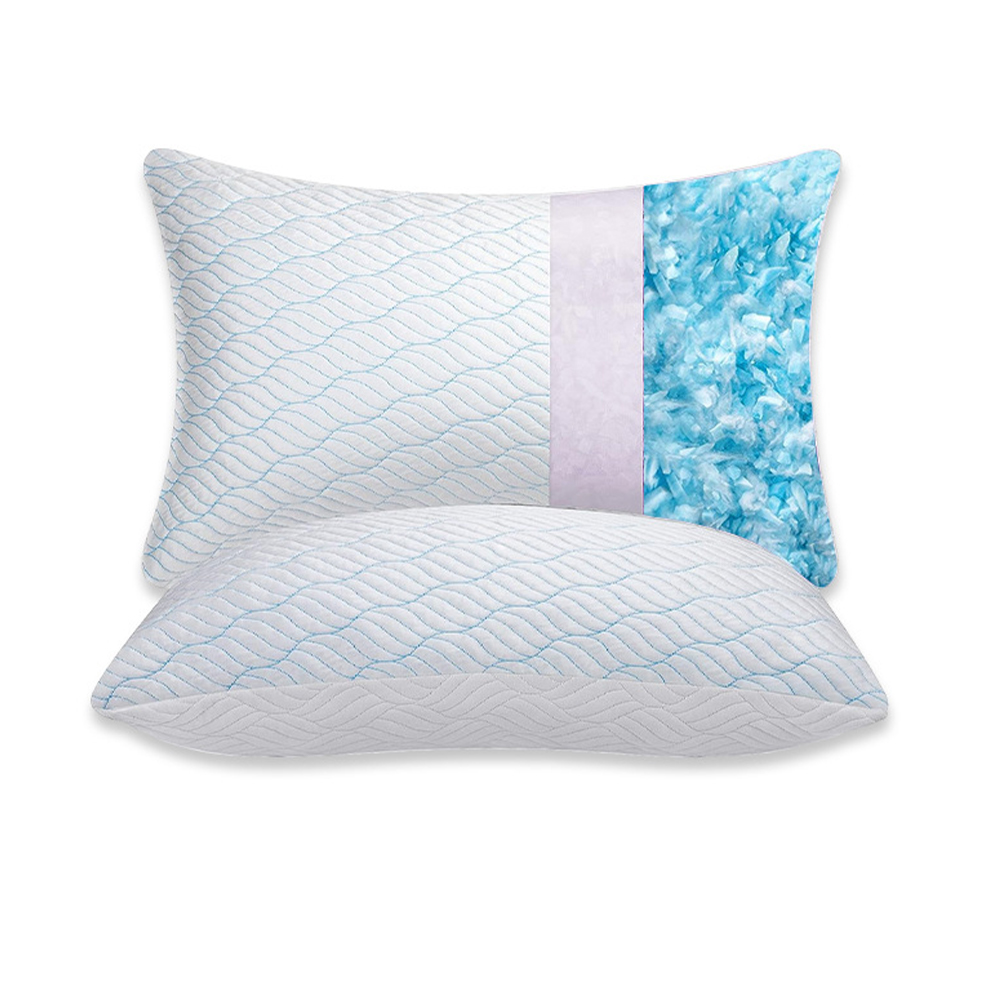
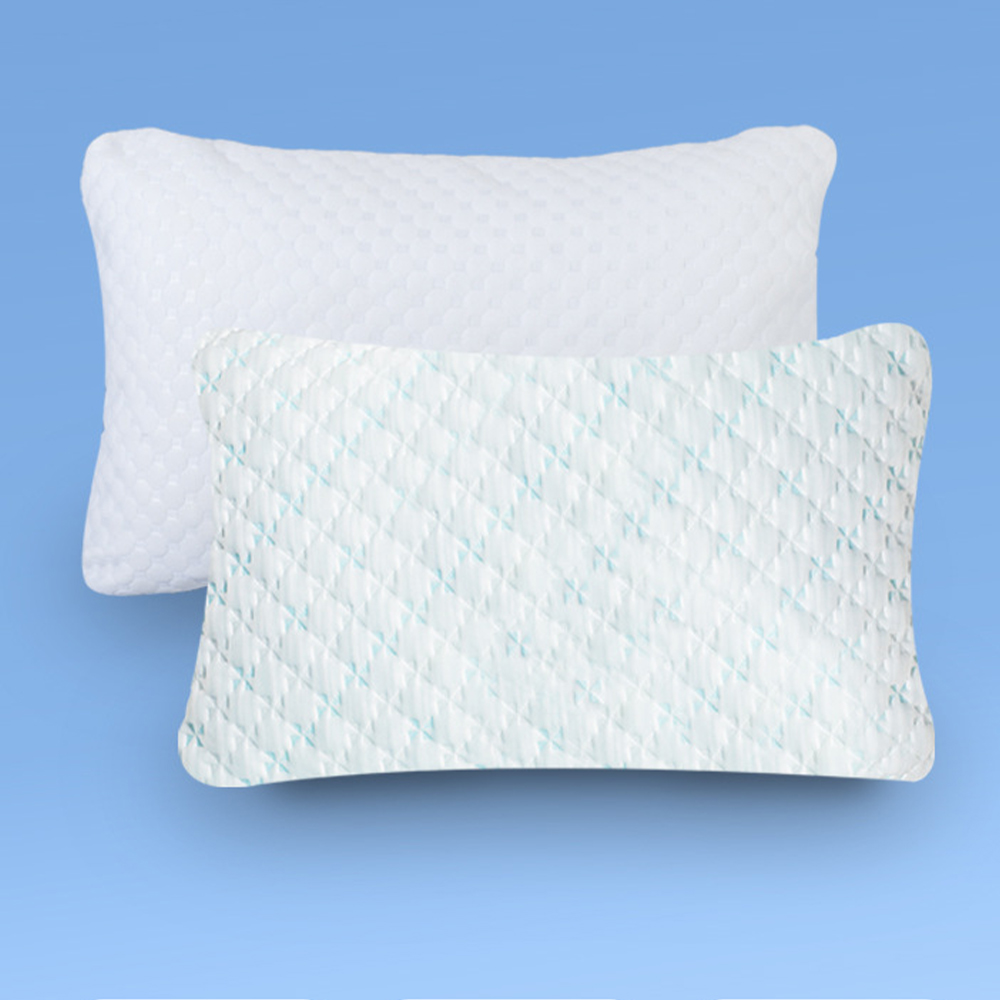
The Gel Memory Foam Sponge Pillow is designed around these practical requirements. Categorized as a shredded foam pillow, it combines a high-density slow-rebound memory foam core with regularly shaped shredded sponge filling. This construction is intended to balance pressure-relieving support with improved airflow and a light, fluffy hand feel. Its rectangular form, quilted surface, blue-and-white visual styling, and customizable dimensions make it suitable for individual sleepers as well as homes, guesthouses, hotels, and cross-border bedding programs.
Unlike a conventional solid foam pillow that may feel dense or restrictive, this design uses a structured shredded sponge component to create more internal space. Unlike a traditional loose-fill pillow that may lack stable support, its memory foam foundation helps the pillow conform to the contours of the head and neck. The result is a hybrid construction that seeks to combine the supportive behavior of memory foam with the adjustable, breathable, and resilient character associated with shredded filling.
The product is supplied by Jiangsu Wellcare Household Articles Co., LTD., a manufacturer focused on foam materials, sleep products, and healthy home applications. The company’s background in material research, foam formulation, product development, and customized manufacturing supports the pillow’s position as more than a simple finished bedding item. It represents a combination of material engineering, filling structure, textile finishing, and production flexibility.
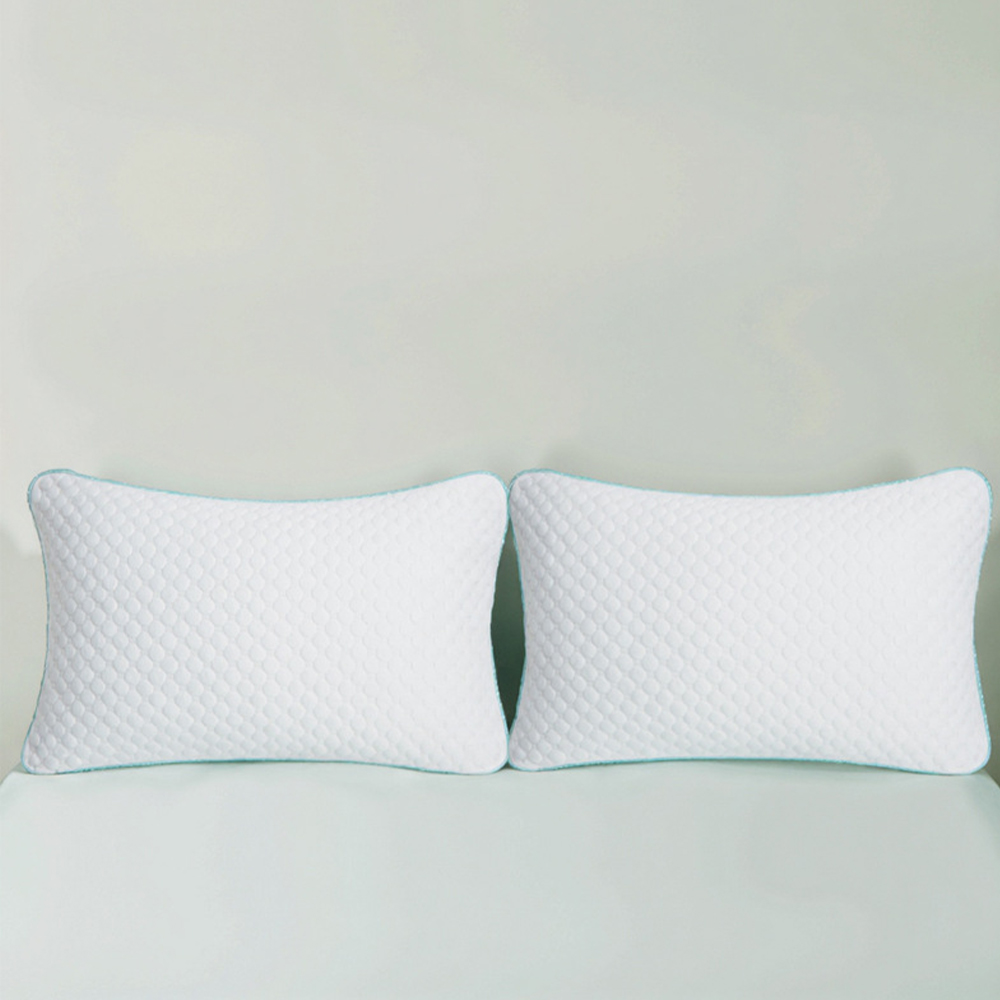
Gel memory foam sponge pillow
Product Overview and Core Construction
The Gel Memory Foam Sponge Pillow has a rectangular shape and a listed size of 60 by 40 by 12 centimeters. Its pillow core height falls within the 10.1 to 15 centimeter range, while the listed product weight is approximately 0.55 to 1 kilogram. This size and height are appropriate for adult single-person use and can be adapted for different market requirements through custom processing.
The pillow is built from several coordinated elements. The first is a high-density slow-rebound memory foam core. Memory foam is recognized for its ability to respond gradually to pressure and body heat, allowing it to conform to the head and neck rather than resisting them like a rigid traditional filling. This can help distribute pressure across a wider area and reduce the feeling that the head is resting on a single hard point.
The second element is regularly shaped shredded sponge filling. The regularity of the pieces is important because a more consistent filling structure can support a more predictable loft and surface feel. Shredded filling also creates channels and spaces within the pillow, which can improve internal air movement compared with a completely solid block of foam. These spaces contribute to a lighter, fluffier sensation and may help reduce the stuffiness that some sleepers associate with dense foam products.
The third element is the textile covering and quilted surface. The product information identifies polyester fiber as the pillow core fabric and describes the outer material as comfortable and skin-friendly. The quilted texture adds visual depth while helping create a soft, structured surface. The blue-and-white color scheme gives the pillow a clean appearance suitable for contemporary bedrooms, guest rooms, hotel environments, and coordinated bedding collections.
These elements are not independent. The foam core provides foundational support, the shredded sponge contributes airflow and loft, and the fabric and quilting influence the initial touch, appearance, and perceived comfort. A well-designed pillow must balance all three. Excessively firm foam may feel uncomfortable, while excessive loose filling may collapse or shift. The hybrid structure is intended to reduce the disadvantages of both extremes.
How the Pillow Supports the Head and Neck
Neck comfort depends heavily on pillow height, resilience, and the ability of the filling to adapt to the sleeper’s shape. When a pillow is too low, the neck may angle downward toward the mattress. When it is too high, the head may be pushed forward or tilted upward. A pillow that is too rigid can create concentrated pressure, while a pillow that compresses too easily may fail to maintain a stable position.
The slow-rebound memory foam component addresses these concerns by responding gradually to the weight of the head and neck. Instead of immediately flattening, the foam conforms to the pressure pattern applied to it. This creates a shaped support zone under the sleeper and helps the pillow retain its general form after the load is removed. The product description emphasizes pressure relief, contour conformity, and shape retention during long-term use.
The shredded sponge filling adds a different type of performance. Because the filling is composed of separate pieces rather than one uninterrupted slab, it can provide a softer transition between the sleeper and the deeper support layer. The pieces may move slightly within the internal structure, allowing the surface to feel less rigid while still benefiting from the support of the memory foam core.
This arrangement is particularly valuable for users who want the pressure-relieving behavior of memory foam without the dense, immovable feeling of some solid foam pillows. The pillow remains supportive, but the surface is intended to feel more flexible and gently enveloping. This balance can be attractive to adult sleepers who prefer moderate softness combined with dependable support.
It is important to recognize that comfort is personal. Sleeping position, body size, mattress firmness, preferred pillow height, room temperature, and individual sensitivity all influence the final experience. The listed 12-centimeter dimension provides a defined reference point, while custom processing allows buyers to request different dimensions, fabrics, or colors for particular markets and applications.
Support for Different Sleeping Preferences
Side sleepers often require sufficient height to fill the space between the shoulder and the head. A supportive foam-based pillow can help maintain a more even head position, provided the height matches the sleeper’s body proportions and mattress firmness. The structured core can help prevent immediate collapse under the side of the head.
Back sleepers commonly prefer a pillow that supports the natural curve of the neck without pushing the head too far forward. The slow-rebound response of the memory foam can provide a gradual contour rather than a sharp raised edge. The shredded filling may also allow the sleeper to settle into the surface with less pressure.
Combination sleepers may appreciate the adaptability of a hybrid pillow. The shredded structure can provide a more forgiving surface when the sleeper changes position, while the memory foam core helps maintain an underlying support zone. However, the ideal result depends on the final filling quantity, pillow height, and individual preference.
The pillow is described as suitable for adults and for single-person use. It is not presented as a medical device and should not be treated as a substitute for professional advice concerning chronic pain, diagnosed sleep disorders, or musculoskeletal conditions. Its intended role is to provide everyday comfort and support within a normal sleep environment.
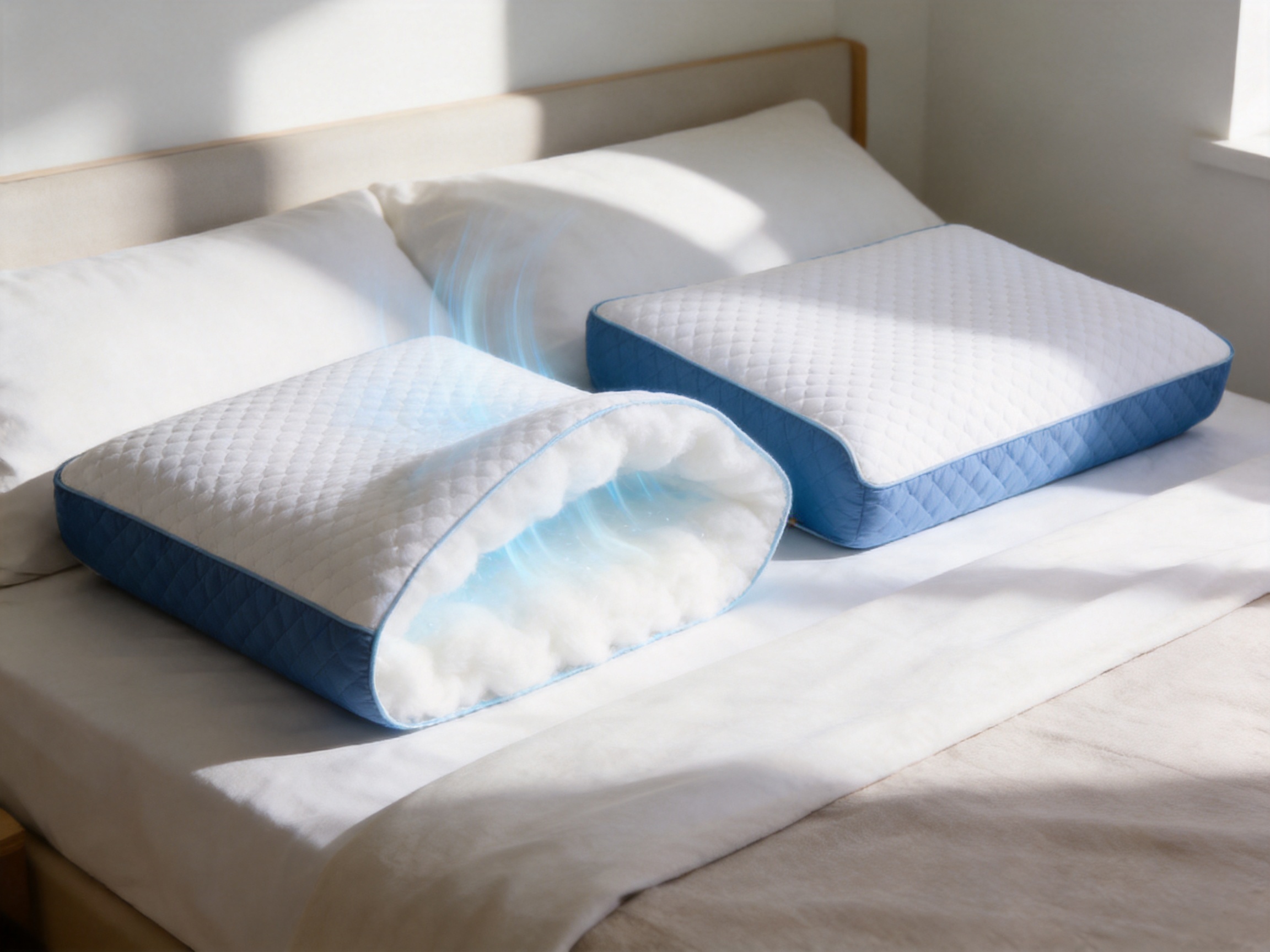
Breathability and the Role of Shredded Sponge Filling
Breathability is one of the main differences between this pillow and a fully solid memory foam design. A solid foam block has a continuous structure, and although foam formulation and ventilation channels can influence air movement, the internal path for airflow is comparatively limited. A shredded construction introduces spaces between pieces, creating a more open internal arrangement.
The product uses regularly shaped shredded sponge filling to improve internal airflow and reduce stuffiness. The shape and consistency of the pieces can help create a more evenly distributed filling environment than irregular fragments of widely varying size. Regular pieces may also contribute to a more uniform surface and reduce the risk of isolated dense or empty areas during production.
Airflow within a pillow is affected by several factors, including the density of the foam, the size and shape of the shredded pieces, the filling ratio, the inner liner, the outer fabric, quilting pattern, and the sleeper’s body heat. No pillow construction can eliminate all heat retention, especially when it is covered by bedding or used in a warm room. Nevertheless, the open structure of shredded foam is a practical way to pursue a lighter and less confined feel.
The breathable character of the filling also influences perceived softness. A pillow with small internal spaces can compress and recover in a more flexible way than a completely compact core. This creates a fluffy sensation while preserving the cushioning properties associated with foam. For buyers comparing products, the relevant advantage is not simply the word “shredded,” but the combination of structured pieces, core support, and fabric engineering.
For hospitality applications, breathability can be especially valuable. Guest rooms may serve users with different comfort preferences, and a pillow that feels heavy, hot, or overly dense may receive inconsistent feedback. A lighter-feeling hybrid design can provide a broadly acceptable comfort profile while maintaining a clean and professional appearance.
Surface Comfort and Quilted Textile Design
The first point of contact between a sleeper and a pillow is the outer fabric. Even when the internal construction is highly supportive, a rough, stiff, or poorly finished cover can reduce the perceived quality of the product. The Gel Memory Foam Sponge Pillow uses a delicate fabric presentation and a quilted textured surface to create a softer and more refined touch.
Quilting gives the surface a three-dimensional appearance. It can also help keep the fabric organized across the pillow, reduce an excessively flat visual impression, and support a consistent relationship between the cover and the filling. The quilting pattern described for the product adds texture without changing the clean, simple character of the design.
The blue-and-white color scheme has broad decorative appeal. White communicates cleanliness and freshness, while blue can introduce a calm, cool, and understated accent. This combination is suitable for modern bedrooms, guesthouses, hotels, and bedding ranges that use neutral or light-colored foundations.
Color selection can also support product segmentation. A white version may be suitable for hospitality environments where a traditional bedding appearance is preferred. A blue-and-white version may work well for retail products aimed at modern home interiors. Since custom colors and fabrics are available, buyers can coordinate the pillow with private-label packaging, hotel room standards, seasonal collections, or regional preferences.
Fabric selection should be evaluated together with care requirements, durability, and intended use. The supplied information confirms customization but does not specify a single universal care method for every customized version. Commercial buyers should confirm washing instructions, cover construction, seam performance, shrinkage control, and any applicable testing requirements before placing a large order.
Advantages Compared with Conventional Pillow Types
Compared with Traditional Fiber-Filled Pillows
Traditional fiber-filled pillows are often valued for their low initial cost and soft, familiar feel. However, some fiber pillows can compress unevenly, lose loft, or require frequent reshaping. The memory foam core in this product provides a more stable support foundation. Instead of depending entirely on loose fiber to maintain the head and neck position, the pillow uses a shaped foam structure underneath the surface filling.
The shredded sponge component preserves some of the softness and flexibility associated with loose-fill pillows. This gives the product a useful middle position: it is more structured than a basic fiber pillow but less rigid than a solid foam block. For customers who want support without an overly firm sensation, this balance can be a significant selling point.
Compared with Solid Memory Foam Pillows
Solid memory foam pillows can provide strong contouring and stable height, but some users find them dense or less adaptable. Their compact construction may also create a warmer or more enclosed feel. The shredded sponge layer in this product introduces additional internal space and creates a more buoyant surface response.
The hybrid design can therefore appeal to consumers who recognize the support benefits of memory foam but prefer a lighter and more breathable experience. It also offers manufacturers and retailers more flexibility in adjusting the filling structure and overall feel than a single fixed-shape block may provide.
Compared with Down or Feather Pillows
Down and feather pillows are traditionally associated with softness and compressibility. They can be shaped by the sleeper, but they may not provide the same predictable contouring as foam. Some users also prefer foam-based products because they want a non-feather filling. This pillow provides a soft, enveloping surface while using memory foam and sponge materials rather than down or feathers.
The product can therefore serve customers seeking a feather-free foam alternative with a more structured support profile. Its quilted polyester-based cover also supports a consistent manufactured appearance, which can be useful for standardized hotel or retail programs.
Compared with Basic Shredded Foam Pillows
Not all shredded foam pillows are identical. A basic model may use irregular fragments, inconsistent filling density, or a simple unquilted cover. This product emphasizes regularly shaped shredded sponge pieces, a high-density slow-rebound memory foam core, a defined rectangular form, and a quilted surface.
Regularly shaped filling can support more predictable production and help the pillow achieve a consistent visual and tactile result. The underlying core provides a stable support reference, while customization options allow the product to be adjusted for different customer requirements. These combined features distinguish it from a low-specification shredded foam pillow that relies only on loose fragments.
| Comparison Point | Gel Memory Foam Sponge Pillow | Traditional Fiber Pillow | Solid Memory Foam Pillow |
| Primary support | Slow-rebound memory foam core | Loose fiber filling | Single foam block |
| Surface feel | Soft, fluffy, and gently enveloping | Soft and compressible | More structured and dense |
| Internal structure | Core combined with regular shredded sponge | Loose or layered fiber | Continuous foam structure |
| Airflow objective | Open shredded filling supports internal air movement | Depends on fiber density and cover | Depends on foam formulation and ventilation design |
| Shape stability | Supported by memory foam core and structured filling | May require reshaping | Generally stable but less flexible |
| Customization | Size, color, and fabric customization available | Commonly available depending on supplier | Usually depends on mold or cutting capability |
| Visual design | Quilted blue-and-white styling | Varies widely | Varies widely |
Customization for Retail, Hospitality, and Private-Label Programs
One of the product’s most important commercial strengths is its support for custom processing. Buyers can discuss adjustments to size, color, and fabric according to the requirements of their market or application. This is valuable because pillow preferences vary by region, sales channel, hotel standard, packaging format, and target price point.
For retail brands, custom dimensions can help create a distinct product rather than a generic catalog item. A private-label program may require a particular pillowcase size, package configuration, loft, or fabric appearance. The listed 60 by 40 by 12 centimeter version can serve as a starting point, while the supplier can evaluate alternative specifications.
For hotels and guesthouses, consistent dimensions and fabric appearance are important for room presentation and linen management. A customized pillow can be coordinated with standard pillowcases, bedding colors, and housekeeping procedures. Buyers may also request specific surface fabrics or color treatments to match an existing hospitality identity.
For distributors and online sellers, customization can support market differentiation. Many bedding products compete primarily on price and generic claims. A distinctive quilted design, selected color combination, defined filling construction, and customized packaging can create a clearer product story. The pillow’s main sales regions include Europe, Southeast Asia, and North America, indicating that the supplier is positioned to serve multiple international markets.
Custom processing should be handled through a detailed technical confirmation. Important points include final dimensions, acceptable tolerances, pillow height, filling weight, foam density, fabric composition, color standard, zipper or closure design if applicable, packaging method, carton dimensions, labeling, and testing documentation. The more clearly these details are confirmed, the easier it is to maintain consistency across repeat orders.
The product information states that dropshipping is not supported. This means the pillow is more suitable for wholesale, project-based supply, distributor purchasing, hotel procurement, or brand inventory programs than for direct one-piece fulfillment. Buyers should plan for production, inspection, storage, and logistics in accordance with their chosen sales channel.

Manufacturing Expertise and Material Research
The manufacturer, Jiangsu Wellcare Household Articles Co., LTD., was founded in 2003 and focuses on high-performance sleep materials and healthy home products. Its work is centered on foam research, material innovation, and the development of products intended for the global sleep market.
A significant strength is the company’s doctor-led research and development team. According to the supplied company information, the team develops more than one hundred new foam materials each year. This activity covers ordinary sponge, memory foam, gel foam, temperature-insensitive memory foam, quick-dry memory foam, flame-retardant sponge, antibacterial sponge, and other foam categories.
Developing a wide range of foam materials requires more than simply changing a product’s exterior. It involves formulation control, density management, resilience evaluation, compression behavior, recovery characteristics, cell structure, processing conditions, and application-specific performance. These capabilities can support the development of pillows with different firmness levels, response speeds, breathability targets, moisture-management requirements, and safety specifications.
The company’s history also reflects a long-term connection with scientific research. Its development began in 1993 as a school-run scientific research enterprise. In 2003, it purchased a 12,000-square-meter factory building and jointly developed a new sponge material with Huai’an Institute of Technology. In 2008, it purchased 50,000 square meters of land, supporting further expansion of its manufacturing and development capacity.
These milestones are relevant to the pillow because foam products depend heavily on process consistency. A supplier that understands material development can be better positioned to adjust the relationship between foam density, softness, resilience, and durability. This is particularly important for customized products, where the buyer may request a specification that differs from the standard catalog version.
From Foam Formulation to Finished Pillow
The manufacturing process for a product such as this generally begins with material selection and formulation. The foam must be produced or selected according to the intended support, recovery, density, and comfort characteristics. For the memory foam core, slow-rebound behavior is a central performance target. The foam must respond to pressure gradually while maintaining sufficient structural stability.
The next stage involves cutting, shaping, or preparing the memory foam core. Dimensional accuracy matters because the core influences the pillow’s final height, support distribution, and fit inside the cover or liner. A consistent core also makes it easier to control the overall appearance of the finished product.
Shredded sponge filling requires its own processing controls. The foam must be divided into pieces with a suitable size and shape. The supplied product information highlights regularly shaped pieces, suggesting that the filling is designed with consistency in mind. Piece size, distribution, and filling quantity can all affect loft, softness, resilience, and airflow.
The core and shredded filling are then assembled into the internal pillow structure. This step requires attention to filling balance. Too little filling may produce a flat or unstable surface, while too much may reduce flexibility and create an overly firm feel. The relationship between the core and the filling determines whether the product feels supportive, fluffy, or excessively compressed.
The outer fabric is cut and prepared before quilting and assembly. Quilting must be controlled so that the surface remains attractive and the fabric is not excessively stretched or distorted. Seams must be secure and consistent, especially if the pillow is intended for repeated handling in a hotel or commercial environment.
Final inspection should examine dimensions, appearance, filling distribution, seam quality, surface cleanliness, labeling, packaging, and any agreed testing requirements. For customized orders, inspection should compare the finished pillow with the approved sample and technical specification. This helps ensure that the product received by the buyer reflects the comfort and appearance agreed during development.
Experience Serving International and Commercial Markets
The company’s supplied history indicates that its products reached cross-border supermarkets in the United States, Germany, and Japan by 2010. It later exported products to the United Kingdom, Canada, Australia, and Kuwait. This international experience is meaningful for buyers who require communication across different markets, product expectations, and logistics environments.
In 2018, the company became an Alibaba-certified Gold Supplier and entered e-commerce. In 2020, it became a designated supplier for five-star hotels. These milestones suggest experience with both online commercial channels and hospitality procurement. Each channel places different demands on a manufacturer. E-commerce products need clear specifications, attractive presentation, and packaging efficiency. Hotel supply requires consistency, reliable delivery, repeat-order capability, and practical durability.
The product’s listed downstream platforms include eBay, Amazon, Wish, AliExpress, independent sites, Lazada, and other channels. Although dropshipping is not supported, the broad platform profile indicates that the product can be considered for distributor inventory, private-label listings, wholesale catalogs, and international retail programs.
Cross-border buyers should still complete their own compliance and quality review. Requirements can vary by destination market and product classification. Buyers may need to confirm material declarations, labeling rules, packaging standards, flammability requirements, chemical restrictions, textile composition, and any voluntary certifications required by their customers. The manufacturer’s ability to discuss custom processing can help begin this process, but final responsibility for market-specific compliance should be clearly assigned.
Quality, Durability, and Product Evaluation
Durability in a pillow is determined by more than the initial softness. The foam should maintain useful support after repeated compression, the shredded filling should remain reasonably distributed, and the outer fabric should resist premature seam or surface failure. The product description states that the memory foam retains its shape even after long-term use, which is a key selling point for users seeking a longer-lasting support profile.
To evaluate durability, buyers can request information about foam density, compression set, recovery testing, fatigue testing, fabric strength, seam strength, color fastness, and packaging recovery. These tests are not all listed in the supplied product data, so they should be confirmed according to the intended market and order requirements.
Sample testing is particularly important for customized versions. A change in fabric, filling quantity, piece size, or core height may alter the final feel. A sample that has been approved for a standard version should not automatically be treated as approval for every later variation. Documenting the approved sample and tolerances can reduce misunderstandings during mass production.
Storage and transportation also influence the product. Foam pillows may be compressed or packed to reduce shipping volume, but the compression method and recovery time should be discussed before production. Buyers should confirm whether the pillow is shipped flat, rolled, compressed, or in another configuration. They should also establish recommended unpacking, airing, and recovery procedures for their customers.
Because the product uses foam and textile materials, odor management may be relevant after production and unpacking. Buyers can discuss ventilation, curing time, packaging materials, and odor-control procedures with the manufacturer. These factors are especially important for hospitality and retail products where the end user may open the package soon after delivery.
Sustainability and Responsible Production
WELLCARE’s company information describes an ongoing focus on sustainability and environmental management. The company has invested in advanced eco-friendly energy systems and aims to integrate respect for nature into its business operations. This approach complements the development of foam materials for healthy home products.
Sustainability in foam manufacturing can involve several areas. Energy efficiency may reduce the environmental impact of production. Improved process control can reduce material waste. Careful formulation and quality management can help lower the frequency of rejected products. Durable products may also reduce the need for frequent replacement, although the actual environmental benefit depends on product lifespan, maintenance, transportation, and end-of-life treatment.
For buyers, sustainability claims should be converted into clear and verifiable requirements. They may ask about energy systems, production waste management, recycled content where applicable, packaging materials, chemical compliance, and available environmental documentation. If a product is marketed as sustainable, the claim should be supported by appropriate evidence rather than relying only on general language.
The manufacturer’s history of researching multiple foam categories may also support more targeted material selection. For example, buyers with special requirements may discuss quick-dry foam, flame-retardant sponge, antibacterial sponge, or other material options. The standard pillow described here uses memory foam and shredded sponge, but the broader research capability may be useful when developing related bedding or home-comfort products.
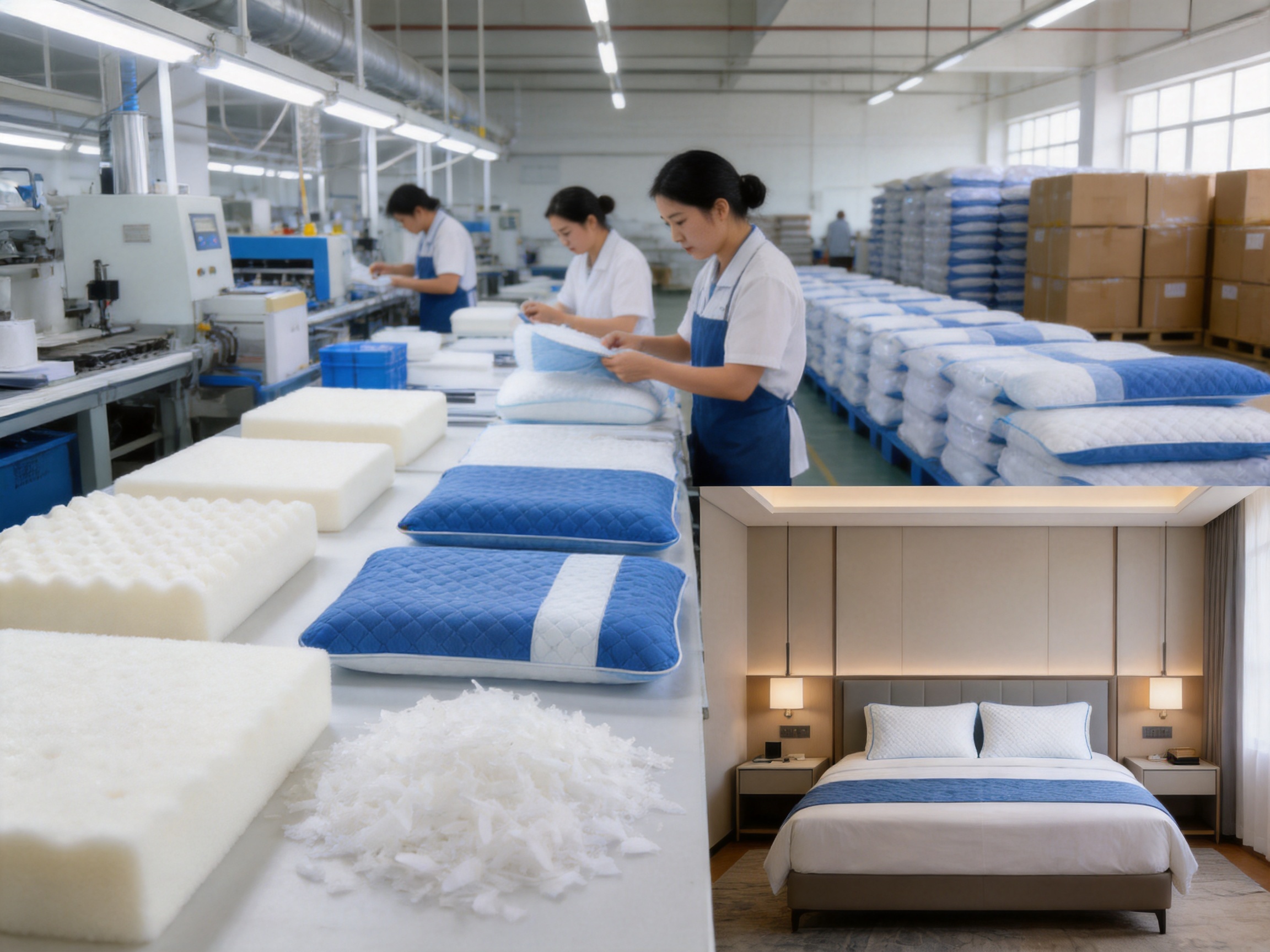
Applications in Homes, Guesthouses, and Hotels
For home use, the pillow offers a combination of clean styling and everyday support. Its blue-and-white appearance can fit modern, minimalist, coastal, light-colored, or hotel-inspired bedroom designs. The rectangular shape is familiar to consumers and can be paired with standard bedding arrangements, subject to confirmation of the final pillowcase size.
In guesthouses and boutique accommodation, the pillow can help create a consistent sleep experience across rooms. The hybrid structure is designed to offer broad comfort rather than an extreme firmness or softness profile. A standardized pillow can also simplify purchasing and replacement, especially when the same model is used across multiple rooms.
Hotels may use the pillow as a primary pillow, a supplementary pillow, or part of a tiered bedding program. For example, a hotel could provide a standard version in every room and offer alternative heights or materials upon request. Since custom sizes and fabrics are available, the design can potentially be aligned with a hotel’s existing bedding specifications.
For furniture and sleep-product distributors, the pillow complements broader categories such as memory foam mattresses, functional pillows, memory foam cushions, and foam pet products. A manufacturer that works across these product categories may offer buyers a more coordinated supply relationship. Product families can share material expertise, quality systems, packaging resources, and development communication.
Guidance for Buyers and Importers
Buyers should begin by identifying the primary sales market and intended user. A pillow for direct-to-consumer retail may require different packaging and presentation from a pillow for hotel procurement. A private-label product may need custom colors, fabric labels, inserts, barcode placement, and carton markings. A project order may prioritize repeatability and delivery scheduling.
The next step is to confirm the technical specification. Important items include the finished length, width, and height; weight range; foam type; core density; filling piece shape and size; filling weight; cover material; quilting pattern; color; closure method; logo or label requirements; packaging; and carton quantity.
Comfort should be evaluated through physical samples rather than written descriptions alone. Buyers can compare the pillow’s initial hand feel, compression response, recovery speed, surface softness, edge stability, and overall loft. Samples should be evaluated by more than one person and, when possible, by users with different sleeping positions.
Buyers should also request production and quality information appropriate to their market. This may include material safety data, test reports, inspection records, factory quality procedures, and documentation related to fire safety or chemical compliance. The supplied product information lists the product grade as a qualified product and identifies the item number as PW030, but buyers should confirm which documents are available for the specific order and destination.
Commercial terms should be established in writing. The company information lists exclusive cross-border export supply as available, while dropshipping is listed as unavailable. Buyers should confirm minimum order quantity, sample charges, production lead time, payment terms, shipping method, export documentation, packaging configuration, and after-sales procedures.
Finally, buyers should confirm whether the standard color choices are acceptable. The product data includes multiple white inner-liner options associated with regular square shredded sponge, irregular shredded sponge, and other white regular-square configurations. Because the color description is presented in a condensed form, the exact available option should be verified with the supplier before ordering.
Recommended Product Positioning
The pillow can be positioned as a supportive yet breathable hybrid foam pillow. Its strongest message is the combination of a slow-rebound memory foam foundation and regularly shaped shredded sponge filling. This allows sellers to explain the product in practical terms: stable support underneath, softer flexibility on the surface, and internal spaces intended to encourage airflow.
Another useful positioning point is customization. Many commodity pillows are sold in fixed dimensions and standardized materials. This product can be adapted in size, color, and fabric, giving brands and hospitality buyers more control over the final product. Customization can support different market preferences without requiring the buyer to start from an entirely new product concept.
The quilted blue-and-white design provides a visual advantage in online listings and showroom displays. It gives the pillow a recognizable appearance while remaining sufficiently neutral for modern interiors. A clean surface and three-dimensional quilting can help communicate quality before the customer experiences the product physically.
The manufacturer’s research background adds credibility to the product story. The company is not presented only as a trading supplier; its history includes foam research, technical cooperation, factory expansion, international distribution, e-commerce participation, and hotel supply. These strengths can matter to buyers who want a supplier capable of supporting future product development as well as the current pillow.
Care, Handling, and Customer Communication
End users should receive clear instructions for unpacking and initial use. If the pillow has been compressed for transportation, it may require time to recover its intended shape. The exact recovery period depends on the packing method, storage conditions, foam characteristics, and ambient temperature, so the supplier should provide confirmed instructions for the final product.
Customers should use a suitable pillowcase to protect the quilted surface. Washing or cleaning instructions should follow the care label and the confirmed cover construction. The complete pillow should not be washed unless the manufacturer specifically confirms that this is appropriate. If the cover is removable, the washing method, temperature, drying procedure, and shrinkage expectations should be clearly communicated.
Foam products should be stored in a dry, ventilated environment away from excessive heat, moisture, sharp objects, and direct prolonged sunlight. Proper storage helps preserve the textile cover and the foam’s recovery properties. Retailers and hotels should rotate inventory and avoid unnecessary long-term compression unless the packaging specification permits it.
Customer descriptions should be accurate. The pillow provides support and comfort but is not a treatment for neck disorders or other medical conditions. Retailers should avoid promising that it will eliminate pain or guarantee a particular sleep outcome. A better approach is to describe its contouring, slow rebound, breathable shredded structure, soft surface, and customizable construction in clear and responsible language.
Q&A
What type of pillow is this product?
It is categorized as a shredded foam pillow. Its construction combines a slow-rebound memory foam core with regularly shaped shredded sponge filling and a quilted textile surface.
What are the main comfort advantages?
The main advantages are pressure-relieving contour support, a soft and gently enveloping surface, improved internal airflow through the shredded structure, and a lighter, fluffier feel than many fully solid foam pillows.
Does the pillow contain memory foam?
Yes. The listed material is memory foam, and the product description specifically identifies a high-density slow-rebound memory foam core.
Why is the filling shredded?
Shredded filling creates internal spaces that can improve air movement and reduce a dense, enclosed sensation. It also contributes to a more flexible and fluffy surface feel while working with the memory foam core to maintain support.
Are the shredded pieces regular or irregular?
The product description emphasizes regularly shaped shredded sponge filling. The available color or inner-liner options also reference different filling configurations, so buyers should confirm the exact filling structure for the selected version.
What is the standard size?
The listed dimension is 60 by 40 by 12 centimeters. Custom sizes are supported, so the final specification should be confirmed for each order.
Who is the pillow designed for?
It is listed as suitable for adults and for single-person use. It may suit side, back, and combination sleepers depending on individual body proportions, mattress firmness, and preferred pillow height.
Is the pillow suitable for hotels?
Yes. The product description identifies homes, guesthouses, and hotels as suitable applications. Its clean visual design, consistent rectangular shape, and customization options can support hospitality programs.
Can the fabric be customized?
Yes. Customization is available for size, color, and fabric. Buyers should confirm the exact fabric composition, quilting pattern, care requirements, and color standard before production.
Can the pillow be sold under a private label?
The product supports custom processing, which can be discussed for private-label programs. Buyers should confirm labels, packaging, branding, minimum order quantities, and related commercial terms with the manufacturer.
Is dropshipping available?
No. The supplied product information states that dropshipping is not supported. The product is more appropriate for wholesale, inventory-based retail, distributor, or hospitality purchasing.
What is the product item number?
The listed item number is PW030.
Does the product have a patent?
The product information states that a patent is not available. Buyers should not make patent-related claims in product marketing unless separate documentation is provided.
What company manufactures the pillow?
The pillow is supplied by Jiangsu Wellcare Household Articles Co., LTD., a Chinese manufacturer focused on foam materials, sleep products, and healthy home products.
What is the manufacturer’s research strength?
The company reports a doctor-led R&D team that develops more than one hundred new foam materials each year. Its material portfolio includes memory foam, gel foam, temperature-insensitive memory foam, quick-dry memory foam, flame-retardant sponge, antibacterial sponge, and other foam solutions.
What should buyers confirm before placing a bulk order?
They should confirm dimensions, height, foam density, filling type and weight, fabric, color, quilting, packaging, labeling, testing documentation, minimum order quantity, lead time, shipping terms, and the specifications of any customized version.
Conclusion
The Gel Memory Foam Sponge Pillow offers a carefully balanced alternative to both basic loose-fill pillows and dense solid foam designs. Its slow-rebound memory foam core is intended to follow the contours of the head and neck, while regularly shaped shredded sponge filling creates a lighter, more breathable, and more flexible surface structure. The quilted fabric and blue-and-white styling add a clean visual identity suitable for modern bedrooms and hospitality environments.
Its competitive advantage comes from the interaction of support, airflow, surface comfort, appearance, and customization. Rather than relying on a single material characteristic, the product combines multiple design elements to create a more complete sleep accessory. This can make it attractive to consumers, hotels, guesthouses, distributors, private-label brands, and international bedding programs.
The manufacturer strengthens the product proposition through its foam research background, doctor-led R&D team, broad material portfolio, factory development, international market experience, e-commerce participation, and hotel supply history. Its sustainability efforts and interest in eco-friendly energy and environmental management add further value for buyers assessing long-term supplier capability.
For the best commercial result, buyers should treat the pillow as a configurable sleep product rather than a fixed catalog commodity. Careful sample evaluation, technical confirmation, quality documentation, packaging planning, and market-specific compliance review will help ensure that the final version meets its intended purpose. With these steps in place, the product can provide a practical foundation for comfortable, breathable, and professionally presented bedding collections.
References
1. Product specification sheet for Gel Memory Foam Sponge Pillow, item PW030, supplied in the product information.
2. Manufacturer-provided company profile for Jiangsu Wellcare Household Articles Co., LTD.
3. General technical principles of viscoelastic memory foam, including pressure response, recovery behavior, and contour support.
4. General textile and bedding quality considerations, including fabric construction, quilting, seam performance, labeling, and care communication.
5. General purchasing guidance for customized foam bedding, including sample approval, dimensional tolerances, packaging, inspection, and market-specific documentation.
Product: Gel memory foam sponge pillow

PREV:How a Neck-Support Silicone Pillow Helps Create a More Comfortable Sleep Environment for Young Children
NEXT:Gray Double Sofa: A Curved, Supportive Seating Solution for Modern Interiors
NEXT:Gray Double Sofa: A Curved, Supportive Seating Solution for Modern Interiors
Interested in cooperation or have questions?
Related News
WELLCARE was founded in 2003, boasting over a decade of profound and extensive experience.
Quick Links
Product
Media Centre
Contact Information
- [email protected]
- +86-517-84998062
- +86-15152354988
- No. 168 Nenjiang Road, Huaiyin District, Huai'an City, Jiangsu Province, China
Copyright © Jiangsu Wellcare Household Articles Co., LTD. All Rights Reserved.
Custom Memory Gel Mattress Manufacturers
