

 English
 日本語
日本語 Español


Deng Caiwei — International Sales Manager

Home / Author / Deng Caiwei — International Sales Manager / Four-Piece Foldable Children’s Building Block Sofa Set: Flexible Comfort, Safe Design, and Scalable Manufacturing
Product Category
NEW Category
Contact us
Four-Piece Foldable Children’s Building Block Sofa Set: Flexible Comfort, Safe Design, and Scalable Manufacturing
Children need furniture that can keep pace with the way they learn, play, rest, and imagine. A sofa may become a reading corner in the morning, a play platform in the afternoon, and a small bed or quiet retreat in the evening. The Four-Piece Foldable Children’s Building Block Sofa Set is designed around this changing rhythm. Rather than functioning as a fixed piece of furniture, it provides a collection of lightweight, soft, and rearrangeable modules that can be combined according to the needs of a room and the activities of its users.
Produced by Jiangsu Wellcare Household Articles Co., LTD., the set combines a high-density foam interior, a frameless structure, rounded edges, skin-friendly velvet upholstery, and a modular four-piece configuration. These characteristics make it suitable for family living rooms, children’s bedrooms, kindergartens, early education centers, reading areas, playrooms, and other environments where flexibility and safety are important. Its silver-gray appearance and modern minimalist form also allow it to coordinate with contemporary interiors without overwhelming the surrounding décor.
The product is especially valuable for buyers seeking a practical alternative to traditional children’s sofas. Conventional sofas often rely on rigid frames, fixed proportions, and heavy construction. They may be difficult to move, challenging to store, and limited in their use. By contrast, this foldable building block design prioritizes adaptability. Its modules can be rearranged into an L-shaped sofa, a reclining or resting surface, a play area, a reading corner, or other personalized layouts. The result is a children’s furniture solution that combines comfort, spatial efficiency, and imaginative use.
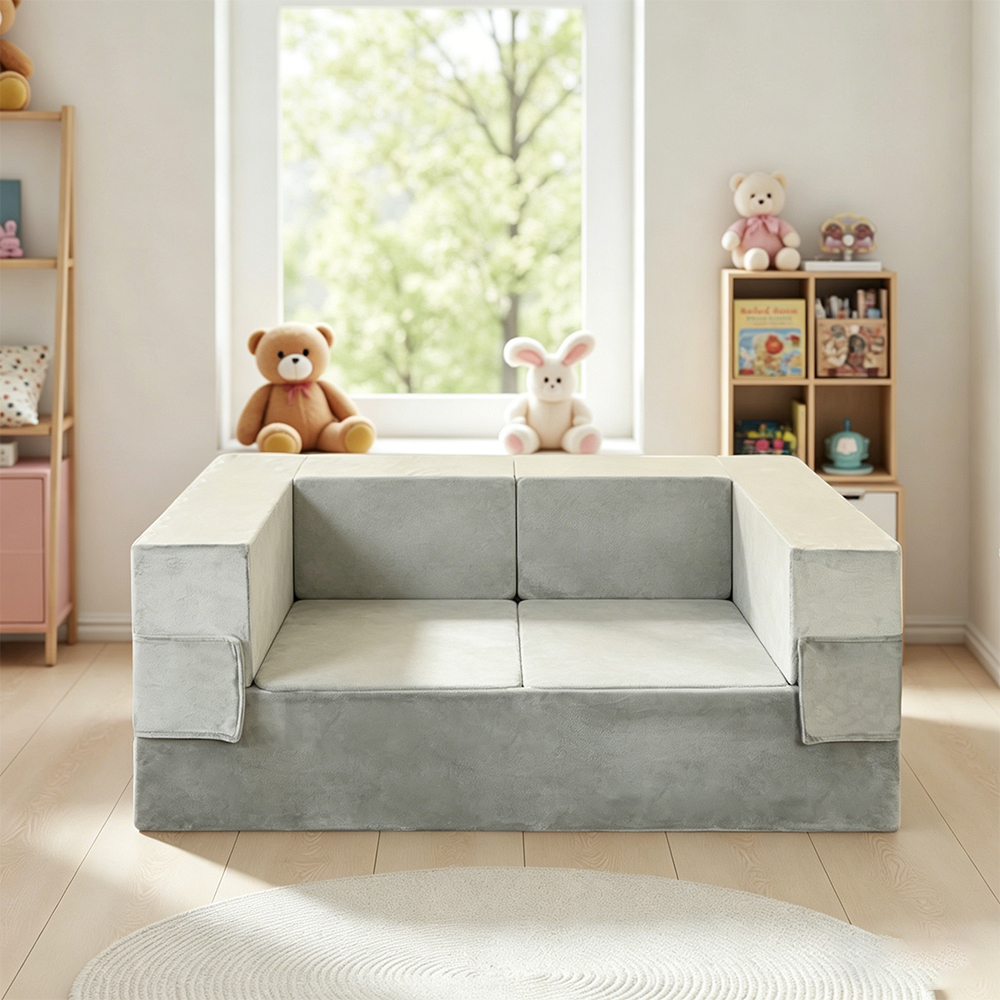
Four-piece foldable children's building block sofa set
What Makes a Modular Children’s Sofa Different?
A modular children’s sofa is made from separate sections that can be positioned in different ways. Instead of asking the room to adapt to a fixed sofa, the furniture adapts to the room. This distinction is particularly useful in homes and educational spaces where available floor area may change throughout the day.
The four-piece structure gives children and caregivers multiple ways to arrange the furniture. The modules may be placed side by side to create a longer seating area, positioned at an angle to form an L-shaped configuration, or spread across a soft play zone. They can also be organized as a low rest surface or reading area. This type of arrangement encourages children to participate in shaping their environment while allowing adults to create layouts that support supervision and efficient use of space.
The modular format offers advantages over a single-piece children’s sofa in several important areas. First, it is easier to transport through doorways, corridors, stairways, and elevators because the individual pieces are more manageable than a large assembled sofa. Second, it can be stored more efficiently when not in use. Third, it can be adjusted as the child grows or as the room’s function changes. Finally, separate modules can reduce the limitations associated with a fixed seating footprint.
For commercial and institutional buyers, modularity can also simplify room planning. A kindergarten may use the pieces as seating during group activities, then rearrange them into a soft activity zone. An early education center may create a reading corner with one arrangement and a movement-based play area with another. A family may use the same set in a living room during the day and move it to a children’s room when additional sleeping or resting space is needed.
High-Density Foam Support for Everyday Comfort
The core of the sofa set uses high-density foam with slow-rebound characteristics. In product descriptions, this material is also referred to as memory foam or high-density sponge. The purpose of the material is to provide a balance between softness and support. When a child sits or reclines on the cushion, the foam responds gradually to pressure and helps distribute body weight across the surface.
Slow-rebound foam can provide a more stable and comfortable sensation than very soft low-density filling. Extremely soft filling may compress quickly and lose its shape during repeated use. High-density foam is designed to offer better structural resilience, helping the modules maintain their form after regular sitting, lounging, and play. This is important for a children’s sofa because it is likely to experience varied use rather than only quiet sitting.
The foam construction also supports a frameless design. Instead of combining rigid wood or metal components with a padded exterior, the sofa is primarily formed by the upholstered foam modules themselves. This reduces the presence of hard internal edges and makes the overall product softer to the touch. The absence of a traditional hard frame is one of the key differences between this product and many conventional sofas.
Foam density and resilience are important purchasing considerations for distributors and project buyers. A product that feels comfortable at first but loses its shape quickly may lead to higher replacement costs and lower customer satisfaction. High-density foam is therefore beneficial not only from a user-comfort perspective but also from a lifecycle perspective. Proper material selection can support longer service performance, particularly when the sofa is used in homes, classrooms, or commercial settings.
At the same time, users should follow appropriate care instructions and avoid exposing the foam to excessive moisture, sharp objects, open flames, or inappropriate cleaning chemicals. The performance of any upholstered furniture depends on its materials, construction, environment, and care practices. The foam core provides a strong foundation, while responsible use helps preserve the product’s appearance and comfort over time.
Frameless Construction and Rounded Edges
Safety is a central consideration in children’s furniture. Young children move quickly, change direction unexpectedly, and may use furniture in ways that adults do not anticipate. A rigid corner or exposed structural edge can create a greater risk during active play. The Four-Piece Foldable Children’s Building Block Sofa Set addresses this concern through a frameless form and rounded external edges.
The frameless structure reduces the number of hard surfaces that a child may encounter while sitting, climbing onto, or moving around the modules. Rounded edges further soften the visual and physical profile of the set. Although no furniture can eliminate every possible risk, a soft-edge configuration can help create a more forgiving environment than furniture with prominent wooden or metal corners.
This design is particularly suitable for playrooms, reading areas, and early learning spaces where furniture may be used for more than one purpose. Children may sit on a module, lean against it, crawl around it, or use it as part of an imaginative game. A soft and rounded structure is better aligned with this kind of flexible activity than a formal adult-style sofa with rigid arms and sharp corners.
Caregivers should still supervise children according to their age and the environment in which the product is used. The sofa should be placed on a stable, level floor, and arrangements should be checked regularly to ensure that the modules remain appropriately positioned. Safe design works best when combined with sensible placement, suitable usage, and routine inspection.
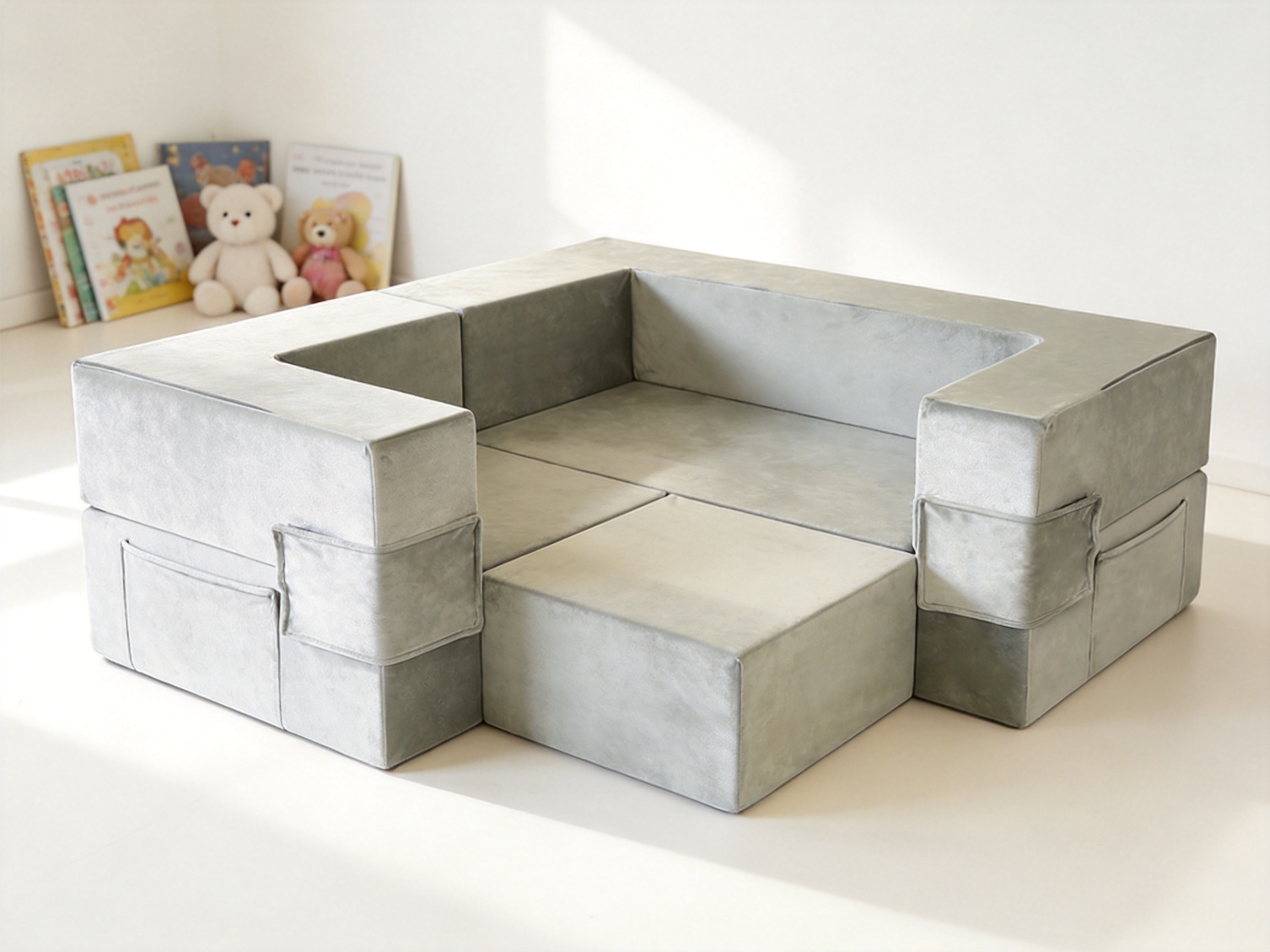
Four Pieces, Many Configurations
The four-piece arrangement is the defining functional advantage of this product. Each module contributes to a larger configuration while remaining useful as an individual soft furnishing element. The pieces can be assembled in different combinations depending on available floor space, the number of children using the area, and the intended activity.
An L-shaped arrangement can create a defined social area where children sit together, look at books, talk, or participate in supervised activities. This layout can help divide a larger room without installing permanent partitions. It creates a visual boundary while maintaining an open and accessible atmosphere.
A straight-line configuration can work well against a wall or beneath a window. It may serve as a compact sofa in a living room, classroom, or children’s bedroom. When positioned in a line, the modules can provide several seating places while keeping the central floor area available for play.
A lower, spread-out arrangement can function as a rest or play surface. Children can use it for quiet time, floor-based games, storytelling, or supervised relaxation. In a reading corner, one or more modules can be positioned near bookshelves or a low table, creating a comfortable space that encourages independent reading and calm activity.
The set may also be arranged to form a temporary bed-like surface. This can be useful for daytime rest, children’s naps, sleepovers, or relaxation. The exact suitability of a configuration for sleeping depends on the arrangement, the child’s age, the room conditions, and appropriate supervision. It should not automatically be regarded as a substitute for a dedicated child’s bed unless the buyer has verified that intended use and relevant safety requirements.
Unlike furniture with a single prescribed configuration, building block sofas invite experimentation. Children can help decide how the modules should be arranged, which can support a sense of ownership and encourage creative spatial thinking. Adults can also adjust the layout as activities change, making the product a practical tool for flexible interior design.
Foldability, Portability, and Storage Efficiency
Space efficiency is increasingly important in modern homes and commercial interiors. Children’s furniture can be bulky because it often includes generous padding and wide proportions. The Four-Piece Foldable Children’s Building Block Sofa Set addresses this challenge with a lightweight construction and support for roll-up compression during storage and transportation.
When compressed appropriately, foam products can occupy less space than their fully expanded form. This may help reduce warehouse requirements, simplify shipment planning, and lower the amount of space needed for temporary storage. For importers and distributors, compact packaging can make a difference in container utilization and handling efficiency. For families, the ability to move or store the set more easily can be valuable in homes with limited space.
Portability also supports seasonal or occasional use. The set may be brought out for indoor play, stored when a room is needed for another activity, or moved between rooms as children’s needs change. In educational facilities, modular furniture can be rearranged during cleaning, classroom reconfiguration, or special events.
Compression packaging must be handled according to the supplier’s instructions. Foam commonly requires time to recover after unpacking, and the recovery period may vary according to compression intensity, temperature, material formulation, and packaging conditions. Buyers should allow the product to expand fully before evaluating its final shape and comfort.
Storage efficiency does not mean that the product should be permanently compressed without consideration. Long-term storage should take place in a clean, dry, and well-ventilated environment. Avoiding excessive heat, water exposure, sharp pressure points, and direct sunlight can help protect both the foam and the upholstery.
Velvet Upholstery and Silver-Gray Modern Styling
The exterior is covered with skin-friendly velvet fabric. Velvet is valued for its soft hand feel and visually rich surface. On children’s furniture, a comfortable fabric can make the sofa more inviting, particularly when children use it for reading, relaxing, or imaginative play.
The silver-gray color provides a neutral foundation for a wide range of interiors. It can coordinate with wood flooring, white walls, pastel accessories, colorful toys, and modern storage systems. Unlike highly themed furniture, a neutral sofa may remain appropriate as a child grows and preferences change. This can extend its visual usefulness beyond a short stage of childhood.
The square and block-inspired shape creates a simple, contemporary appearance. Its clean geometry can complement modern minimalist interiors while also fitting naturally into children’s rooms and educational spaces. The product does not depend on elaborate decorative elements to attract attention. Instead, its visual character comes from the modular structure and the contrast between soft material and simple form.
Fabric care is an important part of maintaining appearance. Buyers should consult the supplier for specific cleaning instructions before applying any detergent or treatment. Regular vacuuming with a suitable attachment can help remove dust and loose particles. Small spills should generally be addressed promptly using a method appropriate for the upholstery material. Strong chemicals, excessive water, harsh scrubbing, and high heat may damage the fabric or affect the foam beneath it.
For childcare and commercial environments, buyers may also wish to request details about fabric composition, colorfastness, seam construction, cleaning performance, and available treatment options. The company supports customization of size, color, and material, making it possible to discuss upholstery requirements for particular markets or projects.
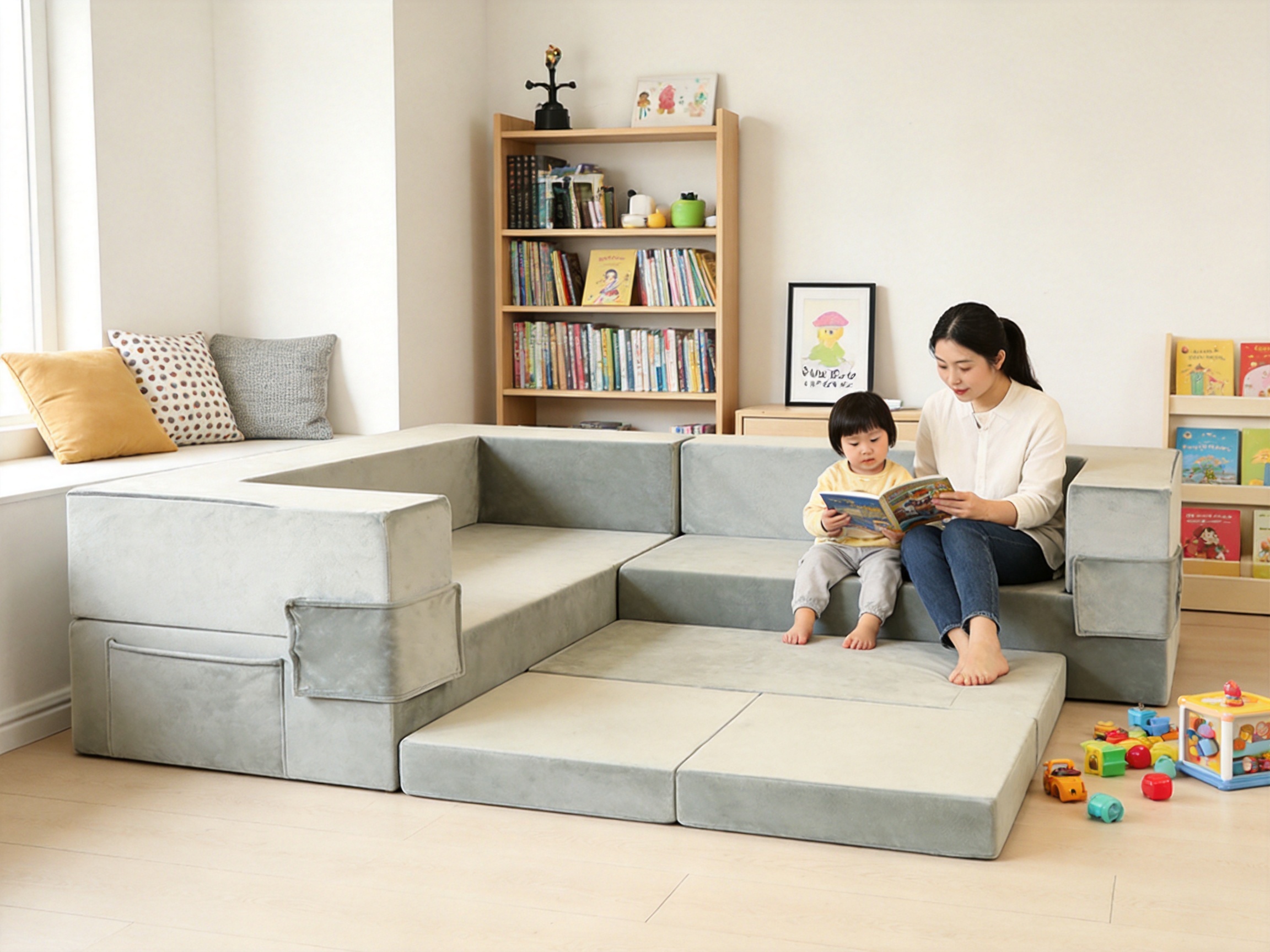
Advantages Compared with Traditional Children’s Sofas
The product’s competitive advantages come from the way several design features work together. A conventional children’s sofa may provide a fixed seat, but this four-piece set combines seating, lounging, play, reading, and temporary rest functions in one coordinated product.
| Feature | Four-Piece Building Block Sofa Set | Typical Fixed Children’s Sofa |
| Configuration | Multiple arrangements and modular layouts | Usually one fixed form |
| Structure | Frameless foam construction with rounded edges | May include a rigid internal frame and defined corners |
| Use Scenarios | Sofa, rest surface, reading corner, play area, or bed-like arrangement | Primarily seating |
| Mobility | Lightweight modules that can be moved individually | Often heavier and more difficult to relocate |
| Storage | Supports roll-up compression and space-saving storage | Usually requires full-size storage space |
| Style | Modern minimalist silver-gray block design | May be more heavily themed or visually restrictive |
| Customization | Size, color, and material can be adjusted | Often limited to standard retail options |
| Target Applications | Homes, kindergartens, early education centers, and commercial spaces | Commonly focused on domestic use |
The first advantage is versatility. A fixed sofa may become unsuitable when the room’s requirements change, while modular components can be repositioned. The second advantage is handling. Individual pieces are easier to move through a building, which is helpful for both households and institutions. The third advantage is safety-oriented construction. A soft, frameless, rounded form is well suited to children’s environments.
The fourth advantage is procurement flexibility. Because the product is customizable, buyers can discuss different sizes, colors, and materials instead of relying only on a standard retail specification. This is especially relevant to hospitality, education, childcare, furniture distribution, and cross-border e-commerce customers that may need market-specific versions.
The fifth advantage is visual longevity. Silver gray and a simple block form are less dependent on a particular cartoon character, color trend, or short-term theme. This can make the sofa easier to integrate into different spaces and potentially easier to market to families with varied design preferences.
Suitable Applications in Homes and Institutions
Family Living Rooms
In a living room, the sofa can provide a dedicated child-friendly seating area without requiring a large, permanent children’s furniture installation. Parents can place the modules near a play zone, use them as extra seating during family activities, or move them aside when the room is needed for another purpose.
Children’s Bedrooms
In a child’s bedroom, the set can define a quiet area for reading, drawing, listening to stories, or relaxing. Its neutral color allows it to coordinate with storage cabinets, beds, desks, and soft furnishings. As children grow, the modules can be rearranged to support changing preferences.
Playrooms
Playrooms benefit from furniture that does not impose a single use. The building block sofa can become part of an imaginative play environment, a soft boundary between activity zones, or a comfortable place for children to rest after active movement. Its low and rounded profile is visually approachable and can support open-ended play.
Kindergartens and Early Education Centers
Educational institutions often need furniture that can support group activities, individual learning, quiet reading, and supervised rest. The modular format allows teachers and caregivers to modify the room arrangement without purchasing separate furniture for every activity. Multiple sets may also be coordinated to create larger seating areas or defined learning zones.
Commercial and Hospitality Environments
Family-oriented hotels, restaurants, waiting areas, clinics, and indoor activity venues may use soft modular seating to make spaces more welcoming to children. The product’s portable structure can simplify cleaning, maintenance, and occasional room reconfiguration. Commercial buyers should evaluate local fire safety, sanitation, durability, and child-use requirements before placing the product into public service.
Manufacturing Expertise Behind the Product
The capabilities of the manufacturer are an important part of the product story. Jiangsu Wellcare Household Articles Co., LTD. was founded in 2003 and focuses on the research, development, and manufacturing of high-performance sleep materials and healthy home products. Its experience in foam and related home products provides a foundation for developing upholstered furniture that depends on material performance.
The company operates with a material-centered approach. Its portfolio includes ordinary sponge, memory foam, gel foam, temperature-insensitive memory foam, quick-dry memory foam, flame-retardant sponge, antibacterial sponge, and other foam materials. This breadth indicates that the company works with multiple formulations and performance targets rather than relying on a single generic foam type.
According to the supplied company information, a doctor-led research and development team develops more than one hundred new foam materials each year. Such activity demonstrates an emphasis on formulation development and continuous improvement. For buyers, an active R&D program can be valuable when they require specific softness, density, resilience, recovery behavior, drying performance, flame-retardant characteristics, antibacterial properties, or other material-related specifications.
The company’s history also reflects long-term involvement in scientific and manufacturing development. Its earlier development began in 1993 as a school-run scientific research enterprise. In 2003, it purchased a 12,000-square-meter factory building and jointly developed new sponge material with Huai’an Institute of Technology. In 2008, it acquired 50,000 square meters of land, supporting subsequent development and production expansion.
Manufacturing strength in foam furniture depends on more than cutting foam into shapes. It involves raw material control, formulation consistency, density management, molding or cutting accuracy, rebound performance, surface quality, upholstery workmanship, compression packaging, and final inspection. A supplier with experience across multiple foam categories is better positioned to coordinate these processes for a product such as a modular children’s sofa.
The product’s customization capability is another reflection of manufacturing flexibility. Buyers can request adjustments to size, color, and material according to their market, project, or brand requirements. Customization may involve changes to dimensions, fabric selection, foam specifications, packaging, labels, or configuration. The exact scope should be confirmed through technical discussion and sample approval.
Quality Control Considerations for Foam Furniture
Quality control should begin with the incoming materials. Foam should be checked for consistency, density, resilience, odor, dimensional stability, and visible defects. Upholstery fabric should be examined for color uniformity, surface damage, weave or pile consistency, and suitability for the intended application. Zippers, seams, handles, and other components should also be inspected where applicable.
During production, accurate cutting and shaping are important because modular pieces must align visually and functionally. Uneven dimensions may create gaps, unstable arrangements, or an inconsistent appearance when the modules are placed together. Consistent foam thickness and edge treatment contribute to a more polished finished product.
Upholstery workmanship is equally significant. Seams should be properly formed, corners should be finished neatly, and the cover should fit the foam without excessive looseness or unwanted tension. On children’s furniture, exposed threads, detachable small components, or poorly finished edges should be addressed before shipment.
Finished products may be reviewed for appearance, dimensions, compression recovery, cover quality, packaging integrity, and labeling. For export orders, buyers may also request inspection procedures related to carton strength, moisture protection, product identification, and shipment documentation. Testing and certification requirements vary by destination and application, so importers should identify applicable regulations in advance.
WELLCARE’s experience supplying customers in Europe, Southeast Asia, North America, and the Middle East gives it exposure to different market expectations. The company has also supplied products to cross-border supermarkets in the United States, Germany, and Japan, and later exported to the United Kingdom, Canada, Australia, and Kuwait, according to the supplied company history. International experience can help a manufacturer understand the importance of packaging, documentation, communication, and market-specific product requirements.
Product Specifications at a Glance
| Product Title | Four-Piece Foldable Children’s Building Block Sofa Set |
| Product Category | Kids’ Foldable Memory Foam Sofa |
| Item Number | CH012 |
| Model Number | CH012 |
| Product Type | Kids Sofa |
| Target User | Children |
| Structure | Frameless |
| Filling | High-Density Sponge or Memory Foam |
| Exterior Material | Velvet Fabric |
| Color | Silver Gray |
| Design Style | Modern Minimalist |
| Furniture Style | Modular |
| Dimensions Listed | 100 cm × 50 cm × 40 cm |
| Main Function | Multifunctional |
| Customization | Size, color, and material supported |
| Installation Service | Not provided |
| Home Delivery | Not included |
| 3D Model | Available |
| Main Sales Regions | Europe, Southeast Asia, North America, and the Middle East |
The listed dimensions should be confirmed with the supplier before ordering because modular products may have individual module dimensions, assembled dimensions, or packaging dimensions that differ from a single specification entry. Buyers should also confirm the exact foam formulation, cover composition, compression method, recovery time, carton size, and gross weight for each order.
Customization for Wholesale and Project Buyers
Customization can help distributors and institutional buyers position the sofa for different markets. A children’s furniture retailer may prefer a particular color palette, while a kindergarten may require a larger configuration or a fabric chosen for frequent cleaning. A hospitality project may need colors that coordinate with an interior design plan. Because the manufacturer supports adjustments to size, color, and material, the product can be discussed as a flexible platform rather than only as a fixed catalog item.
Size customization may involve changing the dimensions of individual blocks, adjusting the height of the seating surface, or developing a configuration for a specific room. Such changes can affect foam consumption, packaging, shipping volume, and the final price. A detailed drawing or 3D model can help buyers and production teams confirm the design before manufacturing.
Color customization may support private-label collections, coordinated room packages, or regional preferences. While silver gray offers broad compatibility, other shades may be considered depending on fabric availability, minimum order quantities, colorfastness requirements, and the intended market.
Material customization may include different upholstery fabrics or foam characteristics. Buyers should clearly define the desired balance of softness, support, resilience, drying performance, cleanability, flame resistance, antibacterial performance, and environmental requirements. Any performance claim should be confirmed through technical documentation or relevant testing rather than assumed solely from a material name.
For customized projects, sample approval is strongly recommended. A sample allows the buyer to examine color, hand feel, seam quality, dimensions, foam recovery, odor, packaging, and overall appearance. It also provides a reference for bulk production and reduces the risk of misunderstanding between the buyer and the factory.
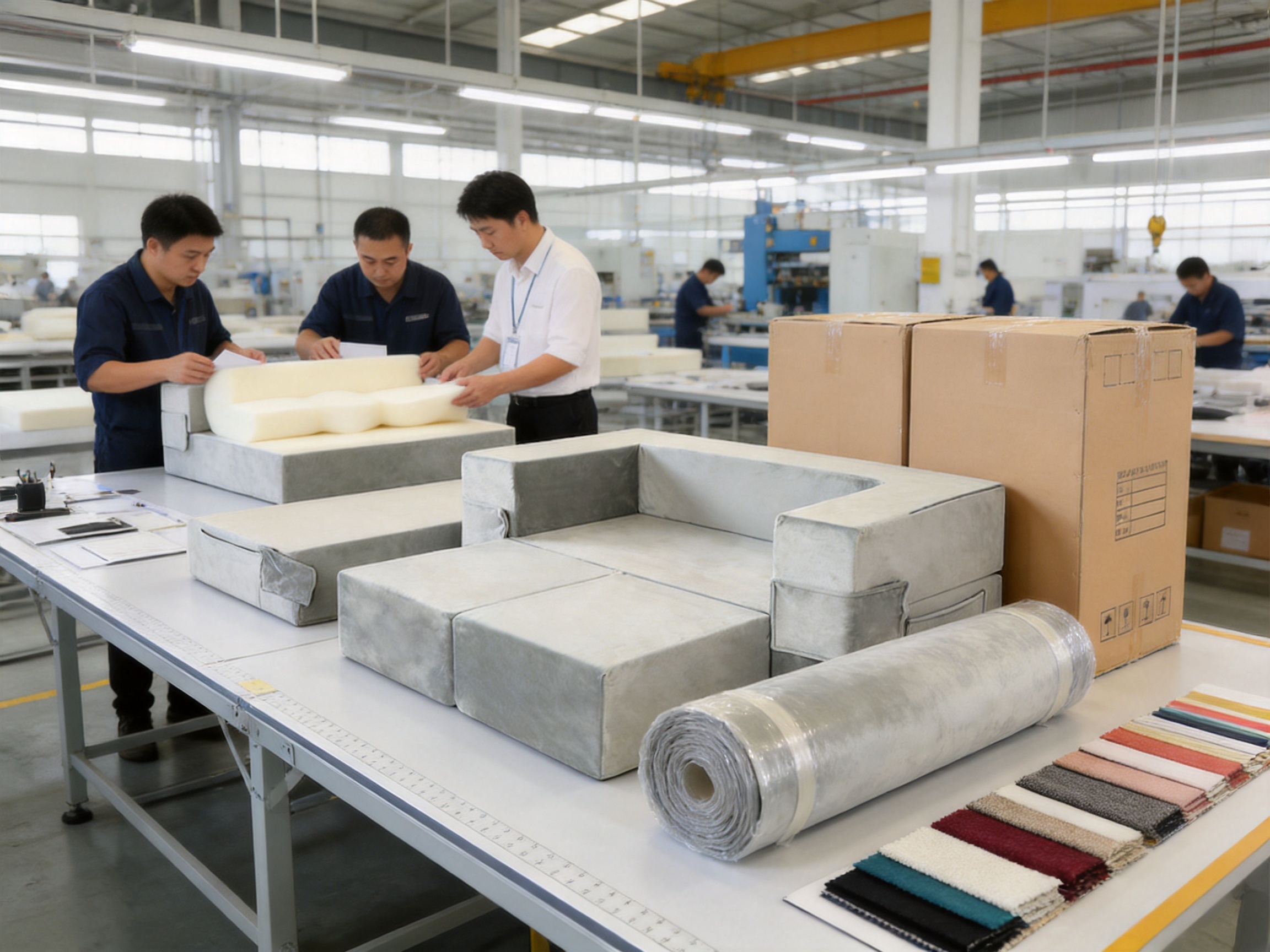
Packaging, Logistics, and Cross-Border Supply
The sofa set is designed to support roll-up compression, which can help reduce transportation and storage space. This feature is particularly relevant to cross-border supply because shipping volume has a direct effect on logistics planning. Compact packaging may improve container utilization and make the product more suitable for e-commerce distribution.
However, packaging decisions must balance compression efficiency with product protection. The packaging should help prevent moisture, dust, abrasion, crushing damage, and deformation during handling. Carton strength, internal protection, product labeling, and recovery instructions are all important considerations.
International buyers should request a complete packing specification before placing an order. This may include the number of pieces per carton, carton dimensions, net weight, gross weight, compression ratio, loading quantity, pallet requirements, and estimated recovery time after unpacking. These details are needed for freight quotations, warehouse planning, marketplace listings, and customs documentation.
The company’s cross-border export supply capability and experience with multiple international markets can support overseas procurement. Its stated main downstream platforms include eBay, Amazon, Wish, AliExpress, independent websites, Lazada, and other channels. This suggests familiarity with the requirements of online product distribution, although each buyer remains responsible for confirming the current packaging, labeling, product compliance, and platform requirements for its target market.
Home delivery and installation service are not included in the listed specifications. The product is intended to be portable and does not require a traditional installation process, but buyers should plan for delivery to the final room, unpacking, expansion, and arrangement. For institutional projects, receiving personnel may need to inspect the shipment before distribution to classrooms or activity areas.
Sustainability and Responsible Material Development
Foam furniture can contribute to efficient logistics when it is designed for compression and compact shipment. Reduced packaging volume may help optimize transportation and storage, although the overall environmental impact depends on the foam formulation, packaging materials, production energy, shipping distance, product lifespan, and end-of-life treatment.
WELLCARE states that it invests in advanced eco-friendly energy systems and improves environmental management practices. The company’s sustainability approach is described as going beyond basic compliance by integrating respect for nature into business operations. These efforts are relevant to buyers who evaluate suppliers according to environmental management, manufacturing transparency, and long-term resource efficiency.
The company’s material portfolio includes specialized foams such as quick-dry, flame-retardant, and antibacterial sponge. These materials may support different application requirements, but buyers should request specific evidence for each performance characteristic. Product claims should be matched with the appropriate test methods, standards, and certification documents for the destination market.
Durability is also part of responsible consumption. A sofa that maintains its shape, remains attractive, and continues to meet the user’s needs over time may reduce the frequency of replacement. The modular structure can further support continued use because the arrangement can change as the child develops or the room is redesigned.
How to Select the Right Configuration
Before purchasing, buyers should consider the available floor area and the intended primary use. If the sofa will be used mainly for reading, a compact L-shaped layout may be appropriate. If it will support group activities, a longer seating arrangement or an open central configuration may be more useful. If the priority is play, the modules should be positioned to preserve safe movement space around them.
The child’s age and physical development should also be considered. Younger children may benefit from a lower, softer environment with close adult supervision. Older children may use the sofa more independently for reading, relaxing, or hosting friends. The product should be selected and arranged in a way that matches the child’s abilities and the caregiver’s expectations.
Room traffic is another factor. The sofa should not block doors, emergency routes, heating equipment, windows needed for escape, or access to storage. In classrooms and commercial spaces, the arrangement should allow adults to see children clearly and move easily through the room.
Buyers should also evaluate the desired upholstery performance. A home user may prioritize softness and appearance, while a kindergarten may place greater emphasis on cleaning, colorfastness, seam durability, and resistance to frequent handling. These requirements can be discussed during customization.
Finally, buyers should confirm all technical details before production. Important items include the dimensions of each module, assembled layout dimensions, foam density, fabric composition, removable-cover availability, cleaning instructions, packaging specifications, compression recovery, odor requirements, customization minimums, lead time, and inspection standards.
Care and Maintenance Recommendations
Regular care can help preserve the sofa’s comfort and appearance. The surface should be kept free of crumbs, dust, and abrasive particles that may work into the fabric. A soft vacuum attachment can be used where appropriate. Spills should be treated promptly according to the upholstery supplier’s instructions.
The sofa should be kept away from sharp toys, exposed blades, rough metal edges, and animals that may scratch or bite the fabric. Although the foam is resilient, it is not designed to resist puncture or cutting. Children should not be permitted to jump from elevated furniture onto the modules, and the sofa should not be placed near unstable shelves or other objects that could fall during active play.
Moisture control is particularly important. Excess water can penetrate upholstery and affect the foam core. If the fabric becomes damp, it should be dried thoroughly in a well-ventilated area using a method approved for the material. Direct high heat may damage certain fabrics or foam, so heating appliances should not be used unless specifically permitted.
Caregivers and facility managers should periodically inspect seams, covers, fasteners, foam recovery, and module condition. Any damaged component should be repaired or removed from use until it is safe. Modular furniture is easy to rearrange, but the individual pieces should still be checked for excessive wear after frequent use.
Why the Manufacturer’s Integrated Capabilities Matter
For buyers comparing suppliers, the ability to manufacture foam materials and finished home products under one organization can offer practical advantages. Material knowledge supports better communication about density, rebound, softness, resilience, and specialized performance. Finished-product experience supports better decisions about shaping, upholstery, packaging, and customer use.
Jiangsu Wellcare Household Articles Co., LTD. combines foam research with household product manufacturing. Its history includes cooperation with Huai’an Institute of Technology and Qingdao University of Science and Technology, indicating a connection between industrial production and technical development. The company also became an Alibaba-certified Gold Supplier in 2018 and a designated supplier for five-star hotels in 2020, according to the provided company information.
These milestones do not replace product-specific verification, but they illustrate the company’s development from a materials-focused enterprise into an international supplier of foam and healthy home products. Its ability to serve domestic and foreign trade, support cross-border export, provide 3D models, and discuss customization can be useful for buyers developing new product lines.
Manufacturing depth is especially important for children’s furniture because the product must satisfy several goals at once. It should be soft but supportive, lightweight but stable, attractive but easy to integrate, flexible but manageable, and suitable for repeated use. A company with experience across foam formulations and home-product applications is positioned to balance these requirements more effectively than a supplier focused only on surface appearance or simple furniture assembly.
Frequently Asked Questions
What is included in the sofa set?
The product is described as a four-piece foldable children’s building block sofa set. Buyers should confirm the exact number, shape, dimensions, covers, and packaging contents with the supplier before ordering, especially for customized versions.
Is the sofa suitable for children?
The product is designed for children and features a frameless structure with rounded edges. These design elements are intended to create a softer and more protective environment. Adult supervision and appropriate placement remain necessary, particularly during active play.
Can the sofa be used as a bed?
The modules can be arranged into a bed-like or resting surface for suitable situations. Buyers should confirm the intended use, dimensions, and safety guidance for sleeping, and should not assume that every arrangement replaces a dedicated child’s bed.
What type of filling does the sofa use?
The supplied specifications identify high-density sponge, while the product description refers to memory foam with slow-rebound characteristics. Buyers should request the exact foam formulation, density, hardness, and recovery specifications for the selected version.
Does the product have a rigid frame?
No. The listed structure is frameless. Its form is created primarily through the foam modules and upholstered construction rather than a conventional rigid sofa frame.
Can the color be customized?
Yes. The product information states that customization of size, color, and material is supported. Minimum order quantities, available fabrics, color matching, and sample requirements should be confirmed before production.
Can the sofa be compressed for shipping?
Yes. The design supports roll-up compression to save transportation and storage space. The supplier should provide compression, packaging, and recovery instructions for each order.
Is assembly required?
No installation service is listed, and the modular design is intended to be arranged by the user. Buyers should confirm whether any covers, labels, or packaging components require additional handling after delivery.
Where can the sofa be used?
It is suitable for living rooms, children’s bedrooms, playrooms, kindergartens, early education centers, reading areas, and selected commercial environments. Public or institutional use should comply with local safety, fire, sanitation, and furniture regulations.
What is the listed size?
The supplied specification lists 100 cm × 50 cm × 40 cm. Because the set contains four modules, buyers should confirm whether this refers to one piece, a standard module, or a particular assembled configuration.
Does the manufacturer offer 3D models?
Yes. The product information indicates that a 3D model is available. This can assist with room planning, custom development, product presentation, and buyer approval.
What markets does the company serve?
The company identifies Europe, Southeast Asia, North America, and the Middle East as main sales regions. It also states that it supports cross-border export supply and serves multiple online and independent-site sales channels.
How should the velvet cover be cleaned?
Cleaning should follow the supplier’s fabric-specific instructions. Routine dust removal and prompt treatment of spills are recommended, while excessive water, harsh chemicals, and aggressive scrubbing should be avoided unless approved for the material.
Can the foam maintain its shape over time?
The high-density, slow-rebound foam is designed to support shape retention during prolonged use. Actual performance depends on density, formulation, usage frequency, weight, environment, and care. Product-specific technical data should be requested for precise evaluation.
Conclusion
The Four-Piece Foldable Children’s Building Block Sofa Set is a versatile response to the changing needs of children and the spaces around them. Its combination of high-density slow-rebound foam, frameless construction, rounded edges, velvet upholstery, neutral silver-gray styling, and four-piece modularity gives it a clear position in the children’s furniture market.
Compared with a fixed traditional sofa, it offers more ways to sit, rest, read, play, and organize a room. Its lightweight structure and compression capability support easier movement, storage, and cross-border transportation. Its modern appearance allows it to fit into family homes, educational environments, and selected commercial settings without relying on highly specialized decoration.
The product is strengthened by the manufacturing background of Jiangsu Wellcare Household Articles Co., LTD. The company’s history in foam research, material development, household-product manufacturing, international trade, customization, and sustainability provides a broad foundation for supplying both standard and project-based orders. Its extensive foam portfolio and research-led development approach are particularly relevant to buyers who require more than a basic upholstered product.
For the best purchasing outcome, customers should confirm dimensions, foam specifications, upholstery composition, packaging, compliance requirements, customization options, and inspection procedures before production. With those details clearly defined, this modular children’s sofa can serve as a practical, comfortable, and adaptable furniture solution for modern childhood spaces.
References
1. Product specification and description supplied for the Four-Piece Foldable Children’s Building Block Sofa Set, Model CH012.
2. Jiangsu Wellcare Household Articles Co., LTD. company profile and manufacturing history supplied for this article.
3. General principles of foam furniture design, including density, resilience, slow-rebound behavior, upholstery construction, and compression packaging.
4. General guidance for children’s furniture planning, supervision, safe placement, surface care, and institutional use.
5. General considerations for international furniture procurement, including product customization, packaging verification, shipment planning, and market-specific compliance review.
Product: Four-piece foldable children's building block sofa set
PREV:Multifunctional Tri-Fold Memory Foam Pad: Flexible Comfort for Modern Living
NEXT:Blue Single-Seater Sofa with Removable Sponge Padding: Comfort, Flexibility, and Modern Manufacturing Excellence
NEXT:Blue Single-Seater Sofa with Removable Sponge Padding: Comfort, Flexibility, and Modern Manufacturing Excellence
Interested in cooperation or have questions?
Related News
WELLCARE was founded in 2003, boasting over a decade of profound and extensive experience.
Quick Links
Product
Media Centre
Contact Information
- [email protected]
- +86-517-84998062
- +86-15152354988
- No. 168 Nenjiang Road, Huaiyin District, Huai'an City, Jiangsu Province, China
Copyright © Jiangsu Wellcare Household Articles Co., LTD. All Rights Reserved.
Custom Memory Gel Mattress Manufacturers
